
‘She was not burdened by the knowledge of her craft and the world. She just was a child till her last days.
When she smiled, everybody in the room would light up.’

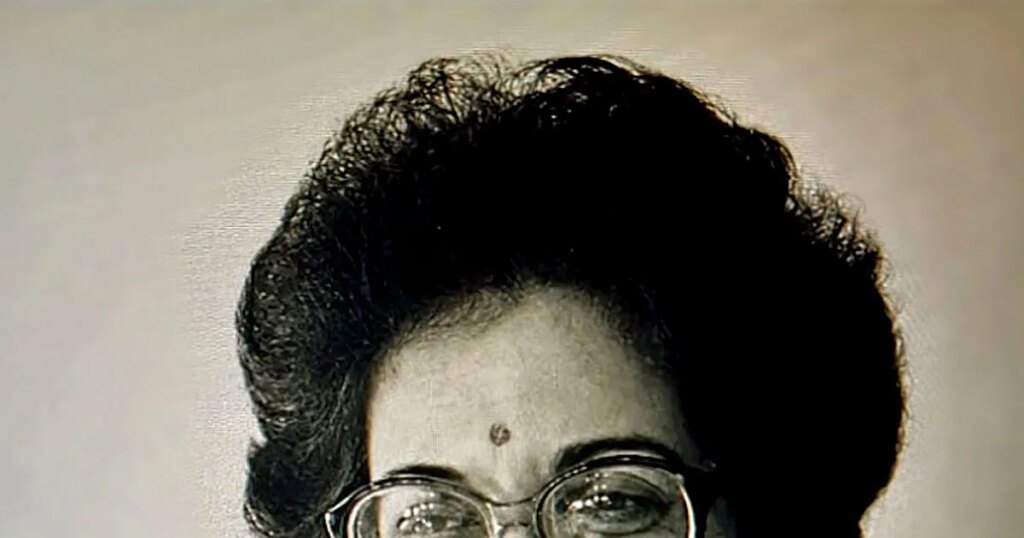
IMAGE: The Incomparable Vijaya Mehta. Photographs: Kind courtesy Ravi Khote
Key Points
- ‘My mother’s humility and the tone of her voice was always very, very acknowledged. Yet at the same time she had the innocence and joy of a child looking forth into the world and seeing possibilities all the time.’
- ‘What really moved people was the bottomlessness depth of her view, but also a bottomlessness depth of innocence at the same time.’
- ‘My mom really stood by her values, hers were human values, based not on ethics but on integrity.’
When actor, director, leading light of Marathi theatre Vijaya Mehta, 91, passed away on June 30, her three children Ravi and Deven Khote and Anahita Uberoi planned a funeral and wake that was about life, not death.
It was a condolence meeting, Ravi recalls, that continued a life force and “our mum’s belief in life, actually a tribute to the spirit of her being alive — it would be a shame to remember her as a death.”
Because there never could be a last curtain call for Vijaya Mehta.
There were no religious ceremonies either. Mehta was an atheist but believed in religious diversity. “Our family is full of all religions. She had no divisions whatsoever, including if you didn’t believe in god, that was also fine.”
Ravi feels blessed to have been raised by a mom who “really allowed us to flower in uniquely independent ways.”
When his father, who they called Harin Dad (Harin Khote) died, Vijaya struggled to bring up her two sons.
“Then my father Farrokh, my second dad, came in. It was a magical relationship. They had a brilliant partnership also and my dad was also a beautiful man.
“He would celebrate, calling in Parsi priests, my father’s birthday and death anniversary every year to thank him for giving him his family.”

IMAGE: Neena Kulkarni with Vijaya Mehta. Photograph: Kind courtesy Neena Kulkarni/Instagram
‘She had a love for the subject matter of humanity’
Speaking to Vaihayasi Pande Daniel/Rediff, Ravi describes what was infinitely special about his maverick mother and her journey as a woman against all obstacles, never compromising “even for second”, who became a great master, yet she always maintained her tremendous humility:
After her death the plethora of stuff posted on social media made us see to what extent she actually touched people’s lives.
One of the hallmarks of my mother being the kind of human being and person she was, was her pioneering spirit.
As a very young girl, she chose to be in theatre, which was a choice tremendously frowned upon.
In those days, women in theatre were assumed to be of loose moral character.
It was almost assured that if you were part of a theatre unit, everybody could have their way, especially the producers, directors, leading men.
She had a love for the subject matter of humanity and the ability to see drama as the way in which she could explore and express that interest she had for human characters, for all their trials and tribulations, for all the diamonds that they are and all their faults as well. She decided to persevere with that despite reputation problems.
Further, she was a very smart academic student. That translated to a BA, then MA, and she could just teach or do something like that, but she jumped ship which was a big shock for the family.

IMAGE: Bharati Achrekar with Vijaya Mehta and Nana Patekar. Photograph: Kind courtesy Bharati Achrekar/Instagram
‘She became very much part of the underground movement’
My mom was surrounded by radical thought.
Her uncle V B Karnik and the Karnik family, were very involved with JP (Jayaprakash Narayan) and the whole freedom of India movement.
They were radical humanists, akin to being against all religion for actually humanitarian aims and objectives above all dogmas. They fought very, very, very strongly for freedom from oppression.
My mum would have been listening, as a young girl and through her teens, to speakers of tremendous conviction about how to overcome the British oppression in India. It was a beautiful dream of limitless proportions.
She’d simply sit in a room and hear all these people airing views and self-auditing the dangers of blindness that they might encounter.
She grew up hearing this level of dialogue just because it was there in her family.
Then she volunteered and became very much part of the underground movement that would bring about change and justice for all.
There was a great leader called M N Roy, whose voice she, my uncle and family were very, very actively involved in keeping alive, against great danger, because the British had declared it virtually treason to have anything to do with him.
Yet they had the courage to go ahead. She learned some stunning lessons. These were the principles she just grew up in the shade of.

IMAGE: Neena Kulkarni with Vijaya Mehta. Photograph: Kind courtesy Neena Kulkarni/Instagram
‘She was an auteur in many ways’
When she discovered the joys of theatre, she decided she wanted to express this.
The astonishingly powerful influence of her uncle, the whole freedom movement, being part of that and putting one’s life in danger for the higher good, necessarily led her to think in terms of theatre as an expression of, perhaps, sharing what it is to really reach for the stars whilst being alive; to take flight, whether or not your flight is successful or not.
She got involved with the Bhulabhai Memorial Institute, the vision of which was that painting, arts, music, theatre, dance and all these areas should have spaces to practice, which is what the institute provided.
There were programmes where these art forms were forced to collide and special presentations by legends like Ravi Shankar, Shiv Kumar Sharma, Kishori Amonkar.
They would speak about music to the theatre people. The theatre people would make presentations to the musicians, sculptors and painters.
My mom was one of those persons who just really thrived in this multidimensional input.
She was an auteur in many ways, one of the primary auteurs of India’s experimental theatre movement, quite influenced by movement, sound, dance, form, arts, sculpture.
All of these things, she said, could be in the live performance art called experimental theater. She was doing really groundbreaking work.

IMAGE: Bharati Achrekar with Vijaya Mehta. Photograph: Kind courtesy Bharati Achrekar/Instagram
Then she discovered great writers of the West. Like Ibsen and so on and so forth.
Translated into Marathi, she brought in like the whole world of theatre, whether it was written primarily for a Western audience or not.
She didn’t do it in English but in Marathi and somehow imbued it with roots of the soil and still make it highly experimental. This was the basis of the group that she founded called Rangayan.
It was a multi-timbral experience. And her maverick nature got forged there.
Not only was she a woman who had done it on her own means, she also became a powerhouse of inspiration… So many of the great Marathi actors, they’re still so devoted to her.
She created a pool of talent, of actors, who are absolutely legendary because they all grew up in the multi-timbral processes that my mother had founded in theatre.
She insisted it would never be experimental for the sake of making it freaky, anti-establishment or just nouvelle-nouvelle.
It had to point to the inescapable truths that exploring what being human leads to, whether they are tragic, whether triumphant, whether uplifting or whether they make you think about how dark we have become.
She made sure all her projects would lead to a deeper understanding of what it is to be human, with all its faults, all its graces.

IMAGE: Vijaya Mehta. Photograph: Kind courtesy Neena Kulkarni/Instagram
‘She stayed true to her cause’
Then she did something unique. During Rangayan, she took a decision, sharing it with some of her colleagues.
Her view was those actors who had become very senior in years as well extremely experienced — instead of helping younger talent bloom because of the power, the reach, the influence they had to encourage young writers and actors and continue to make new forms of theatre — those people chose to be alone, fighting for each small role that they could get. Their whole focus was still on being in the running.
She stayed true to her cause. At the zenith of her reputation as a director and an actress of great quality, she decided to abandon both those ships willfully and take on the directorship of the National Centre for the Performing Arts (Mumbai).
This was a return to the exposure of Bhulabhai Institute, that all forms of expression, in India, be allowed to flourish.
Not just in the native language of Marathi, but in Hindi, Sanskrit, classical, neoclassical, traditional, modern Western, the works.
In her thirsting-bursting young years, she vowed to be there for other artists, helping unknowns and young people flourish.
True to her decision, she took that call ‘I’m now getting this opportunity to do NCPA. I’m going to do it for the better of everybody else.’
‘I’ll spend the rest of my life, perhaps never directing again, perhaps never acting. But allowing other people to direct, act, dance, sing, compose, create music, create painting, create multiple medium intersections and all of that.’

IMAGE: Neena Kulkarni with Vijaya Mehta and her daughter Anahita Uberoi. Photograph: Kind courtesy Neena Kulkarni/Instagram
For a while many people assumed she’d done a bourgeois sell out from being an experimental, highly sort of non-conformist artist to suddenly being director of the NCPA with a cushy air-conditioned office and a driver.
After all that speaking of inspiring people, (they would have felt) she took a cushy job and said, “Chalo, now you guys slog while I enjoy the air conditioning.”
But she did an amazing job. She came into the directorship of the National Centre for the Performing Arts when there were probably three-four programmes a week.
They had all this space, but not much was happening. All of it was archival stuff, sort of representing history and what not.
When Mum took over, she said, wait a minute, this is not the National Centre of Performing Historical Arts.
We have to allow contemporary stuff. We have to make spaces where people are inspired to do something because there’s spaces like that that exist.
Under her stewardship, new spaces were created, new ways of art collaborating — workshops open to the general public, and specific workshops open to great artists, sharing their inner processes.
All of a sudden, from like three to four programmes in a week, it became over 100 in a month.
It’s only when people realised what her vision was, that they realised, ‘My god, she’s not a sellout, man’.
It takes a lot of guts to leave at the top of your game and make sure that others can strive to get as high as you and possibly beyond, if possible.
During her 17 years at NCPA, she has made that possible with actors like Nana Patekar, Anupam Kher, Naseeruddin Shah.
All these people see her as one of the most important meetings they’ve ever had in their life. And in the Marathi theatre, it’s to the power of x.
The leading group of quality actors, who’ve had extremely long-running legendary careers, all say that it’s all because of Vijayabai.

IMAGE: Neena Kulkarni, Bharati Achrekar, Reema Lagoo with Vijaya Mehta. Photograph: Kind courtesy Neena Kulkarni/Instagram
‘My grandmother Durga Khote and my mum went against the grain and against reputational slander’
My grandmother Durgabai Khote (legendry actress, the mother of Vijaya Mehta’s first husband Harin Khote) had followed almost a similar trajectory to my mother.
She got into theatre first and was considered absolutely a woman of ill repute for having done so, especially because she came from the Khote family, a family that was ultra rich but lost all their money, because of bad mismanagement.
So, she stooped, in the eyes of others, to do theatre in order to send her kids to school.
It was there that V Shantaram happened to see her on stage and said, ‘My God, this person has something special.’
When she moved over to film, society was 1,000 per cent sure that she was a woman of ill repute.
My grandmum said, you can think what you want but none of you are helping with the family budget. I’m going to do whatever puts khaana on the table. She became a legend of India.
In that sense, their stories — hers and my mother’s — are mirrored. They went against the grain and against reputational slander.
We’ve all grown up with tremendous respect for womanhood.

IMAGE: Neena Kulkarni, Bharati Achrekar, Reema Lagoo, Suhas Joshi, Nana Patekar, Vikram Gokhale with Vijaya Mehta. Photograph: Kind courtesy Neena Kulkarni/Instagram
My mother, as a female, had sufficient administrative and male energies to put projects on the line, the leadership role, the CEO vibe of the NCPA.
At the same time, us men in the family have had the sort of the respect for motherhood in all aspects of the word and respect for what female energy is all about.
The balance in life, at one level, is by appreciating the need for both these forms of shakti or energies to be in balance.
What is Shiva-Shakti? It is the male and female form — they appear separate but cannot exist unless they’re together. And my mom was kind of Shiva-Shakti herself in her own way.
We had the incredible presence of my mum as a strong woman equitable with a strong human being as well.
It wasn’t a feminist woman-ness, it was a woman-ess humanity which went beyond all boundaries.
Then also my grandmother mavericked against all odds and made this happen, going suddenly from ill repute to legendary saintliness.
It’s amazing. That translates into the outer areas of our family as well. It’s like when you put camphor in a drawer, then all the clothes and the books, they just smell of camphor.

IMAGE: Ravi Khote is now a spiritual teacher. Seen here with his mom and the family, left to right: Sister Anahita Uberoi, her husband Samir Uberoi, Ravi Khote, his brother Deven Khote, his niece Aliya Uberoi, and his mother Vijaya Mehta. Photograph: Kind courtesy Ravi Khote
My mother’s humility and the tone of her voice was always very, very acknowledged.
Yet at the same time she had the innocence and joy of a child looking forth into the world and seeing possibilities all the time.
What really moved people was the bottomlessness depth of her view, but also a bottomlessness depth of innocence at the same time.
She was not burdened by the knowledge of her craft and the world. She just was a child till her last days.
In fact, her smile was what threw everybody because her whole body smiled.
I don’t think she ever knew what a polite smile could be. When she smiled, everybody in the room would light up.
I’m talking about people not just in the arts, but my friends and people who met her once or twice. They would say, “Wow! Yeah, what a complete person.” She was in many ways.

IMAGE: Vijaya Mehta with Ravi Khote. Photograph: Kind courtesy Ravi Khote
The amount of material released on social media after her death was a real eye-opener for us three children.
People, from all walks of life, had collected snippets of interviews. Before we knew it, had uploaded their memories of Vijaya Mehta, or interviews and thoughts of her and the number of comments…
She’s never been on social media or an influencer. But the number of people saying, “Good Lord, the humanity in this!” These were anonymous people. And we started looking at interviews that Mum was in, whether in English or Marathi, predominantly Marathi.
The respect of the interviewer and the depth of Mum’s integrity are just on display.
There’s one interview between Sachin Khedekar, who’s a pretty well-known Marathi and Hindi character actor, interviewing Nana Patekar just a few days before Guru Purnima.
Sachin tells Nana, “There’s a surprise for you.” It was my mom.
She agreed to speak to Nana — an audio message and a little photograph saying, “Nana, you know, Guru Purnima is like a day where guru and shishya get together, and you are such a beautiful experience in my life.”
You can see Nana’s eyes tearing up and Sachin’s eyes tearing up (external link).

Photographs: Kind courtesy Ravi Khote
Yes, that’s the kind of influence my mom had because she really stood by her values, hers were human values, based not on ethics but on integrity.
Ravi Khote lives a monk’s life in the Himalayas, where he teaches about Peace Happiness in Everyday Life.
Feature Presentation: Rajesh Alva/Rediff