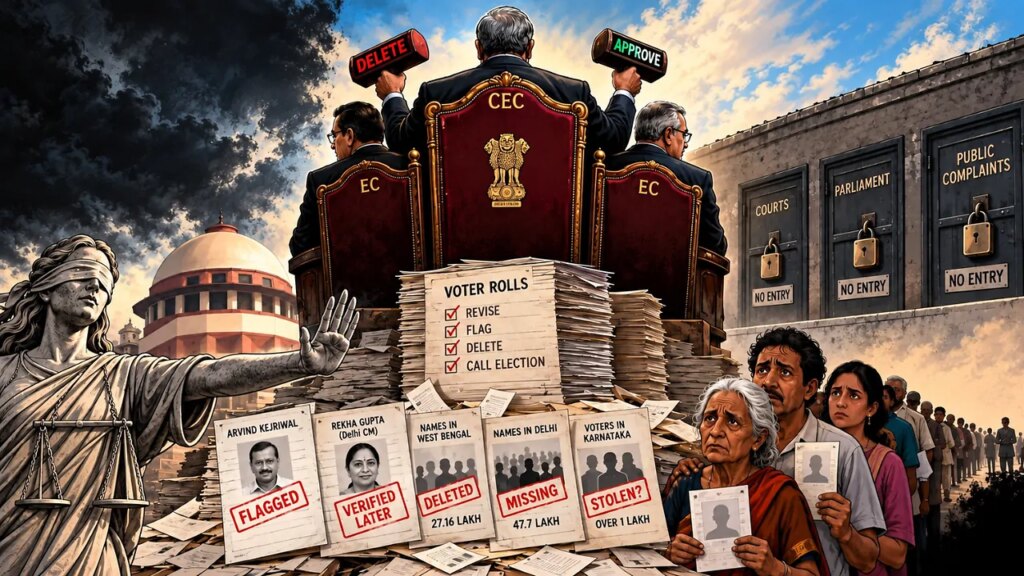


They can revise the rolls, flag a name, delete a voter and call an election. No court may hear a case against them for any of it, in office or long after they leave. The charges against India’s Election Commission are piling up. The places where they can be tested are running out.
On Wednesday, the 2023 law that grants them this shield was back before the Supreme Court, over a different clause: the one that replaced the Chief Justice on the selection panel with a minister nominated by the Prime Minister. The two-judge bench delivered a split verdict. Justice Dipankar Datta refused to refer the challenge to a larger bench and, prima facie, found that the law does not appear to ensure an independent selection. A minister nominated by the Prime Minister, he observed, cannot be expected to defy him, leaving the Leader of the Opposition “largely ornamental”. “Free and fair elections depend on a truly independent ECI,” he said. It is not enough for the Commission to be independent; it must also appear to be.
Picked by a panel the government commands, shielded for life by the same law’s Section 16: that is the Commission the 2023 law has built.

Outside the court, the opposition sharpened its attack. Reacting to a media report of a rift inside the three-member Commission over the Special Intensive Revision (SIR) of rolls, Rahul Gandhi called “vote chori” “a crime against the Indian people”, accused the BJP, the RSS and the Commission of “an act of treason”, and promised: “Justice will be served.”
Former Union minister P Chidambaram put it in the language of law. The Supreme Court, he noted, has repeatedly held that a flawed decision-making process makes for a flawed decision. “If two ECs have taken a contrary view,” he asked, “how could the CEC make his view the ‘decision’ of the ECI?” He wants a parliamentary committee to review the Commission’s recent decisions, and the SIR suspended nationwide. Commission sources insist every decision was unanimous.

Wednesday’s charges top a long list. Rahul Gandhi alleges over a lakh votes were “stolen” in Karnataka’s Mahadevapura in 2024. Trinamool told the Supreme Court that over 58 lakh names were struck off West Bengal’s draft roll without notice or hearing. Ashok Gehlot claims booth officers in Rajasthan were handed pre-filled deletion forms. AAP calls the flagging of Arvind Kejriwal’s family an attempt to delete opponents’ votes.
Charges may be wrong, but ask for accountability – surely not! The ECI calls the vote-theft allegations baseless; the BJP says the same of Rajasthan. But right or wrong, the questions will be asked, and answers must be sought. Last August, the Commission gave Rahul Gandhi seven days to put his claims on oath in a signed affidavit, or have them treated as baseless. That standard does not run both ways.
Here is the catch: whatever the answers, no court may try the people who gave them. A court can examine what the Commission decided. It cannot hold to account the people who decided it. Protection for independence is defensible. Immunity without accountability is not.
A shield with no expiry date
Section 16 of the Chief Election Commissioner and Other Election Commissioners Act, 2023 bars any court from hearing civil or criminal proceedings against anyone who “is or was” a Chief Election Commissioner or Election Commissioner, for anything done “in the course of acting or purporting to act” in official duty. “Or was” makes the shield lifelong; “purporting to act” covers conduct that merely claims to be official. “Good faith”, the words that usually rein in such clauses, is missing. Honest mistake or abuse of office, the courthouse door stays shut.
Compare the President, who is shielded from criminal proceedings only for the length of the term. Section 16 has no end date. In a separate case, on January 12, the Supreme Court issued notice on a petition by the NGO Lok Prahari, which calls the clause “unprecedented, unbridled power” and argues it was added late under Article 324(2), a provision about appointments. The court declined to stay it. The case for protection is that commissioners need insulation from vexatious complaints. A good-faith test or a prior-sanction rule would do that. Section 16 does not filter. It forbids.
When the rolls flag a sitting CM and ex-CM
In Delhi’s SIR, 33.1 lakh electors have been flagged for verification. Among them were Chief Minister Rekha Gupta, since cleared, and Arvind Kejriwal, marked “no mapping” along with his family. Another 47.6 lakh, nearly one in three of Delhi’s 1.45 crore electors, never made the draft roll, and claims close on September 30.

In West Bengal, 27.16 lakh names were struck off after adjudication, and the state voted in April with nearly 98 per cent of roughly 38 lakh appeals still pending, according to RTI data placed before the Supreme Court. If the system can question a serving Chief Minister’s vote, what is it doing to voters with no press conference to call?

Every door, shut
Parliament has offered no remedy. On April 6, the presiding officers of both Houses rejected notices by 193 MPs seeking CEC Gyanesh Kumar’s removal, ruling that the charges, even if true, fell short of “misbehaviour” and roll revisions are open to judicial review. A fresh notice is pending. The government calls the campaign an attempt to discredit constitutional bodies. But judicial review reaches the Commission’s decisions, not the commissioners.

Why it matters more than ever
A name on the electoral roll is the state’s most public acknowledgement that a citizen belongs to the republic. The SIR now makes voters prove with documents what the state once simply recorded. In its 2018 Aadhaar ruling, the Supreme Court’s majority said a clause letting only UIDAI file criminal complaints needed amending so that the person wronged could complain too. The principle is simple: whoever holds a citizen’s identity in their hands, the citizen must have a door to knock on. Section 16 bolts that door at the body that decides whether that identity counts at the ballot box.
Four questions for the Commission
If its decisions are made in good faith, why fear a good-faith test?
If every decision was unanimous, why not publish the record?
Will it argue in the Supreme Court that it should be beyond every court?
When a voter is wrongly struck off, who answers, and where?
The Commission’s independence was built to protect voters from whoever holds power, not to protect commissioners from the voters. A referee no one can question is not independent. He is unaccountable.