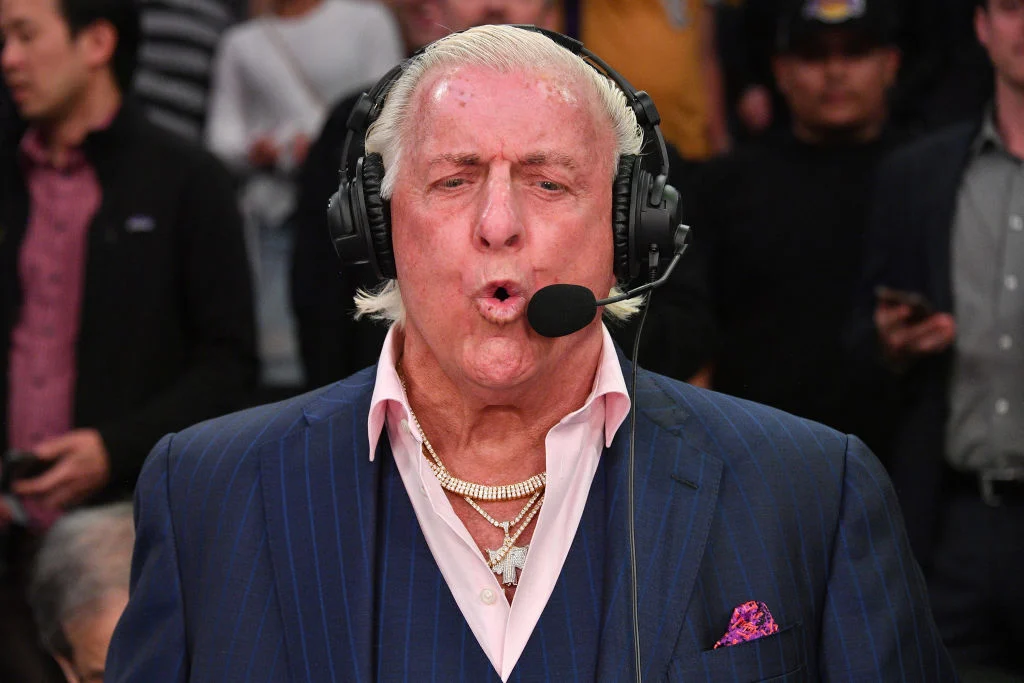

Ric Flair spent more than 50 years building the Ric Flair brand.
The bleached-blond hair. The extravagant robes. The Rolex watches. The “Woooo!” The limousine-riding, jet-flying, kiss-stealing Nature Boy persona. Flair turned himself into one of the most recognizable professional wrestlers in history, then watched that identity become valuable well beyond wrestling through merchandise, licensing, appearances, endorsements, social media, and countless references in popular culture.
So imagine Flair decided to sign a contract granting another company sweeping rights to that incredibly valuable identity. You would probably expect his attorneys to spend days or weeks reading the agreement. There might be revisions, counteroffers, negotiations over exactly how his name and likeness could be used, how much he would be paid, who controlled his social accounts, and what would happen if the relationship fell apart.
Maybe the process would take months.
That’s not what Ric Flair did. According to a lawsuit he filed earlier this month, Flair received a contract from digital talent agency FAM Networks at 5:57 PM on December 5, 2025. At 6:11 PM, he signed it. That’s 14 minutes.
Flair now says he did not have an attorney review the agreement before he signed it. According to his lawsuit, what he agreed to during those 14 minutes included an extraordinarily broad, supposedly irrevocable and perpetual license covering his name, image, likeness, voice, social media accounts, and commercial identity.
Now Flair wants out. And he’s suing FAM Networks for at least $10 million.

(Photo by Allen Berezovsky/Getty Images)
50 Years To Build It. 14 Minutes To Sign.
The 14-minute timeline is perhaps the most astonishing detail in the entire dispute because the asset involved wasn’t some minor endorsement or one-off appearance. It was Ric Flair.
The lawsuit says FAM’s agreement granted the company an “irrevocable, perpetual, sublicensable” license over Flair’s name, image, likeness, voice, accounts, and commercial identity. The language was apparently expansive enough to cover all languages and media, including forms of media that haven’t even been invented yet. The contract reportedly described the geographical scope as “throughout the universe.”
Even more remarkably, Flair’s complaint says he did not have an attorney review the agreement. That creates one of the central tensions in the case: Flair’s lawyers now portray the contract as predatory and say FAM exploited him, but based on the timeline described in his own complaint, he also appears to have made an exceptionally consequential business decision very quickly.
Flair’s Lawsuit Says FAM Knew He Didn’t Have A Lawyer
This is where Flair believes responsibility shifts back toward FAM.
According to the complaint, the contract contained a recital indicating that the agreement had been negotiated with legal counsel. Flair now claims that wasn’t true and alleges FAM knew perfectly well that no lawyer was advising him.
“FAM knew he had no lawyer,” the complaint alleges. “FAM wrote the clause saying he did anyway.”
Flair’s attorneys argue that FAM wasn’t merely the beneficiary of a celebrity failing to read his contract carefully. They accuse the company of inducing Flair into the agreement through false representations and taking advantage of the situation to obtain extremely valuable rights.
The lawsuit puts it dramatically: “What FAM did was simple: it waited until he needed help managing the digital legacy of everything he had built, presented him with a document he was not equipped to understand, told him he had lawyers when he did not, gave him fourteen minutes to read it, and walked away with a perpetual license to his identity.”
That phrase — “gave him fourteen minutes” — makes for powerful legal rhetoric. But the publicly reported timeline appears to establish that Flair opened the email at 5:57 and signed at 6:11. It does not establish that FAM imposed a 14-minute deadline or told Flair the offer would disappear if he didn’t immediately sign.
So one of the biggest questions hanging over the case is extremely simple: Why did Ric Flair sign it so quickly?
What Was Flair Supposed To Get?
Flair obviously did not agree to the arrangement for nothing.
According to his lawsuit, FAM pitched itself as a company capable of dramatically expanding the money Flair earned from his digital audience. A major part of the plan involved his Facebook page, which had reportedly been hacked and demonetized. Flair says FAM represented that it could restore and monetize the page, potentially producing six figures in revenue every month.
The agreement also allegedly promised Flair 90% of the proceeds from speaking engagements and personal appearances sourced by FAM, 50% from collaborative projects, and 10% from what the contract called passive content.
For Ric Flair, the opportunity was potentially significant. He may be decades removed from his peak years inside the wrestling ring, but the Nature Boy identity remains commercially powerful. Flair still commands appearance fees, sells merchandise, attracts substantial social media attention, and licenses his name and persona for various projects.
His complaint argues that FAM promised to turn that residual fame into a substantial digital revenue stream. According to Flair, it didn’t happen.
Flair Says FAM Was Making As Much As $20,000 A Month
Flair’s lawsuit claims FAM failed to deliver the business opportunities it had promised.
“It sourced not one speaking engagement. Not one in-person appearance. Not one personal project at the ninety percent royalty tier,” the complaint alleges. Instead, Flair says FAM mostly reposted existing material while gaining increasingly significant control over his digital presence.
The biggest point of contention appears to be Facebook. According to the complaint, FAM transferred control of Flair’s page in a manner that effectively locked members of his existing team out of the account. Flair alleges this also interfered with an advertising opportunity his representatives had already been working on.
Meanwhile, he claims FAM itself was generating as much as $20,000 per month from the page while paying him very little. Flair told The Independent that he believes he has already lost at least $250,000 in revenue because of the arrangement.
Flair Wants His Identity Back — And $10 Million
Flair isn’t merely asking for unpaid royalties. He wants a judge to rescind the entire agreement, return control of his Facebook page, declare that FAM has no continuing rights to his name, image, or likeness, and require a complete accounting showing exactly how much money was generated using the Ric Flair identity.
Then Flair wants damages. The complaint seeks at least $5 million for alleged breach of contract and at least another $5 million for alleged fraudulent inducement. It also seeks additional damages connected to alleged violations of New York law and interference with prospective business opportunities, plus disgorgement of money FAM allegedly earned at Flair’s expense, attorneys’ fees, and costs.
Flair’s lawyers have also pointed to something they believe he should have been told before signing. According to the complaint, FAM was already involved in another lawsuit involving ufologist Steven Greer when Flair entered his agreement in December 2025. Flair’s attorneys characterize that dispute as involving similar issues and claim FAM never disclosed it to him.
These are, of course, Flair’s allegations. No judge or jury has determined that FAM defrauded him, breached the agreement, or improperly took control of his assets. FAM had not publicly answered the allegations when the lawsuit was reported.
“I Built This Name”
Flair certainly isn’t mincing words now.
“I spent more than forty years building the name Ric Flair, with my body, my blood, and everything I had,” Flair told The Independent. He also invoked one of his most famous wrestling lines: “For decades, to be the man, you had to beat the man. FAM hasn’t beaten me.”
Flair said he trusted the wrong people and accused the company of overpromising and underdelivering after obtaining control it should never have had.
“I built this name, I earned this name, and I’m going to fight to take it back,” he said.
It’s a compelling argument emotionally. Very few performers have spent as much of their lives creating a singular public identity as Ric Flair. But it also brings the story right back to those 14 minutes. If the Ric Flair identity took decades of “body, blood and everything” to build, why sign an agreement governing that identity without first having an attorney spend even an afternoon reading it?
Ric Flair Has A Long History Of Financial Problems
Unfortunately, questionable financial decisions are not exactly new territory for Ric Flair.
For decades, Flair portrayed a fabulously wealthy man on television. The Nature Boy bragged about Rolex watches, custom suits, limousines, private jets, expensive hotels, and living a lifestyle ordinary people could only dream about. The character wasn’t entirely fictional.
Flair has openly acknowledged that during his prime, he spent enormous amounts of money maintaining the lifestyle he portrayed on television. And despite earning millions over one of the longest and most successful careers in wrestling history, he has repeatedly experienced serious financial trouble. Celebrity Net Worth currently estimates his net worth at just $500,000.
Taxes have been a recurring problem. In 2000, the IRS reportedly filed a lien involving approximately $870,000 in unpaid taxes, and several years later the government reportedly began garnishing some of Flair’s WWE income. In 2019, additional filings indicated that Flair owed approximately $240,000 in federal taxes and another $40,000 to the state of Georgia connected to previous tax years.
A $1.8 Million Medical Bill
Flair has also dealt with enormous medical expenses. In 2017, he suffered a catastrophic health crisis that required surgery, led to multiple organ complications, and resulted in doctors placing him in a medically induced coma. Flair eventually recovered, but he later said the ordeal left him with approximately $1.8 million in medical bills that were not covered by insurance.
Flair later recalled reaching a point where he was approximately $500,000 in debt and credited longtime wrestling rival Hulk Hogan with helping him financially during a particularly difficult period.
Add multiple marriages and divorces, decades of famously extravagant spending, tax problems, medical costs, and assorted business ventures, and it becomes easier to understand how one of wrestling’s most famous performers ended up with dramatically less wealth than his career earnings might suggest.
Flair may not have preserved a massive fortune, but the Ric Flair name itself remains one of his most valuable assets… which makes signing away sweeping rights to it in just 14 minutes all the more remarkable.