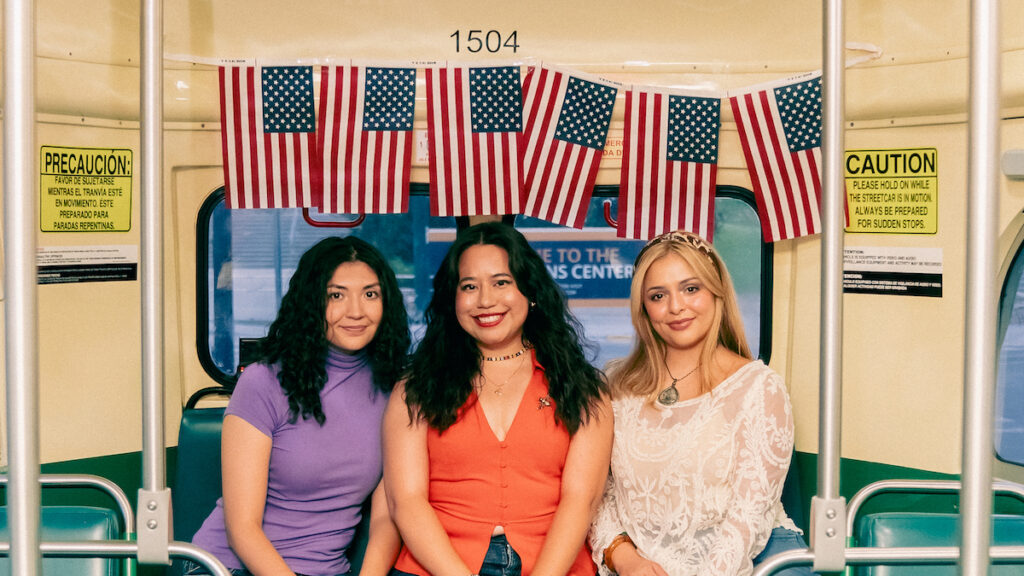

It may be hard to imagine now, when immigration is one of the most painful and divisive issues in the country, but there was a time when people could ride a streetcar across the U.S.-Mexican border from El Paso to Ciudad Juárez and back. This is the era that writer-director Valeria Contreras lovingly recreates in her lyrical short film “Oranges,” playing today at the El Paso Film Festival.
“Growing up in El Paso, I experienced the border as part of everyday life, where families, friendships and communities extend across two countries,” she recalls. “For me, it has always been a place full of love, movement and connection, and that is the experience of the border I want to bring to the screen.”
The film follows two young sisters, the free-spirited Lucia (Maria de Los Angeles), who plans to leave El Paso for Mexico City, and Griselda (Edmy Montes), who is bound to El Paso by family responsibilities. Contreras is in the process of turning the short into a feature.
A creative producer as well as writer-director, Contreras thrives on motion, and is one of the most active filmmakers in El Paso’s vibrant film community. She also has strong ties to New York City, where she earned her film MFA at Columbia University.
And while her films lean toward stories of connection, they are very conscious of the political and cultural division they seek to help heal. She has a recent history in politics, and sees film as a way of recognizing shared humanity.
On the eve of her film screening in the El Paso Film Festival’s El Paso Shorts block, we asked her about bringing 1970s El Paso back to life, the connections between communities and the films they produce, and how to pitch.
Valeria Contreras on ‘Oranges’

MovieMaker: How did you become a filmmaker?
Valeria Contreras: I was interested in film and storytelling from a very young age, and first explored that interest through writing and illustrating educational comics for kids. That was my first experience writing scripts, storyboarding, and thinking visually.
Before beginning to pursue film professionally, my career was in local government and politics, including working here in El Paso. That experience deeply shaped the kinds of stories I wanted to tell. Growing up on the U.S.–Mexico border, I often felt that national narratives about this region didn’t reflect the complexity of the place I knew, and filmmaking became a way for me to contribute a different perspective.
That eventually led me to Columbia University in New York, where I earned my MFA in film and began producing and directing narrative work. My first short film, “Homesick,” brought me back to El Paso to make a film here and in many ways, I’ve been building on that connection ever since.
MovieMaker: Can you talk about recreating 1970s El Paso for this lovely film?
Valeria Contreras: Recreating 1970s El Paso was one of the most exciting challenges of the film. As a writer, I was particularly drawn to the history of the streetcar, which once carried passengers directly between El Paso and Ciudad Juárez. I loved the idea of being able to board the streetcar in the United States and exit in Mexico, or vice versa, and it became an important element in the story.
Our producer Soumya Singh and key department heads were instrumental in bringing the period to life. Our production designer Leticia Marie Holtz and locations manager Jacob Cena worked especially hard to envision period details, coordinate picture cars and identify locations that could transform contemporary El Paso.
We also worked closely with the City of El Paso and the film commission to film at these key locations, including aboard the streetcar. It was exciting to bring an earlier version of El Paso to the screen and highlight pieces of the city’s history that many people may not know about.

MovieMaker: So many films about the border are about harrowing crossings, crime, or other intense drama. But this is a more lyrical look at two sisters parting ways at a time when crossing the border was easy. (We’ve both heard older El Paso residents recall how people used to pass freely back and forth from El Paso and Juarez). Why did you want to focus on this apparently less-contentious era?
Valeria Contreras: I was drawn to the 1970s because the streetcar offered such a beautiful physical representation of that interconnectedness. At the time, you could board the streetcar in El Paso and cross directly into Ciudad Juárez. The streetcar has since returned to El Paso, but its route no longer crosses into Mexico. I found that contrast between time periods especially meaningful because even though the connection between these two communities remains, the physical and political landscape around the border has since changed. The 1970s streetcar is a reminder of how directly that connection was once built into the infrastructure of everyday life.
With “Oranges,” I also wanted the border to be part of the fabric of the story rather than its central conflict. The drama is instead much more intimate and personal, focusing on two sisters who love each other and are facing the reality that one of them is leaving. At its heart, “Oranges” explores how we stay connected to the people and places we love, even as our lives take us in different directions. To me, that is a border story.
MovieMaker: I understand this was selected for the NALIP Director Incubator program sponsored by Netflix, and also incubated through the El Paso Community Foundation Border Art Residency and Cine Qua Non Storylines Lab. How did you successfully pitch it to all of those prestigious places? Any tips on pitching for fellow filmmakers? And did your supporters indicate why they wanted to be part of the film?
Valeria Contreras: As a filmmaker, I’m interested in film as a community practice and in the impact a production can have on the people and places it represents. “Oranges” was always intended to be rooted in El Paso, from the story itself to the people behind the camera.
My advice to filmmakers is to understand what makes your project and your team unique. A strong pitch isn’t just about what happens in the story, but why you are the right people to tell it and what each collaborator brings to the project.
We were incredibly fortunate to receive support from NALIP, the El Paso Community Foundation Border Art Residency and Cine Qua Non at different stages of this project, which is also a proof-of-concept for a feature film screenplay. Their mentorship, resources and communities helped us expand the ambition of the project and ultimately make the short film we dreamed of.
MovieMaker: You’re expanding this into a feature – where do we go next? Do we follow Lucia to Mexico City?
Valeria Contreras: For the feature, I’m exploring different ways to expand Lucia and Griselda’s relationship and how their story moves between the United States and Mexico. I recently returned from the Cine Qua Non Script Revision Lab in Tzintzuntzan, Michoacán, where I had the opportunity to workshop the feature screenplay extensively with an international community of screenwriters. That experience opened a lot of new possibilities, including how Mexico might become a larger part of the story.
The feature screenplay is still evolving, but the streetcar remains an important emotional throughline for me as a symbol of connection across borders, between places, and ultimately between the sisters themselves.
MovieMaker: How does it feel to play this very El Paso story in El Paso?
Valeria Contreras: It means the world to me to premiere “Oranges” at the El Paso Film Festival. This is a story rooted in El Paso, made by El Pasoans, and it feels incredibly meaningful to share it with a community that will recognize the places, history and experiences reflected on screen.
More than anything, I’m excited to celebrate the collective of artists who brought their unique talents to this film. So many people in this community helped make Oranges possible, and there is something really special about all of us being able to experience it together in the place where it all began.
Here are more details on the El Paso Film Festival, one of our 50 Film Festivals Worth the Entry Fee. And you can read more of our film festival coverage here.
Main image: Maria de Los Angeles, Valeria Contreras and Edmy Montes on the El Paso streetcar. Photo by Valeria Contreras