
Dorothy is an audacious and tender exploration of masculinity and gender identity that becomes muddled just when its ideas matter most, points out Sreeju Sudhakaran.

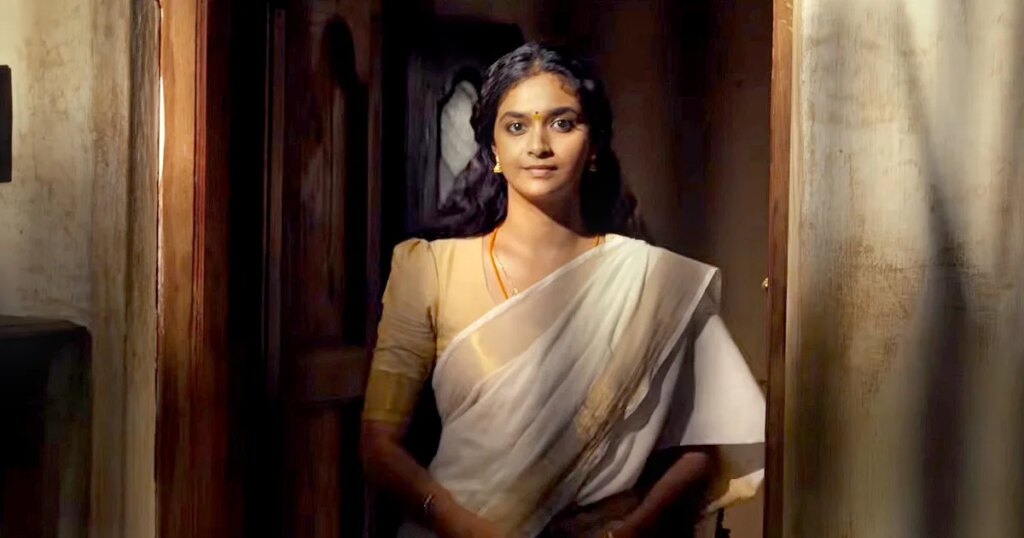
IMAGE: Keerthy Suresh in Dorothy.
Key Points
- Karthik Subbaraj’s Dorothy is praised for its visual flourishes, particularly in the first half, and its audacious attempt to tackle complex themes.
- The film explores the friendship between the two leads, Subbu and Karthi, in a toxic, misogynistic village environment.
- Keerthy Suresh’s character, Dorothy, serves as a crucial catalyst for Subbu’s transformation and rebellion against his upbringing.
Karthik Subbaraj’s new film Dorothy has left me genuinely confused as a spectator. There are parts I really like, sequences where I felt I was watching a masterpiece unfold.
But by the time Dorothy starts pushing its central theme in a direction that challenges the audience’s acceptance, the film starts wavering, struggling to clearly convey its own thoughts on sexuality and gender identity.
The Tale Of Two Friends
Subbu and Karthi are best friends from their school days after Subbu, a Bruce Lee fan, rescues Karthi from the local bullies of their school.
Subbu comes from a deeply toxic environment dominated by the men in his family; the women have already become tragic victims of their intense misogyny. The men in his village are much like his father and elder brothers, so vain about their masculinity that a moustache and beard serve as ultimate symbols of pride. Violence becomes their primary language and their way of dispensing honour.
The meek Karthi, raised by his widowed mother, is not just in awe of Subbu’s fierce protective nature but also of the aggressive ways of his family, even though Subbu’s father treats him dismissively because of his caste.
When they grow up, however, their personalities completely flip, as if they naturally embraced each other’s childhood qualities while rejecting their own.
Karthi (Rishikanth) has morphed into an aggressive alpha, easily provoked into violence, while Subbu (Sananth) has grown sensitive and prone to tears, a shift Karthi struggles to accept in his best friend.
Their friendship is further challenged when one of Subbu’s brothers gets married and brings home Dorothy (Keerthy Suresh), a girl from Kerala.
Subbu strikes up a close bond with Dorothy, who brings out his sensitive side even more, much to the annoyance of both Karthi and Subbu’s father.
A shocking incident, however, forces Subbu to confront his own identity and pushes Karthi to evaluate his friendship with his oldest chum.
Karthik Subbaraj’s Boldest Attempt
I have always found Karthik Subbaraj to be a very fascinating ‘hit-and-miss’ director. He has a maverick voice as a filmmaker and a strong resolve to avoid getting stuck in a creative loop. You never expect him to just safely recycle what works.
He constantly pushes for varied ideas that challenge him as a filmmaker, yet his distinct stylistic stamp remains visible across those variations.
When I call him a ‘hit-and-miss’ director, I do not mean he delivers duds on an alternate basis. I just want to point out that when he makes movies with huge stars carrying box office baggage, his work tends to be far less fascinating. Mahaan, Jagame Thanthiram, and Retro are prime examples of that.
Dorothy comes with no such star-driven baggage, and it is therefore quite audacious for what it wants to convey. In fact, I would easily call the movie the director’s boldest and most provocative attempt yet.
I will not say the film explores themes completely unseen in Tamil cinema. Thiagarajan Kumararaja’s Super Deluxe instantly comes to mind as a film that explores LGBTQ themes, particularly exploring the trans community, and Subbaraj’s own Iraivi and Jigarthanda DoubleX previously tackled the stubborn nature of vain machoism.
Well-Crafted First Half
Where Karthik Subbaraj impresses most in Dorothy is in depicting the testosterone-fuelled atmosphere of Subbu and Karthi’s village, placing their tight friendship right at its centre.
It is a space where Subbu’s evolving sensitivity is constantly challenged by everyone around him, where the men have tied their entire gender existence to violence, perversion, and the harsh suppression of women.
It also helps that the trademark Karthik Subbaraj black humour shines through the distinctive characters of the village, aided by Ganesh Siva’s incredibly sly editing and fun visual and audio cues.
In one scene, the Star Wars theme is randomly played by a local wedding band. In another, a theatre operator tells the patrons not to ruin the floor right before projecting exactly what they came to watch.
The sequence where Karthi and Subbu try to pull off their first contract hit is comical, highlighting both their hilariously awkward macho attempts and just how differently the two have grown up.
While Karthi adapts effortlessly to this grim setting, Subbu’s reluctance finds strong resonance with Dorothy’s arrival.
Dorothy acts as the catalyst for Subbu to confront his upbringing, sparking a transformation that becomes both a personal and a societal rebellion. The scenes between them carry a distinct tenderness that stands out beautifully against the far brasher sequences happening around them.
Strikingly Shot Sequences
If you have watched enough Karthik Subbaraj movies, you know the director loves bringing a unique visual flair that makes his scenes pop in execution. Even in his blandest films, these moments stand out.
That visual styling is exactly why fans still debate whether Retro is a genuinely bad movie or a misunderstood masterpiece. My two-paise thought: It is firmly the former.
Dorothy boasts quite a few of these striking scenes. The absolute standout involves a major character’s death and Subbu’s reaction to it. The camera pans through the house, actively following Subbu as he pieces together what transpired. His eventual breakdown and violent outburst are captured excellently.
Another standout sequence features him and Karthi desperately trying to fend off a hefty rival in the fields. Cinematographer Tirru has completely delivered on the director’s vision, framing striking shots that effortlessly hold your attention.
A Quieter Second Half With Confusing Shifts
The second half of Dorothy is where the film takes a major tonal shift, turning into a road trip movie as it embraces its queer themes tightly. This is exactly where I have really mixed feelings.
The performances of both Sananth and Rishikanth shine here. I loved some of their intimate interactions and a few quiet, reflective scenes in this stretch that remind you how far the characters have travelled from the chaos of their village.
But I was also convinced the director is not entirely clear on how to address gender fluidity and identity crises. Through Subbu, the first half gave the impression that masculinity should not be defined by society’s misogynistic views, or cinema’s skewed depiction of hypermasculinity.
When Karthi keeps insisting that frequently sexist slogan of ‘men don’t cry’, Subbu proves to be the worthy breaker of the argument. He wants to learn cooking, he wants to wash the dishes and he wants to cry when he wants to cry.
However, a major transformation scene betrays that convention-breaking notion.
Sure, the director drops early clues hinting that this character is ‘different’ from his peers, but there is absolutely no proper character development to justify the sudden change. It felt at that moment there, that Dorothy was more focused on manufacturing a shock reveal than crafting an organic transition, and then relying on scenes showing their gender identity crisis only after the big twist has landed.
As a result, the film undermines its own attempt to dismantle the toxic ideas of masculinity that society and cinema so often glorify.
Preachy Commentary, Predictable Progression
At times, you can almost feel Karthik Subbaraj patting himself on the back. He frequently forces his characters to deliver preachy commentaries criticising prevalent homophobia and transphobia.
While some of it feels like a painfully obvious dressing down, a couple of lines do hit the mark. Like when a trans character quietly tells Karthi that they are the ultimate test of humanity for the rest of the world, judged purely on how society chooses to accept them.
The road trip taken by the two friends comes with certain predictable expectations regarding character progressions, and it firmly ticks those boxes.
Subbaraj tries to play around by jumping across timelines, showing the most recent events in stark black and white. While that framing is okay at best in keeping the audience guessing, the actual emotional weight lands much better through the film’s depiction of Karthi’s internal development.
But then again, Subbaraj refuses to stop when the film hits that right emotional peak note. Instead, he drops in an epilogue where the friendship between the two protagonists takes on an entirely new shade. It just did not work for me. While the earlier transformation at least had a few subtle clues going for it, this finale felt like it came out of nowhere and felt quite forced.
Performances, Ilaiyaraaja’s Score
What works consistently throughout Dorothy, however, is the director’s choice of composer: Ilaiyaraaja. While the maestro excels at amplifying the rugged rural aesthetics of the first half, it is during the serene portions of the second half that his score hits the peaks. The recurring use of a haunting female vocal in the quiet scenes between the friends is simply brilliant.
The two lead actors are equally impressive. Sananth’s role requires him to traverse drastically different body languages and mannerisms. If it does not always look fully convincing onscreen, the blame lies firmly with the execution rather than the actor because he easily delivers exactly what every scene demands of him.
While he is not bad in showing his character’s volatile side in the first half, Rishikanth gets more scope to perform during the road trip, managing to convey his character’s inner conflict exceptionally well.
Keerthy Suresh shines brightly within the limited space given to her. Among the supporting cast, Jeeva Subramanian as Vadivu and Muthukumar as Whistle Veeraiya (Subbu’s hateful, caste-proud father) easily stand out.
Dorothy is undeniably a bold attempt and a well-made film, anchored by two excellent lead performances. Yet, Karthik Subbaraj’s film becomes frustratingly shaky and confusing exactly when it matters the most. In his exuberant rush to push the envelope, it seems he simply did not know which direction to push it in.
Dorothy Review Rediff Rating: