
Prom has become part and parcel of leaving school, giving Year 11s the chance to come together for one final celebration before they head off on their new ventures.
While some parents believe every child should be able to attend, many schools have restrictions in place to prevent students who have behaved badly or had poor attendance from taking part.
Now one Stockport school has tightened its rules by telling kids they must attend at least 30 after school revision sessions in their final year if they wish to go to prom.
Click here to keep up to date with the latest Family news in our newsletter
It means instead of finishing school at 3.10pm, they’ll stay behind until 4pm on those days.
The move, part of Werneth School’s Passport to Prom programme, has sparked a mixed response from families, who took to social media to discuss the rules, with some calling them ‘excessive’, saying pupils spend enough time in school, but others welcoming the extra support offered by staff and saying they’ll ‘get more out of it than just revising at home’.
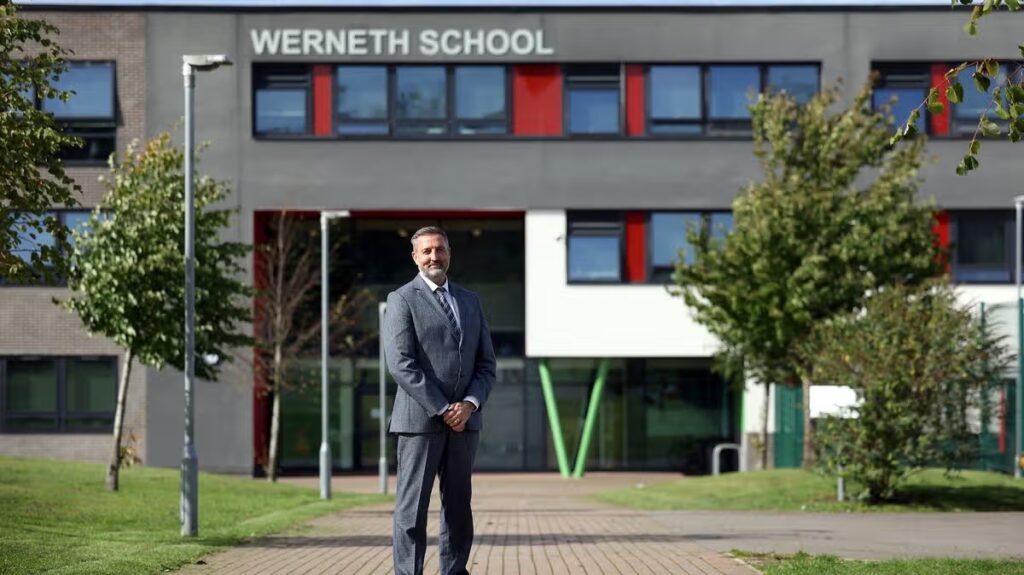
Yet principal Dan Willis, who only took the reins at the school in Harrytown, Romiley, in July, is standing firm and says ‘we will never apologise for wanting the very best for our young people’.
He has already overseen quite a turnaround at the school, where last year teachers were striking over violence and abuse from pupils and leaders were previously under fire over a ‘humiliating’ rule, which made children with learning disabilities carry a sunflower lanyard and show it to staff when asked.
With a new leadership team in place, the school, which was taken over by the Education Learning Trust (ELT) in January 2021, says it’s looking confidently to the future, with ‘improving GCSE results, stronger behaviour and a renewed culture of ambition’.
The revision sessions are delivered by teachers after the normal school day and are designed to ‘help students develop positive study routines, strengthen their subject knowledge and prepare effectively’ for their exams.
Thirty sessions across the year equates to around one session a week and students can select sessions according to the subjects where they feel they’d benefit most from additional support.
The head says the initiative should be understood as part of the school’s wider commitment to helping pupils succeed.
“Our Period 6 programme is not about punishing students or creating unnecessary barriers,” he said. “It is about encouraging young people to develop the habits, resilience and commitment that will give them the best possible chance in their GCSE examinations and beyond.
“Our teachers are providing this additional support because they care deeply about the students they teach. We are asking pupils to attend 30 sessions over an entire academic year, which is a little over one each week. We believe that is a reasonable and achievable expectation when the potential benefit to their future is so significant.
“Prom is an important celebration, but it is a celebration of the whole Year 11 journey. Our Passport to Prom encourages students to demonstrate positive attendance, behaviour, engagement with learning and commitment to their revision. We want every student to achieve it, and we will support them to do so.”
He says the initiative forms part of ‘a much bigger story’ at Werneth School, where improving outcomes and a renewed sense of purpose are creating growing confidence across the school community.
This summer, more than half of Werneth’s Year 11 students achieved a grade 4 or above in both English and mathematics for the first time in many years. This represented an increase of 7.73% compared with the previous year.
The school has also seen considerable improvements in behaviour. Suspensions have reduced, internal suspensions have fallen substantially and external visitors have repeatedly commented upon the calm and purposeful atmosphere around the school.
Despite only being appointed principal in the summer, Mr Willis is far from new to Werneth. He has worked at the school for 25 years, beginning his career there as a geography teacher before holding a wide range of curriculum, pastoral and senior leadership positions.
He says it’s that experience which has given him a ‘deep understanding’ of the school, its students and the community it serves.
“Werneth is much more than the place where I work,” he said. “I have spent 25 years of my life here. I know our children, our families and our community exceptionally well, and I know just how much potential exists within this school.
“I was immensely proud to become principal, but I also recognise the responsibility that comes with the role. Our community deserves a brilliant school, and that is exactly what we are determined to provide.
“We are honest about the fact that improvement is a journey, but we are equally clear that Werneth is already a much stronger school. Behaviour is good, the building is calm and our students are responding positively to clear routines and higher expectations. There is a real sense of momentum.”
Mr Willis is supported by two new vice principals, Priya Jones, who leads on quality of education, and Steve Taylor, who leads on inclusion.
Together with the school’s wider leadership team, they are driving improvements in teaching, behaviour, attendance, safeguarding and support for students with additional needs.
At the heart of this work is the ‘Werneth Way’ – a shared culture built around the school’s values of respect, kindness, hard work and good communication.
The approach combines high expectations with strong pastoral care, with the aim that every student feels known, safe, supported and appropriately challenged.
Mr Willis added: “High expectations and genuine care are not opposites. The most caring thing a school can do is believe that its students are capable of great things and then provide the support, structure and encouragement they need to achieve them.
“We will never apologise for wanting the very best for our young people. However, we will always listen to parents, explain the reasons behind our decisions and work with families when individual circumstances make something difficult.
“Our aim is not to prevent students from attending their prom. Our aim is for every student to earn their place, attend with pride and know that they have given their very best during this crucial year.”
The head says the school’s improving results, stronger culture and increasingly positive atmosphere are now providing the foundations for its next stage of development.
“We want Werneth to be the school of choice for families in our community,” he said. “We want our students to be proud that they attend Werneth, our staff to be proud that they work here and our community to be proud that this is its school.
“There is something very special happening at Werneth. We have an experienced and ambitious leadership team, dedicated staff and fantastic young people. We know there is more work ahead, but we are moving forward together with confidence, optimism and an absolute belief in what our students can achieve.”
Vanessa McManus, CEO of Education Learning Trust, said: “Improving educational outcomes is a long-term commitment and does not happen overnight. We are immensely grateful for the dedication of our teaching and support staff, who work tirelessly to provide additional opportunities for our students as they prepare for their GCSEs across both of our secondary schools.
“Parents play an important role in supporting Werneth School and we value the strong relationships we have. Their continued engagement and feedback are essential as we work together to ensure the best possible outcomes for every young person in our trust.”
Does your child’s school have rules around prom attendance? Do you think every student should be allowed to attend the end of Year 11 celebration? Let us know your views in the comments here.