
As a social tool, the Israeli documentary Naza aims for change on two fronts: It hopes to energize a defund-the-IDF movement in the US. while swaying an electorate as it heads to the polls next month in Israel.
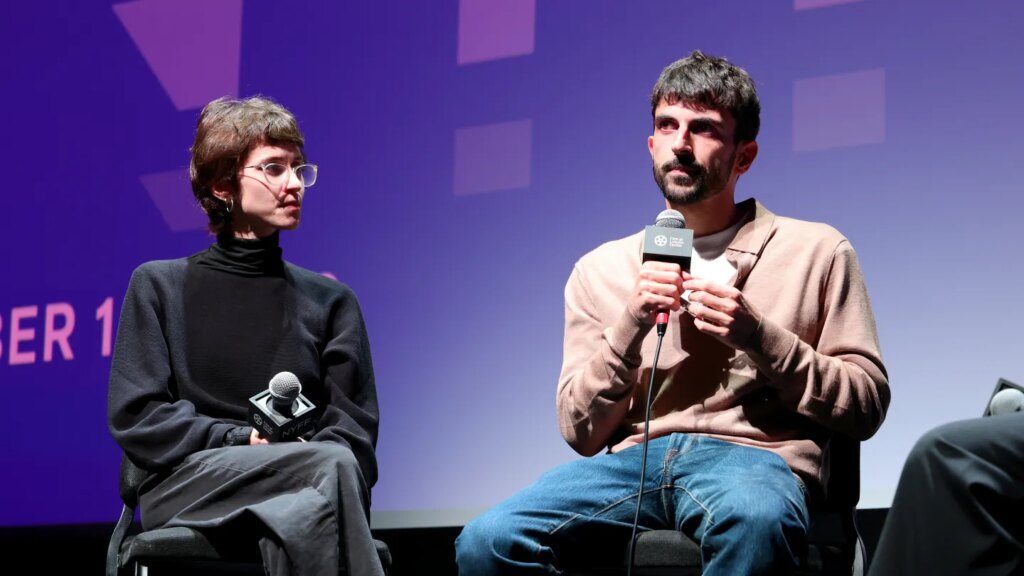
The success of the second goal — “to penetrate the walls of justification and silence in Israeli society,” as director Yuval Abraham put it — will play out in the coming weeks 6,000 miles from these shores as voters decide whether to return Benjamin Netanyahu to office. But the first aim saw a key opening step this weekend as Abraham and his co-director Rachel Szor debuted their Guardian-produced movie in the U.S. with an enthusiastic (if hardly 25-minute-Venitian-ovation) screening at the New York Film Festival.
Abraham made clear that his purpose in bringing the film to New York as well as to release it theatrically across America beginning Oct. 9 was to change the political calculus.
“For us, [it’s] the main motivation,” he said from the Alice Tully Hall stage after the premiere Saturday night. “It’s not a coincidence the last line of text in the film is that these crimes are ongoing not just because our country is doing it but because your country is supporting and funding it,” he told the Manhattan audience as Szor and moderator-NYFF programming chief Dennis Lim looked on.
Of course, whether pieces like this will persuade undecideds (do they exist?) on the question of U.S. support for Israel or simply prompt a gotcha fingerpoint from two fiercely divided camps is a similarly open question. (A small but intense pro-Israel protest outside the theater and the rapt interest inside it literalized the divide and suggested its intractability.)
That the movie lands in a U.S. midterm season when American aid to Israel has animated Congressional races from Michigan to Minnesota makes it the rarest of objects among independent films: a foreign-language documentary injecting itself directly into the bloodstream of electoral politics.
At least for its run time at the festival, the film asked to be taken on its own journalistic terms. Centering on anonymized Hebrew-language interviews with two dozen IDF veterans of the Gaza war, Naza lays out in uncommonly specific detail the various ways the Israeli army has prosecuted that war. The movie is both less than the controversy that surrounds it (AI surveillance and selection of targets will not shock anyone who follows the latest in technological warfare) while also lobbing a more explosive and enraging grenade than even some coverage suggests (descriptions of acceptable and unquestioned human collateral damage, the “Naza” of the title, and an admission from a soldier that he feels like a Nazi, to name two), though of course the inclusion of such moments will enrage opposing camps for different reasons.
Surprisingly, one of the most charged choices Abraham and Szor make is to intersperse, between the rooftop confessions, drone shots of Israelis watching TV in their well-appointed high-rise apartments below — a juxtaposition that will further galvanize critics of Israel who see rampant privilege undergirding its actions while angering supporters of Israel who will see in this a cheap trick sensationalizing the routine goings-on of country at war. This is a film that, like so much else in culture these days, Rorschach-ifies our politics, only more so.
Abraham, who along with Szor directed the 2025 West Bank-themed Oscar winner No Other Land, built the film on his text-based reporting for The Guardian, Local Call and +972. He can be seen on the rooftops of Tel Aviv engaging his interview subjects, often coaxing info out of and sometimes challenging them. (“And you didn’t feel any remorse about this?” is the kind of thing he might say.) Like many advocacy journalists, his goal is clearly to provoke grassroots American action, a theme he returned to several times as he spoke to the liberal NYFF audience.
Szor also was eager to say that the film was aimed at the left in Israel.
“When you walk in Tel Aviv you feel all these crimes are happening and no one is speaking about it,” she said. “And Tel Aviv is a liberal place; a lot of people consider themselves leftist. But they don’t talk about it or they try to justify it.”
The center-left media in Israel has been receptive to the film’s message if at times also skeptical, as this Ha’aretz review suggests, objecting to a lack of precipitating context. The right has as a rule been far less interested; culture minister Miki Zohar, who has a history of threatening critical voices with the tools of the state, says he wants to revoke the citizenship of Abraham and Szor.
Such comments should be taken with a grain of salt given both a) the bombastic nature of Israeli politics and b) that he lacks the authority to do this, though the filmmakers were not taking other threats lightly.
“Netanyahu compared this film to a barrage of ballistic missiles. And you know what happens to people who shoot missiles — they kill them,” Abraham said at the screening.
For all their sharpness against the right, the filmmakers did not entirely negate the claims of those standing outside the theater. “You’ve probably seen the protesters out there with the video of Oct 7 on the trucks,” Abraham brought up from the stage. “It’s important for me to say that [Oct. 7] is completely unjustified. But that doesn’t justify what you see in the film, the slaughter of so many civilians, the massacres at food sites.”
He added, “I don’t want to live in a world where rightful empathy of Israeli victims is weaponized to mean a lack of empathy to Palestinians and used by Bibi to justify the occupation and crimes in Gaza. … I don’t think we want to live in such a world. I think we should all refuse to play this zero-sum game,” he said.
Such comments has also earned Abraham over his short but impactful career criticism from the left for centering Israelis in his work — a sign to some that even liberal Israelis can’t win with the global left and, for some, proof that they shouldn’t even try.
The audience and Lim, at least, welcomed what Abraham and Szor had to say.
“I think we all knew this would be an important screening,” Lim said, winding down, as he cited U.S. aid to Israel and military actions in Iran.
“Thank you, Dennis. for inviting us,” Abraham replied. “The [U.S. military support] is one of the reasons we thought it was so important to see.”