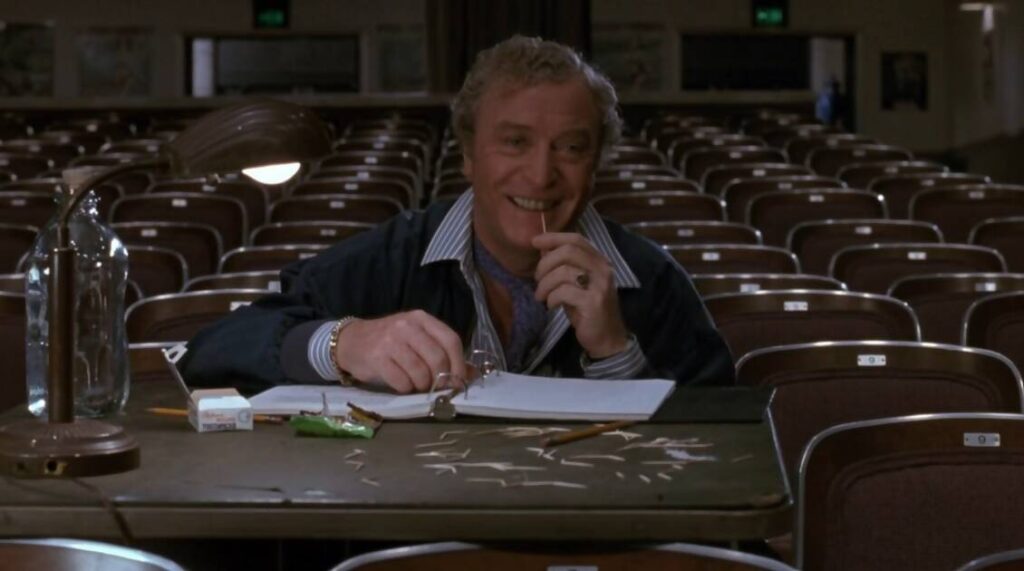

Peter Bogdanovich gave Michael Caine a great 90s role in the stage farce, Noises Off. We take a look back at an underrated comedy…
The 1990s were Caine’s last decade as a consistent leading man before he moved more permanently into supporting actor elder statesman territory. This decade features some of his most forgotten work, but it also contains one of his most beloved and enduring roles as Scrooge in The Muppet Christmas Carol, his second Best Supporting Actor Academy Award win for The Cider House Rules, a return to his iconic spy character Harry Palmer for two TV movies, the villain role opposite Steven Seagal in Seagal’s directorial debut and the role he was born to play, yes, Joseph Stalin. Join me as I delve into Caine’s 1990s to see what gems I can unearth and what’s perhaps best left hidden.
NB: Spoilers for Noises Off lie ahead.
Directed by: Peter Bogdanovich (The Last Picture Show, What’s Up, Doc?, Paper Moon, Mask)
Other Featured Geezers:
Carol Burnett as Dotty Otley/Mrs Clackett
Denholm Elliott as Selsdon Mowbray/The Burglar
John Ritter as Garry Lejeune/Roger Tramplemain
Christopher Reeve as Frederick Dallas/Philip Brent
Nicollette Sheridan as Brooke Ashton/Vicki
Marilu Henner as Belinda Blair/Flavia Brent
Julie Hagerty as Poppy Taylor, Mark Linn-Baker as Tim Allgood.
Tagline: The comedy where everyone gets caught in the act.
What’s it all about, Alfie?: Caine is beleaguered English theatre director Lloyd Fellowes, struggling to stage a production of hit British farce ‘Nothing On’ as it tours the US before its Broadway debut.
His troublesome cast includes a fading star who has put her own savings into the production in hopes of a career resurgence. Dotty Otley (Carol Burnett), the younger, emotionally volatile actor with whom she’s having a fling. Garry Lejeune (John Ritter). The amiable yet neurotic Frederick Dallas (Christopher Reeve). The gossipy Belinda Blair (Marilu Henner). The seemingly vacant ingénue and Lloyd’s secret lover, Brooke Ashton (Nicollette Sheridan). The ageing alcoholic Selsdon Mowbray (Denholm Elliott).
On the sidelines are Lloyd’s frazzled stage manager, and his other romantic squeeze, Poppy Taylor (Julie Hagerty), and perpetually put-upon jack of all trades Tim Allgood (Mark Linn-Baker).
We join the troupe at three pivotal points: the dress rehearsal on the eve of their first performance, further along their tour during a 2pm Wednesday matinee at Miami Beach and then, the “final horror, Cleveland” towards the end of their run.
Sardines are misplaced, axes are swung, a cactus is shoved up a bum and, of course, multiple pairs of trousers fall down. But will ‘Nothing On’ make it to Broadway with its cast and crew intact?
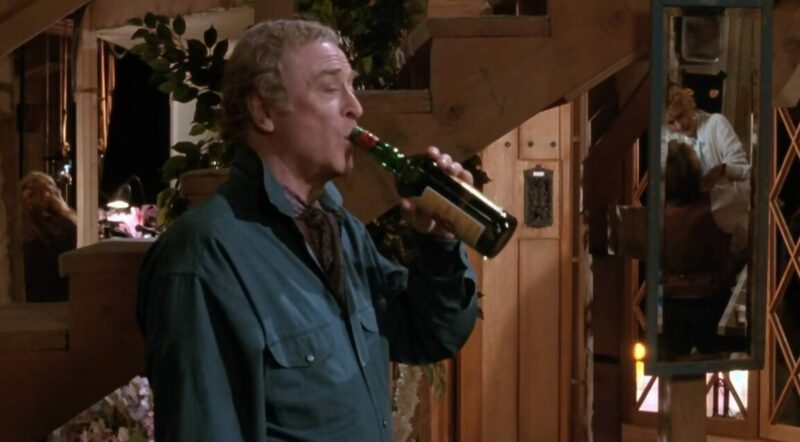
Caine-ness: The opening credits are in alphabetical order, but thanks to the handy perk of having a surname beginning with “C” (a canny move when picking his stage name), Caine still gets prominent second billing after Carol Burnett. If only he’d opted for Michael Aine. He was just one letter off peak billing. Drat!
This is a true ensemble piece, with everyone getting their chance to shine, but Caine is the closest thing to a lead, with lots of individual screentime.
It’s his voiceover that bookends the different sections, centering the film around his particular concerns regarding the play’s potential failure, and we first hear this voiceover two minutes in.
“A big Broadway opening, everybody who’s anybody in New York is inside this theatre tonight. Everybody but one man. This man – me!”
Then we see Caine in person as Fellowes, looking dishevelled and bursting out of a theatre door. “It’s going to be a disaster, I can’t just sit there and watch,” he declares.
“I’m not running away,” Lloyd asserts as we see him very much running away from the theatre. “I’m just not the kind of person who gets a kick out of watching an automobile crash, particularly when it’s my automobile. It’s going to be the worst catastrophe Broadway has ever seen, they’re gonna forget their lines, the set will fall down, none of us will get out of New York alive, they’ve got big pictures of us in the lobby!”
The film has only just started, so perhaps he’s overreacting, but we soon flashback to the show’s rehearsal night and see that his worries actually are perfectly well-founded.
As Lloyd, decked out in a purple cravat (a signature style choice of the film’s director Peter Bogdanovich), Caine maintains his English accent, but in a slightly posher register as suits the stereotype of a stuck-up theatre director (especially one with the snooty sounding name of Lloyd Fellowes). And there’s plenty of signature shouty Caine sprinkled liberally throughout his performance.
There’s a barely hidden contempt for his performers, and Caine plays this world-weary exhaustion to amusing effect – as seen in his early exchange with actor Gary who, during a break in rehearsal, tells Lloyd:
“Can I just say one thing? Since we’ve stopped, I’ve worked with a lot of directors, Lloyd. Some of them were geniuses, some of them were bastards, but I’ve never met one who was so totally and absolutely… I don’t know.”
To which Lloyd responds, calmly and gently, with a light smile:
“Thank you, Gary, I’m very touched. Now will you get off the fucking stage.”
Lloyd himself is mostly professional (apart from sleeping with cast and crew and his frequent bouts of yelling) and he does try his best to keep things on track. “If we can just get through the play once tonight for doors and sardines. That’s what it’s all about. Doors and sardines. Getting on. Getting off. Getting the sardines on, getting the sardines off. That’s farce, that’s the theatre. That’s life.”
He seamlessly flits between gently corralling his actors, calling them affectionate albeit patronising appellations such as “my dear” and “precious”, to brief fits of rage, and then back again to gently massaging of their fragile egos. The best demonstration of Lloyd’s rollercoaster of emotions is when Freddy is questioning his character’s motivation for holding on to a bag of groceries.
“The wellsprings of human action are deep and cloudy, maybe something happened to you when you were a very very very small child that made you frightened to let go of groceries,” Lloyd assures Freddy, but when that still doesn’t pacify the fastidious actor, Lloyd’s patience snaps to unleash some prime Caine yelling.
“You carry those groceries into the study Freddy, honey, because it’s just slightly after midnight and we’re not going to be finished before we open tomorrow night. Correction: TONIGHT!”
But after quietly being informed by Belinda that Freddy’s wife left him that morning, Lloyd shifts tone yet again, softly calling Freddy over to him. “I think the point is you had a great fright when she mentions income tax, and you felt very insecure and exposed and you wanted something familiar to hold onto.”
This finally pleases Freddy and allows them all to move on with the scene.
After the tour starts, Lloyd goes elsewhere to direct Hamlet, where things seem equally as bad. As he tells Tim, “I have Hamlet’s ghost on the phone for an hour every evening after rehearsal complaining that Polonius is sucking sourballs through his speeches. Claudius is off every afternoon doing a soap and Gertrude is off the entire week doing a commercial for Gallo wine. Hamlet himself, would you believe, has come down with a psychological problem.”
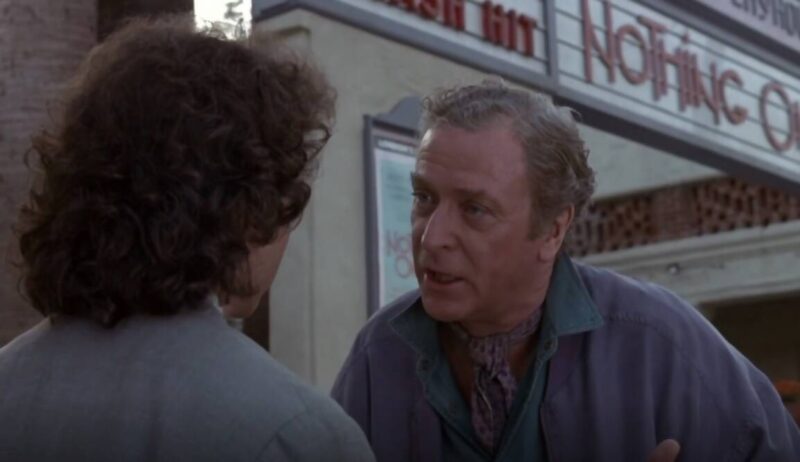
But he is forced back into the fray when Brooke contacts him, saying that she’s unhappy and has a doctor’s certificate for nervous exhaustion. They haven’t got the time to find and rehearse a new Vicky, so Lloyd has “just one afternoon, while Hamlet sees his shrink, and Ophelia starts divorce proceedings, to cure Brooke of her nervous exhaustion with no medical aids except a little whiskey, a few flowers […] and a certain fading bedside manner.”
Caine doesn’t get to do as much slapstick – or farcical door opening and closing – as his co-stars, but does get a cactus shoved up his bum by a jealous Garry who mistakenly thinks Larry is having a fling with Dotty. Then, as must inevitably happen to all actors in a farce, his trousers come down as the unfortunate Tim is made to remove some of the cactus spikes from his posterior.
Caine is great in this role. He has the believable authority of a director, and has great chemistry with all of his co-stars.
Although he started his career in theatre, Caine never returned to the stage after becoming a movie star. In his autobiography, What’s It All About, Caine writes, “I was once asked the difference for me between theatre, film and television. They were like three women, I said, the theatre was a woman I loved, but who didn’t love me back and treated me like shit.”
It’s a shame that he felt unloved by the theatre world as his performance here shows what the stage was missing out on.
Caine-nections: Caine also appeared with Denholm Elliott in Alfie (1966) and Christopher Reeve in Deathtrap (1982), which were also both based on plays, as was Sleuth (1972), California Suite (1978) and Educating Rita (1983).
Best Non-Caine Actor: I initially had reservations about the mostly American cast. I was unsure how the play’s original setting being moved from the provincial UK theatre scene to the States would work for such an intrinsically English farce.
After Caine, the second main cast member we’re introduced to is Carol Burnett as Dotty, whom we see performing as the sardine misplacing housekeeper Mrs Clackett. Her broad exaggerated English accent didn’t help assuage those initial concerns.
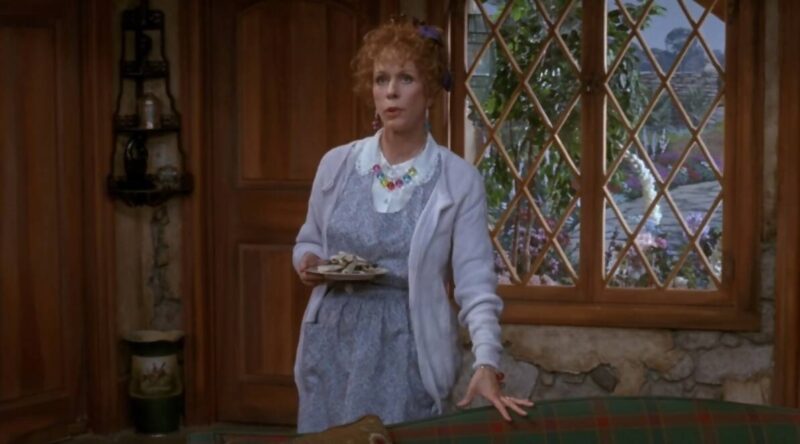
However, those fears proved unfounded. Burnett is playing a washed-up American actor of dubious talents, and so, as becomes clear, her shoddy in-show English accent is intentional. When we see Dotty towards the end of the show’s run, after being kicked through the stage door, and walking with a noticeable limp, she is completely distracted in her performance with very little attempt to maintain an accent.
Ultimately the whole cast won me over. Everyone gets at least a couple of laughs and a chance to shine. There’s genuine chemistry and a sense of camaraderie between them, which makes it feel like a real theatre company with a believable undercurrent of interpersonal drama.
John Ritter plays Dotty’s jealous younger lover, Gary. When he’s performing in ‘Nothing On’, he affects a camply posh English accent, even going a bit Austin Powers at times, especially during his innuendos.
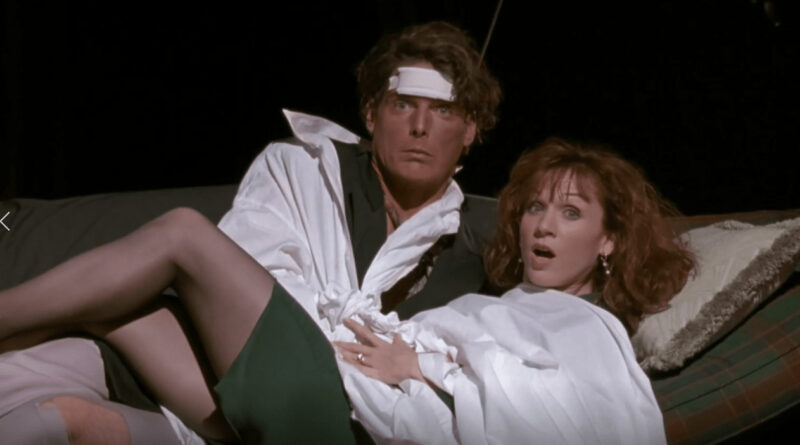
Ritter gets to perform much of the physical comedy, falling down staircases, nearly falling over the banister, swinging an axe, and brandishing a cactus with intent to maim. His work in the farcical studio sitcom Three’s Company obviously put him in good stead.
Another experienced sitcom actor, Taxi’s Marilu Henner, is equally amusing albeit in a subtler way. Her character, Belinda Blair, is ostensibly the least troublesome and seems to be the only one to actually enjoy her work. “This is such a nice company to work with, such a happy company,” she chirps. But she’s also a massive gossip and a bit of a stirrer.
Henner’s best work comes in the final section, as Belinda desperately tries to make sense of the rapidly unravelling play, with her ad-libbing: “How odd to find a telephone in the garden. I thought I better bring it in, somebody’s bound to want it!”.
Ritter and Henner, with their experience of performing comedy in front of a live studio audience, and Burnett with her extensive background in vaudeville, were obvious good fits for these roles. Christopher Reeve, on paper, is a less obvious comedic choice, but he fits in with the troupe perfectly.
After the indignity of Superman IV: The Quest For Peace (1987) Reeve had mainly starred in TV movies, but Noises Off is a great cinematic return to form, and demonstrates his often-forgotten range.
He is in more Clark Kent than Superman mode here, as a bumbling neurotic who gets nosebleeds at the sight of violence. He’s overly apologetic and self-conscious, such as when there’s a technical problem with the set doors. “Sorry folks, am I doing something wrong? You know how stupid I am about doors. As long as it wasn’t me who broke it!”
Reeve stoically handles hopping up stairs with his trousers round his ankles and a plate of sardines and a sheet of paper superglued to his hands. His seemingly unflappable dignity makes his performance all the funnier.
Rounding out the cast are a young Nicollette Sheridan as Brooke, who keeps losing her contact lenses and her clothes, and is the only actor who rigidly sticks to the script of ‘Nothing On’ no matter what is happening around her. She also has the best English accent, but that may be because she was playing an English character, and it turns out she actually was born in Worthing.
Julie Hagerty as stage manager Poppy, and Mark Linn-Baker as Tim who “hasn’t been to bed for 48 hours”, are fantastic at playing the frazzled backstage crew desperately trying to wrangle the unruly performers.
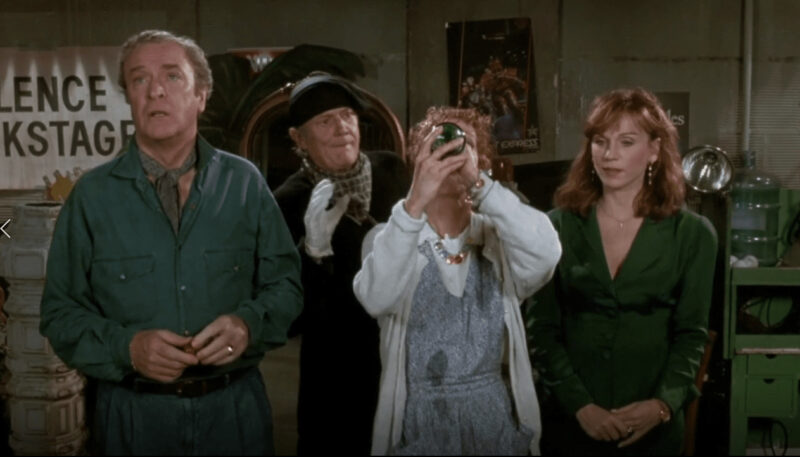
Special mention should go to the great Denholm Elliott who plays affable lush Selsdon Mowbray, who has selective deafness and a distinctive aroma. This was Elliott’s final theatrically released film, which adds unintended poignancy to his line regarding the opening curtain delays: “Some of the seniors out there haven’t got long to go.”
Although only 70, Elliott died just a few months after the release of this film, from complications of AIDs. According to IMDB (but I can’t find the original source, so it may not be true), Elliott had confided in Caine about his worsening condition, and Caine only agreed to be in the film if Elliott was also cast, knowing that it was likely to be one of Elliott’s final chances at a pay check.
Elliott’s bright and sprightly performance doesn’t betray how ill he was. We first see Selsdon after the cast and crew are panicking about his whereabouts, thinking he’s done a runner to the pub, but in the background we see him getting up from the auditorium floor where he’s been snoozing. “So, what’s next on the bill?” he asks.
“Well Selsdon, I thought we might try a spot of rehearsal,” Lloyd responds calmly.
“Oh, I won’t thank you.”
“You won’t?”
“No, you all go ahead, I’ll just sit and watch.”
Selsdon gets the last line of the play: “When all around is strife and uncertainty, there’s nothing like a good old-fashioned plate of sardines.”
These too ended up as being the last words spoken in Elliott’s film career. There could be worse ones to go out on I suppose.
Trivia (Courtesy of IMDB): Gary mispronounces “Mrs. Clackett” seven times; Mrs. Crockett, Mrs. Clockitt, Mrs. Crackitt, Mrs. Blackitt, Mrs. Sprocket, Mrs. Spratchit and Mrs. Slotchit.
In the play, Lloyd is directing a production of Richard III but it was changed to Hamlet in the film because it was felt that would be better known to American audiences who hadn’t seen Richard One or Richard Two.
Michael Caine, Carol Burnett, and the play’s author Michael Frayn were all born in 1933. At the time of writing all are still with us.
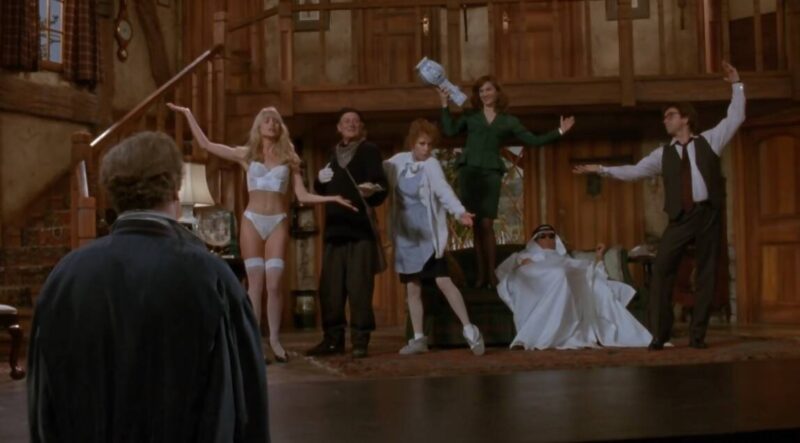
My Bleedin’ Thoughts: The acclaimed English play that this film is based on, Noises Off by Michael Frayn, was first staged at the Lyric Theatre in Hammersmith in 1982, and has had multiple successful revivals since on the West End and Broadway.
I’ve seen it myself on stage twice (this is me just wanting to show off that I’m classy and have been to the theatre). I loved it, but considering how intrinsically tied to the stage and live performance it is, and also after reading about the initial tepid reactions to the film adaptation, I admittedly had trepidation about this movie version.
Being amidst a full laughing theatre audience adds greatly to the play’s enjoyment, and although the frenetic comedic choreography is still impressive on film, and there are plenty of long takes to show this off, it doesn’t compare to seeing the whole thing live where there can be no sneaky edits or opportunities for re-takes.
For a critically acclaimed filmmaker, Bogdanovich’s work hasn’t had the cultural staying power of many of his peers, although Irish musician CMAT did do a good song inspired by his personal life recently.
I’m a voracious movie watcher, but have only seen two of his other films, The Last Picture Show (1971) and What’s Up, Doc (1972), and so he’s not a director that I automatically have confidence in, since I’m mostly unfamiliar with his wider work.
However, Noises Off clearly demonstrates his talents as it’s a very confident and mostly successful adaptation. It’s always going to work best on stage, but this made a bloody good go at transferring it to the cinema and Bogdanovich gets excellent performances from all of his cast.
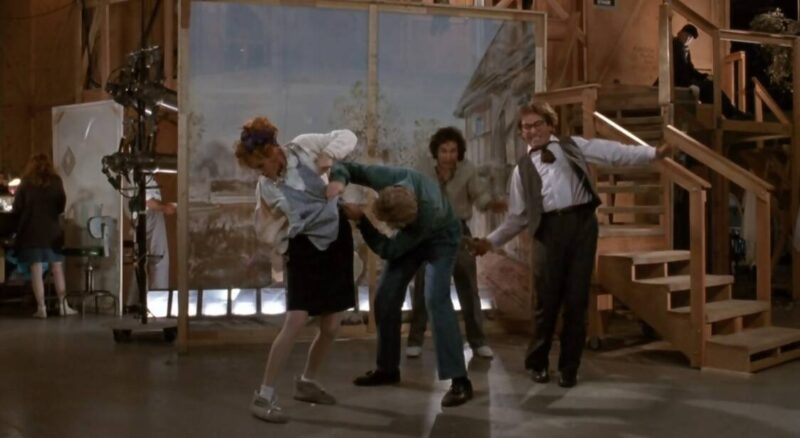
The high point is the chaos of the film’s middle section, which focuses on the backstage antics of the production during the height of Dotty and Gary’s relationship troubles where Gary, who has got the wrong end of the stick, seems intent on killing his co-stars, and there’s lots of funny business with whiskey bottles and fire axes.
The film’s only creative misstep is the unearned happy Hollywood ending. The play ends at the close of the third act’s disastrous performance, with the accidents, errors and adlibs reaching a delirious fever pitch.
The film carries on after this to the play’s miraculously successful Broadway debut where, outside of the theatre, Lloyd can hear laughing and he goes inside to see a full audience unironically enjoying the play, whistling and clapping with shouts of “Bravo” as the curtain falls.
“Yes! I did it!” Lloyd exclaims. “All my wonderful cast, I knew we’d make it, never doubted it for a moment”.
Then we see the cast pair off and kiss each other; Belinda and Freddy, Brook and Garry, and even Selsdon and Dotty, even though that particular pairing doesn’t make any sense.
Then we cut to Poppy happily dressed as a policeman with a pregnant belly.
“Oh yes, by the way, another funny thing happened on the road,” Lloyd says and, whilst joining his cast and crew for their triumphant curtain call, he shows off his and Poppy’s wedding rings.
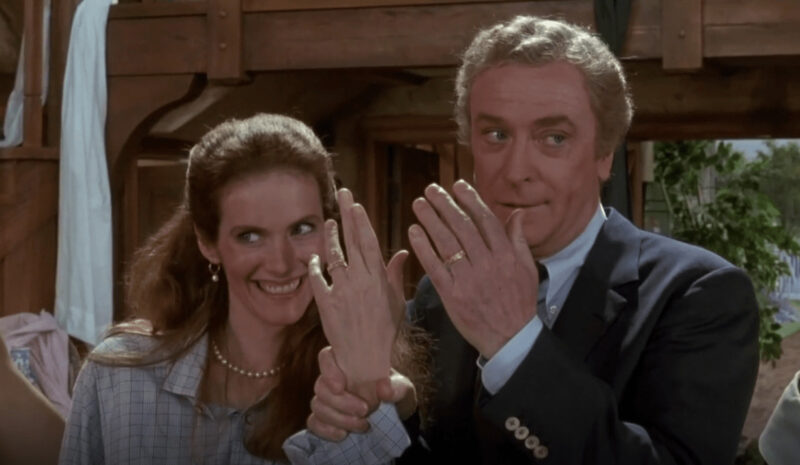
It’s a much funnier, and more apt, ending when it finishes with the play being a disaster. I seriously doubt the characters that we’ve been watching were capable of pulling off even one moderately successful performance. The new ending doesn’t spoil what’s come before it, but it does mean that it closes with more of a whimper than the bang of the stage ending.
The film’s added opening and middle sections of Lloyd fretting about the Broadway performance are fine, but are also not particularly necessary additions and consequentially the least funny parts.
Although I really enjoyed this movie, I’d argue that the best spiritual cinematic adaptation is 2017’s One Cut Of The Dead. I’m not sure if that film’s director, Shinichirou Ueda, was influenced at all by Noises Off but, without giving away too much, it’s basically if Noises Off was about the making of a low-budget zombie movie rather than a stage play, and so suits its medium better.
Noises Off was sadly a commercial flop on release and received middling reviews, but looking at more recent comments on Letterboxd it now seems to be finding the more appreciative audience that it deserves.
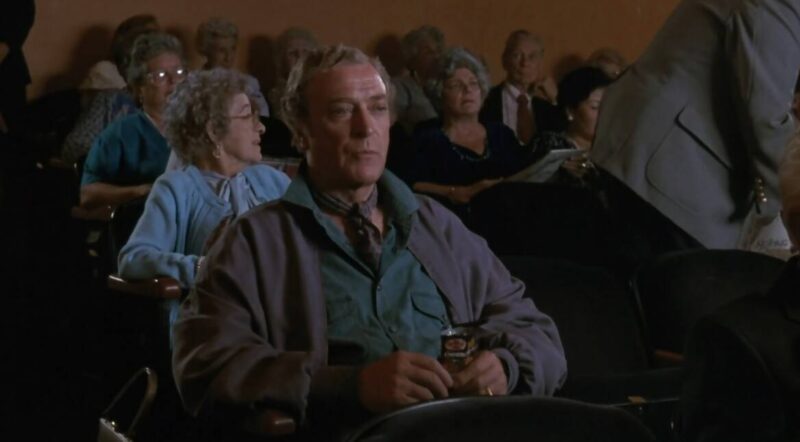
Overall Thoughts: Not quite as good as its truly excellent source material, but still very funny, with great comic performance. Underrated and definitely worth seeking out.
Rating: 4/5 Misplaced Plates of Sardines
Where You Can Watch This: This is available on DVD or to rent or purchase digitally from all the usual places.
Up Next: It’s Blue Ice! Is it about the troubled invention of the Tango Ice Blast? The poster has Caine holding an Uzi while embracing Sean Young, so perhaps not, but we’ll find out together next time!