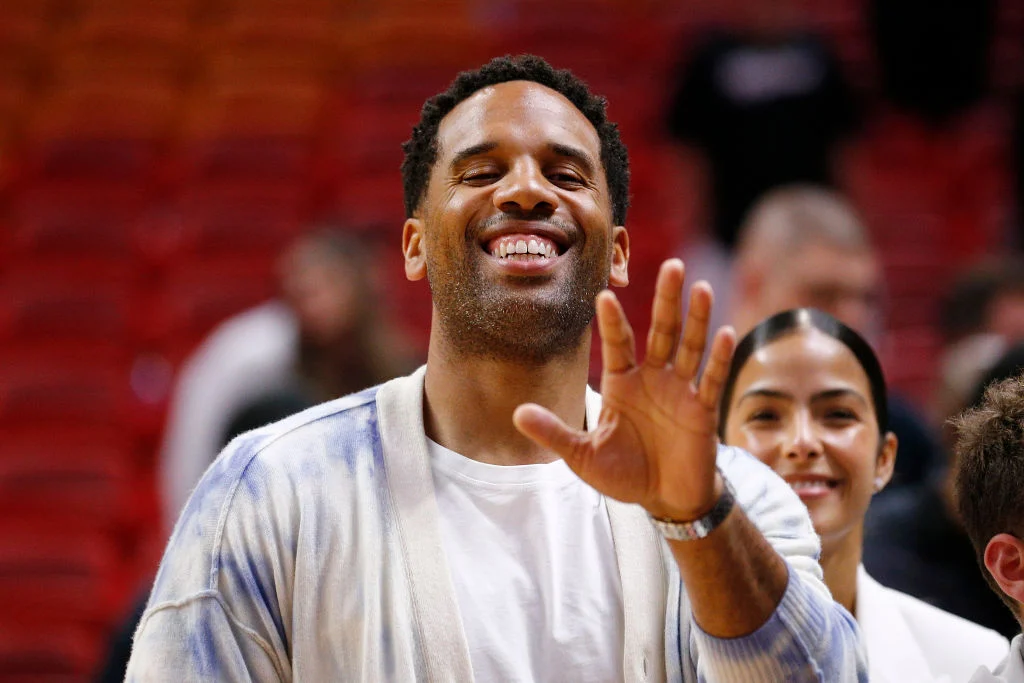

Maverick Carter, LeBron James’ childhood best friend and business partner, was previously in a relationship with a woman named Crystal Streets. I’d love to tell you how long they were together or if they were ever legally married, but there is surprisingly little info about their relationship online. Crystal is not mentioned on Maverick’s Wikipedia page, and there is literally not a single photo of them together on Getty Images.
I do know that Maverick and Crystal have a child together, an 18-year-old daughter. I know that because Maverick recently filed a petition requesting to make a small adjustment to his monthly child-support obligation. Specifically, he would like to adjust it from $25,000 a month to…
$0
Crystal has a somewhat different proposal. She would like the monthly payment increased to $35,000.
And as part of her argument for why Maverick can afford that amount, she gently pointed out something rather important: She claims he’s worth more than $100 million.
But before this starts sounding like a story about a centimillionaire trying to save a few bucks on his daughter, Maverick’s actual argument is a little more complicated…

(Photo by Michael Reaves/Getty Images)
From $25,000 A Month To Zero
According to court documents obtained by TMZ, Carter currently pays Streets $25,000 per month in support for their daughter. Their daughter turned 18 in July and is enrolled full-time at a boarding school, which Carter says he pays for in full. He also claims that he directly covers everything else his daughter needs.
His argument is essentially that the old child-support arrangement no longer reflects reality. Their daughter spends most of her time living at school, and Carter claims Streets therefore has relatively little physical custodial time with her. In other words, Maverick isn’t arguing that his daughter is 18 and therefore suddenly on her own. He’s arguing that he already pays for her school and other expenses directly, so sending another $25,000 every month to her mother no longer makes sense.
Carter, who is represented by famed divorce attorney Laura Wasser, has therefore asked the court to eliminate the monthly payment entirely.
She Wants $35,000 A Month
Streets strongly disagrees. She says her daughter’s enrollment at boarding school does not mean she has stopped parenting, arguing that she continues providing emotional support, coordinating travel and tending to her daughter’s needs even while she lives away from home.
Rather than reducing the existing $25,000 monthly payment, Streets wants it increased to $35,000 per month until their daughter graduates. According to Streets, the two sides had actually agreed to that higher amount previously, although the agreement was never finalized.
That’s where Maverick’s finances became particularly relevant. In her court filing, Streets claimed Carter has a net worth of more than $100 million.
For perspective, $25,000 per month works out to $300,000 per year. Streets’ requested $35,000 would equal $420,000 per year. Maverick’s requested amount is, of course, $0.
A hearing was held on September 15. The court has not yet made a final ruling, but it temporarily suspended Maverick’s child-support payments for three months while considering the issue.
There also appears to be some genuine hostility between the former couple. One alleged email included in the court documents shows Carter telling Streets in December 2025:
“Dealing with you is the only thing bad about my life, and I’ll be soooo happy when it’s over.”
So… things seem to be going great.
Is Maverick Carter Really Worth $100 Million?
This is where the story gets especially interesting for us. Maverick Carter isn’t simply LeBron James‘ childhood friend who happened to land an incredible job managing a superstar. He has spent more than two decades building businesses alongside LeBron and accumulating his own ownership interests in sports, media, entertainment and private companies.
Carter, James, Rich Paul and Randy Mims originally created LRMR, the business operation that took control of much of LeBron’s marketing and commercial strategy. Carter helped negotiate LeBron’s landmark lifetime agreement with Nike, a deal that has often been described as potentially worth more than $1 billion over its full duration.
He and LeBron also pursued a strategy that became increasingly common among elite athletes: don’t just take the endorsement check, ask for equity. That strategy gave them interests in companies including Beats Electronics and Blaze Pizza.
Beats was co-founded by Jimmy Iovine and Dr. Dre. Apple acquired the company for approximately $3 billion in 2014. LeBron reportedly made tens of millions of dollars from his stake, although Carter’s individual ownership and proceeds have never been disclosed.
Then there is Fenway Sports Group. In 2021, Carter and LeBron became partners in FSG, whose holdings have included the Boston Red Sox, Liverpool F.C., Pittsburgh Penguins and other sports assets. Once again, Maverick’s individual ownership percentage has never been publicly revealed.
He also serves on the board of Live Nation Entertainment and owns a serious piece of Los Angeles real estate. In 2021, Carter paid $9.3 million for a large estate in Santa Monica.
Put all of that together and $100 million does not sound remotely absurd. But there’s one asset that needs a giant asterisk.
Remember When SpringHill Was Worth $725 Million?
In 2021, The SpringHill Company, the media business founded by Carter and LeBron, raised money at an eye-popping valuation of $725 million. That funding round included investors such as RedBird Capital Partners, Fenway Sports Group, Nike and Epic Games, while Carter and James retained control.
At the time, that valuation generated some extraordinary paper net-worth calculations. In fact, when Forbes declared LeBron a billionaire in 2022, it assigned roughly $300 million of his net worth to his estimated ownership stake in SpringHill.
We’ve previously explained at length why we don’t think that math held up. SpringHill’s $725 million number was a private fundraising valuation reached during the ultra-low-interest-rate investing frenzy of 2021. It was not $725 million sitting in a bank account, and it did not mean every owner could actually sell their shares at the implied valuation.
The years that followed made that distinction especially important.
The SpringHill Hangover
SpringHill generated substantial revenue, but leaked financial information later revealed that it was also burning significant amounts of cash. The company reportedly lost $17 million in 2022 and another $28 million in 2023, for a combined $45 million in losses over two years.
Meanwhile, Hollywood’s streaming gold rush cooled dramatically. Media companies began cutting budgets, investors became much less willing to fund loss-making content businesses, and SpringHill’s standalone future started looking considerably less glamorous than its $725 million valuation had implied.
Some of its heavily promoted projects also failed to become major commercial blockbusters. “Space Jam: A New Legacy” grossed around $163 million worldwide against a production budget of roughly $150 million before marketing expenses. “House Party” generated only around $9 million globally, while much of SpringHill’s other output shifted toward streaming, documentaries, unscripted programming and branded content.
There were successes. The Adam Sandler basketball movie “Hustle” was well received after its Netflix release. But producing respectable streaming content is very different from building a media company capable of supporting a $725 million valuation.
By late 2024, SpringHill agreed to merge with British production company Fulwell 73, whose partners include James Corden and whose productions have included “Carpool Karaoke” and “The Kardashians.”
Importantly, this was not a blockbuster sale of SpringHill for anything resembling $725 million. It was described as a cashless merger of equals.
The combination closed in 2025 and created Fulwell Entertainment, with Carter and Fulwell executive Leo Pearlman serving as co-CEOs. SpringHill’s brands survived inside the larger company, but its former $725 million standalone valuation should not be treated as though it remains intact today.
Which brings us back to Crystal Streets. Her argument essentially boils down to: this man is worth more than $100 million, so why are we discussing reducing $25,000 a month to zero? Maverick’s response is effectively that net worth is beside the point because he already pays for everything their daughter needs directly.
That’s the issue the judge now has to sort out. For the moment, Maverick has received at least a temporary version of what he requested because his $25,000 monthly obligation has been suspended for three months while the court considers its ruling.
So for now, the numbers are:
- Crystal’s request: $35,000 a month.
- Previous payment: $25,000 a month.
- Maverick’s request: $0.
- Estimated net worth: $100 million.
Quite a spread.