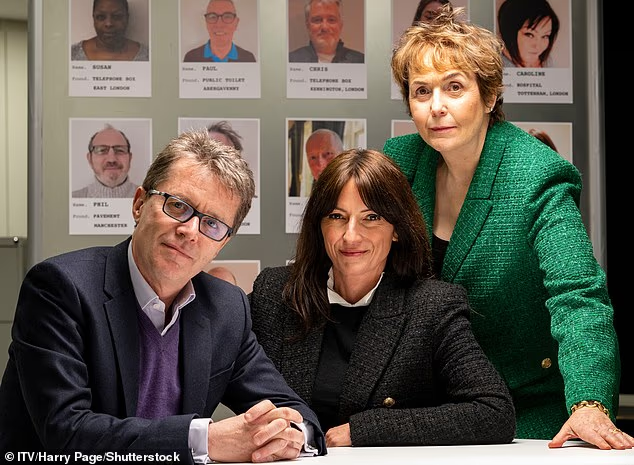

Ariel Bruce solves mysteries and reunites siblings, daughters, sons, mothers and fathers for the ITV show Long Lost Family, with spectacular success. She’s been called ‘the Agatha Christie of the adoption world’, but in fact a better comparison would be with Christie’s sleuth Miss Marple.
‘Some cases are extraordinary because they’re spooky and ask unanswerable questions about nature and nurture,’ says the post-adoption specialist, who has been working on the series since it began in 2011.
‘For example, what do we make of the two men who both worked in the same most specialised area of medicine and knew each other from conferences, but had no idea they were half-brothers?’ Then there are the wins that tug the heartstrings. ‘A lady of 86 finds her long-lost daughter, who is 68,’ says Ariel. ‘They make a relationship, at last. That touches me emotionally.’
Presenters Nicky Campbell and Davina McCall may host the tearful reunions on camera for the highly charged BAFTA-winning show, but Ariel and her team are the ones who have carried out 1,320 searches over six continents in the programme’s 15 years and 16 series. In that time they have arranged a staggering 887 reunions – including brother and sister Anita and Richard, who appear in a new run of episodes on ITV1 and ITVX.
Anita Rowntree was eight when she found a photo of a little boy in her mum’s wardrobe, while rooting around for Christmas presents. There were baby tags too. It soon emerged that her mother Judy had given birth at the age of 16. The father disappeared. Judy met a young man who offered to bring up the baby as his own, but he was refused.
‘She was sent away by my nan to the mother and baby home,’ says Anita. ‘My nan did not want to see her until “that thing”, as she called it, was got rid of. It was the worst day of Mum’s life. She hated saying goodbye to him.’

Ariel Bruce, right, solves mysteries and reunites siblings, daughters, sons, mothers and fathers for the ITV show Long Lost Family, presented by Nicky Campbell and Davina McCall
Judy married the boy who had been prepared to stand by her and a year later gave birth to Anita. Three other siblings followed. Now, all these years later, Anita is trying to find her long-lost brother. ‘It would be so good to let him know how much he’s loved,’ she says. ‘It would be such a weight off my shoulders, then Mum can rest in peace.’
Astonishingly, some of the answers Anita is looking for are just down the road from her, as we will discover in the episode. ‘Sometimes the results of what we do are neat and marvellous, and in a relatively short time everybody goes off into the sunset and they’re fine,’ says Ariel.
‘But sometimes the search can go on for years.’ Ariel herself was born in Hampstead, north London, in the 1950s. Did she have any personal experience of adoption that drove her into this work? ‘Not adoption, but I was in the care of the local authority for some years,’ she says. ‘I ended up with rather splendid foster parents, who I thought of as parents.’
Ariel raised her own family, and then became a post-adoption social worker. ‘The work combined complex searches and the need to be logical and rational about research with an awareness of its emotional importance for people,’ she says. She already had 25 years of experience when Long Lost Family came calling.
‘By being involved at the beginning, I was able to be part of how we set up proper duty of care for people. Our intermediary role is governed by a strict legal framework so it’s important we separate the social work from the requirements of making a TV show.’
It’s a TV show that changes lives, that’s for sure. ‘We recently had a film about a foundling, a young woman. Her birth father, who I identified through DNA, said to me that he wasn’t interested. That was that,’ says Ariel. ‘The day after the film went out, he contacted me to say he’d watched it and, actually, he would welcome contact with her. So things change.’

Anita Rowntree was eight when she found a photo of a little boy in her mum’s wardrobe, while rooting around for Christmas presents

In south London, in Anita’s episode, Davina tells her that her long-lost brother Richard has been found, just seven miles away
What changes has Ariel, who stepped back to act as a consultant two years ago (her place as search team lead has been taken by her daughter, Lottie Bruce-Lloyd), seen in her time?
‘The biggest has been the use of DNA. Back in the day, if a foundling asked me to try to find something about their family, it was impossible,’ she says. ‘When people didn’t know who their birth father was, again, that was impossible. DNA has completely transformed that landscape.’
Now, thanks to genetic testing, people are being found. ‘On a personal level, I’ve been able to resolve the searches of foundlings who first came to me when they were 20 years old and I couldn’t help. They are now 45 or 50. That’s been quite amazing.’
In south London, in Anita’s episode, Davina tells her that her long-lost brother has been found, just seven miles away. Her first response is a question: ‘Is he well?’ Then, with brimming eyes and a hopeful heart, as if on behalf of all those who have been helped over the years by Ariel, ‘Does he want to meet us?’
How you can trace your long-lost family
Where do you start if you want to find a long-lost family member, or trace your own family of origin? ‘If you want to trace a person who’s been placed for adoption, you have to find an adoption support agency,’ says Ariel.
‘If an adopted person wishes to trace their family of origin, there are public records. Go to your local authority, where you have a right to ask for birth records. If you don’t know what your birth name was, your local authority fostering adoption team will help you find that. There is a process and it is free.
‘Once you have discovered the name, there are public records of births, marriages and deaths on sites like Ancestry, or many local libraries have access to them. You are entitled to apply for your adoption file. Sometimes they don’t exist, or are inaccurate. Remember that prior to 1976, when the law changed, there was never a view that these files would be of use again after an adoption, or be seen by the adopted person.
‘If you do find someone, it’s always best to use an intermediary,’ Ariel continues. ‘Go back to your local authority and see if they will assist you. Otherwise, there are registered individuals who can do it.’
Long Lost Family, Thursday, 9pm, ITV1. All episodes are on ITVX.