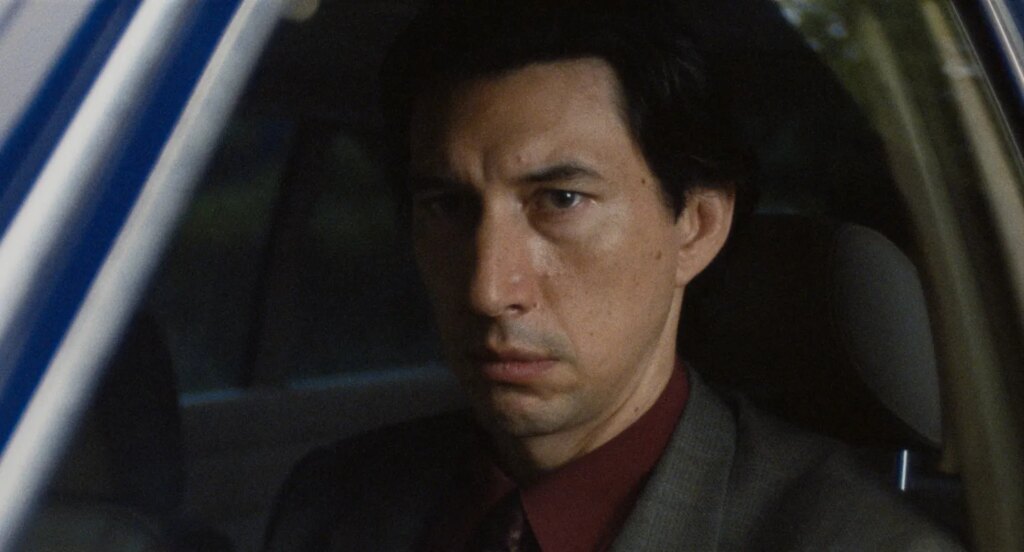

That’s probably why both of their sons idolize Adam Driver’s Gary, a former NYPD detective who made his fortune through nebulous business deals and now comes to the house with stylish suits, stylish stories, and even a chic service revolver fashionably strapped to his leg. On one such Sunday dinner, he also brings a business opportunity for his little brother: help do some consulting work for new Russian entrepreneurs cleaning up the Gowanus Canal and pocket a lot of extra cash. Unfortunately for all parties, Irwin is a little too eager to prove his usefulness to both Gary’s business associates and his boys. Hence why he takes the kids one evening down by the canal to show them what daddy does… and instead gets all of them in the sights of some incredibly scary thugs—the kind who will point a gun at a child, slap the boy’s father so hard he bleeds, and hen keep his driver’s license.
“Now we know where you live,” the bad man warns. And he’ll come calling after his boss tells Gary the next day that they need assurances neither Irwin or his sons would ever do something so foolish as to tell anyone, even Hester, about what they saw.
While watching Paper Tiger at the New York Film Festival last week, I was reminded of any number of classic morality plays about the nuclear family under siege. Films like Shane or The Desperate Hours. At the premiere, Gray put a finer point on it when he named Alfred Hitchcock’s second stab at The Man Who Knew Too Much in 1956 as an influence. They’re stories about “typical” hearth and kin finding itself bewildered by forces beyond comprehension. But all of those films came with some degree of Hollywood reassurance and censorship. Just as how the more modern crime film has its familiar beats about rot belying the fantasy, these are tales of normalcy and “order” reasserting itself in the face of unnatural disruption.
What makes Paper Tiger so evocative is how Gray introduces tense, even pulpy thriller elements to his character-driven dramaturgy, but he does not diminish or ignore the human element in the process. It is in fact how real this scenario plays out that makes it absolutely terrifying when Irwin is awakened in the middle of the night to what sounds like an old Polaroid camera’s flashbulb firing up while he and his wife are sleeping—or just how vulnerable even tough-talking, worldly Gary can appear when he enters a field of tall grass, all alone in the world as an unknown number of stalkers trailing his movements vanish into the weeds behind him.
The grueling dread in both of these harrowing set-pieces is borne out of exquisite performances by Driver and Teller. The former remains one of the most fascinating actors of this era, but it’s been a long while since Driver starred in a movie this good. All cocksure swagger, Driver’s portrait of Uncle Gary is of a proud self-made man whose outer-borough boasting is always just a little too loud, his smile a smidge too flashy, and his comforting reassurances to the nephews a little too insistent. He is out to prove his place in the world, which cuts a strangely lonely silhouette, like a quarrelsome squirrel hanging to a cracking tree branch in the depths of winter.
Teller, meanwhile, seems to have discovered an unlikely sweet spot as an actor in the last year between this film and the A24 comedy Eternity: he is excellent as the nebbish, mid-20th century putz who seems perpetually baffled by the world around him. Opposite Driver, the two create an archetypal sibling rivalry, but also a more understated admiration that gives their corresponding jealousies teeth.