
“In medieval Irish literature he’s the master seanchaí, master judge, and master poet, the oldest man, the first inhabitant of Ireland. He’s called in for disputes for his knowledge, his understanding. He is able to change forms into a salmon, an eagle, and a hawk.”
Shape-shifter Fintan mac Bóchra, otherwise known as Goll Essa Ruadh, has lived many lives in human and animal form. Arriving in Ireland with Noah’s granddaughter, he is reputed to have survived the Biblical flood and witnessed the coming of the Fir Bolg and Tuatha Dé Danann.
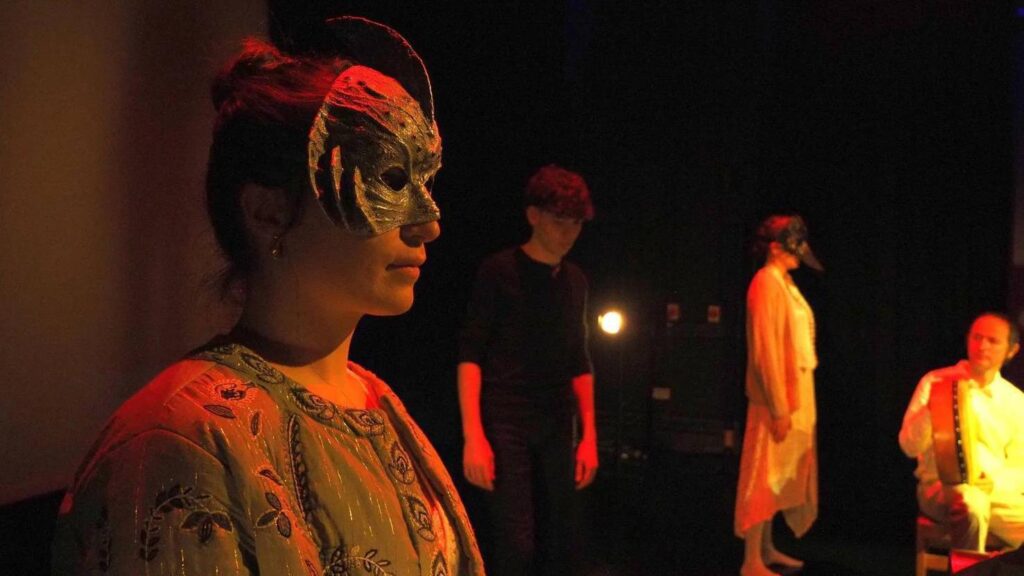
This weekend, Fintan and his stories undergo another transformation as they are reimagined in poetry, music, dance, film, and drama in a bilingual multimedia production at Cork Arts Theatre.
created by Strive Theatre and Cork band MacBóchra, plunges audiences into the darkness of a post-deluge Ireland, turning the theatre into an “imaginative, dreamlike space” which, says scriptwriter Brendan Duffin, is “analogous to a seanchaí sitting in the dark by the fire”.
“My main focus is trying to bring the huge wealth of stories into the contemporary, out of archives and academic research, in my own way trying to be a bridge into popular culture,” he says.
It was Duffin’s research while studying folklore and music at UCC that sparked his fascination with Fintan, his major study, ‘An Scéalaí’, being a precursor to
“I’ve always had an interest in seanchas or Irish myth and the more I read about this character, the more he interested me. UCC kind of turbocharged my interest in this material but I’ve been writing since a teenager,” says Duffin, who grew up in Loch Beg in rural Antrim. “I started off as a poet so I suppose I have an ear for a good yarn.”
Fintan was, he says, “central to medieval literary culture but he also had this liminality — he was able to pass outside the human world into the ancestral realm, or that’s how I view him, so I found the combination of liminality and centrality very interesting”.
As to Fintan’s identity, “there’s a number of theories”, says Duffin. Appearing in medieval ‘rememberer tales’, Fintan is thought to have been used as a narrative device, giving credibility as first-hand ‘witness’ to events predating historical records, his longevity and shape-shifting allowing him to relay information on return to human form.
“He could have been a pre-Christian deity that was connected to a salmon cult perhaps, in the Boyne. There’s overlap with Fionn MacCumhaill and he is compared to the Salmon of Knowledge in a 16th-century text. Other people say it’s an invention of the medieval Christian period.
“Fintan and his wife Cessair appear to have been the primordial couple, an echo of the Old Testament,” says Duffin, who adapts the story of their arrival as Ireland’s first human inhabitants in the opening tale in a sequence of six told in .
Fintan and Cessair feature in the or , in which they are said to have reached dry land in Dún na mBarc near Bantry, notes UCC Department of Early and Medieval Irish lecturer Dr Emma Nic Cárthaigh, who was “invaluable in the making of Goll”, says Duffin. Her translations form part of the show, which spans English and early, middle, and modern Irish.
At its premiere at Macroom’s Briery Gap in February, “there were a few hardcore mythologists who said they understood all of it”, says Duffin, who is currently learning modern Irish. For the majority in the audience though, listening to medieval Irish is “about the rhythm, the sound” rather than following a narrative.
For Duffin, who after eight years consulting academic research on Fintan, completed the show’s script this January, the creative challenge was to present the tales for modern audiences. “How can we bring these stories into a world that has had internet, cinema, television, video?” he asks.
“We’re trying to fuse together different art forms. I enjoy the adaption process and the challenge of trying to bring the richness of the material, which is so highly wrought, to translate that into the show and bring that to people in a way which is engaging, exciting, and they come out of the theatre with something to think about.”
Incorporating film footage of floods and referencing the M3’s construction near the Hill of Tara, ’s experimental theatre experience attempts to “honour what went before but also to speak to the concerns of this time”, says Duffin, who performs as a member of both Strive Theatre and the band MacBóchra. “This is our turn now. In our own small way we’re trying to carry the story on.”
- , directed by Ciarán MacArtain, Cork Arts Theatre, October 2-4. Tickets corkartstheatre.com