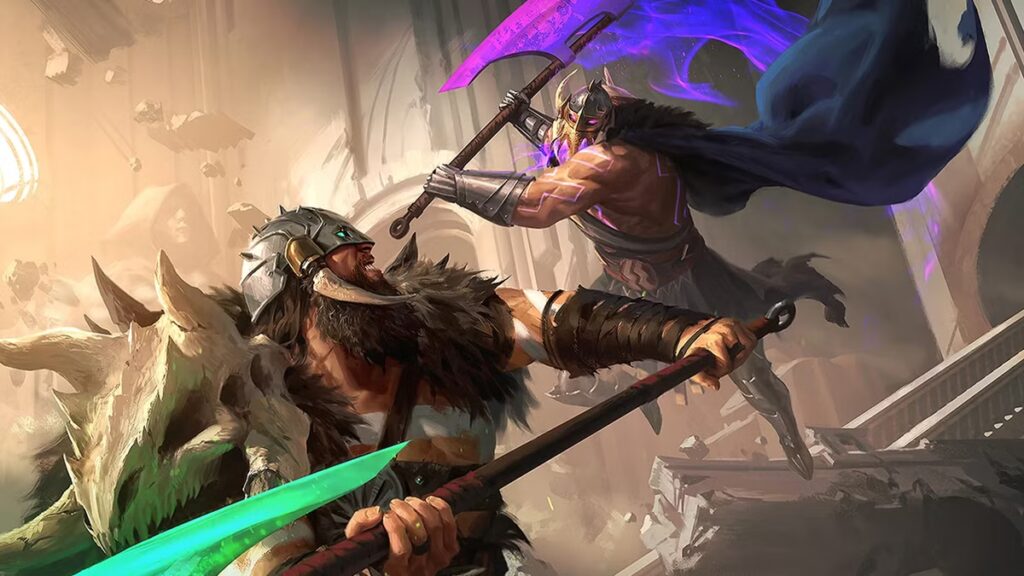

I hadn’t looked close enough at all the individual cards in Magic: The Gathering’s latest expansion, Reality Fracture, before I started opening packs, which may have been the best possible way to experience the new set.
Almost every pack contained something that made me stop and think, Wait, which one of my Commander decks wants this? That sensation is a major reason Reality Fracture has quickly become my favorite Magic set in a long time: because it’s fun to open, and because it forced me to remake basically every deck in my rotation. The cards are just that good.
Reality Fracture makes every pack feel unusual
The set’s echoed-pairs system gives every play booster its own mini-narrative. Each pack contains two “Echoed Pair” cards: one character from the traditional Magic Multiverse and an alternate version from Jace’s Echoverse. That means opening a pack feels like discovering a collision between timelines, or at the very least a familiar hero and their evil alt-reality doppelgänger.
Beyond the echoed cards, there is a traditional rare-or-mythic slot and a foil slot that can contain another rare or mythic card. Under the right circumstances, it is theoretically possible to open four mythic rares in a single pack. That’s obviously not going to happen often, but knowing it could happen adds some extra spice to the experience.

One of my best echoed pairings included the Echoverse verse of Garruk, Veiled Butcher as a wonderfully nasty black Planeswalker. He forces players to sacrifice creatures and discard cards. Even his +2 loyalty ability can destroy weak creatures or at least severely nerf them by giving them -4/-1. But Garruk, Curse Breaker was the card that immediately found a home for me. My Multani, Maro-Sorcerer Commander deck is filled with big creatures, but it needs blanket trample effects to help Multani actually damage opponents (he comes with shroud inherently, and his power and toughness are equal to the total number of cards in all players’ hands). Curse Breaker draws cards whenever my creatures with power 4 or greater enter, creates its own 4/4 Beasts with trample, and can give all of my creatures +2/+2 and trample with his -4 loyalty ability. That’s three separate things my Multani deck wants on a single card.
Ghalta the Unstoppable joined it almost immediately for many of the same reasons. As long as I have something with 8 power in play (which is Multani most of the time), that means Ghalta costs a single green mana to play for an 8/8 — and he gives all of my other creatures trample.
Verdant Kraken came close to finding a place in Multani as well. While it costs a staggering seven mana for a 6/6, Verdant Kraken creates a 3/3 green forest tentacle land creature token at the beginning of each players’ upkeep (that’s four times every round!). So you get a sizable token body that’s also a land. That’s even better for my Toph, Hardheaded Teacher deck, which is a strange midpoint between Gruul (red-green) ramp/landfall synergies with Lesson spellslinger vibes that emphasizes earthbending. This version of Toph earthbends 1 every time you cast a spell, doubling that number if the spell in question is a Lesson. It may sound unfocused, but somehow it works really well.

For echoed pairings, I also opened both versions of Vraska, the gorgon Planeswalker who previously lost her Spark. Vraska, Soul of Stone is one of the more interesting new Commanders I’ve seen from this set. She’s an artifacts-matter Jeskai (blue-red-white) creature that gives all of your artifact creatures Vigilance and creates 1/1 Sculpture Treasure artifact tokens whenever you cast a noncreature spell. Those are weak token bodies that you can also sacrifice to generate mana, just like a regular Treasure. If I didn’t already have an Izzet (blue-red) Tony Stark // The Invincible Iron Man artifact deck, then Vraska would be my next experiment.
The gorgon’s main-Multiverse counterpart, Vraska, the Cutting Glare, immediately made me consider finding it a spot in my Jenova, Ancient Calamity deck. Jenova can place a +1/+1 counter on Vraska to turn her into a Mutant, while Vraska offers a 4/4 deathtouch body that can destroy any opposing permanent once I control six lands. She may ultimately be too much of a generic Golgari goodstuff card to earn a slot, but that tension became typical of my experience opening Reality Fracture: Almost every pack gave me something new to debate.
Even Reality Fracture’s lower-rarity cards demand attention
The sheer number of Commander-worthy cards across every rarity impressed me far more than any individual mythic.
Tetsuko Umezawa, Fugitive might be an uncommon reprint dating back to Dominaria, but it makes your creatures with power or toughness of 1 unblockable. That’s one of the strongest upgrades imaginable for my Astonishing Ant-Man deck which literally just creates an army of 1/1 ants. Variable Chaser, a rare, has the prepared spell Arc of Fortune that allows each player to discard their hand and draw seven cards. Considering the fact that Ant-Man gets +1/+1 every time I draw a card, that’s a slam dunk.
Everybody’s already clocked that Flickering Hound — an echoverse variant of Displacer Kitten — is one of the set’s best rares, allowing you to exile one of your creatures in play and return it to the battlefield every time you cast a creature spell. It’s perfect for my Yuna, Hope of Spira deck, which is all about saga creatures and enchantress synergies. Blink effects like this mean I can re-trigger Final Fantasy summon saga chapters.
For similar reasons, another slam dunk for Yuna is Rescue Girl, First Responder (which comes paired to Massacre Girl, Most Wanted). Both cards are uncommon, and while this version of Massacre Girl is great for black decks that like to ping damage, Rescue Girl feels tailor-made for my Yuna deck. Yuna recurs an enchantment from your graveyard to the battlefield with a finality counter on it at the end of every turn. Say I do this with a saga creature that’s already expired. Because of the finality counter, they’re exiled if they die or expire again. But if I tap Rescue Girl to return that saga to my hand, that wipes the finality counter. I can then replay it, let it expire, and have Yuna pull it out of my graveyard all over again.
-
 Image: Wizards of the Coast
 -
 Image: Wizards of the Coast
 -
 Image: Wizards of the Coast
Another echoed pairing with huge value in uncommon rarity: Pia, Aether Ascetic in green and Pia, Determined Rebuilder in red. The green version lets you discard a card upon entering to search your library for any enchantment and put it into your hand. Another Yuna slam dunk. Red Pia has potential as a Thopter artifacts Commander in her own right, but her expensive bottom ability gives a creature +X/+0 based on the number of artifacts you control for a cost of six mana. And since it’s not a tap ability, you can do that twice if you have the 12 mana to spend. That’s a game-ending move if you play your cards right. She’d be great with Vraska, Soul of Stone — or in my Iron Man deck.
Even a two-cost common like Something Worth Saving feels worthwhile in my Yuna deck since it mills four cards, returns one of them to my hand, and gains 1 life. The self-mill and lifegain feed two of Yuna’s core strategies simultaneously. Another common, Memory Trap, is essentially another version of Banishing Light, a solid exile-based piece of removal for decks that care about enchantments.
Thalia, the Survivor is more is one of those generically useful uncommons, especially for players that like to make their opponents groan out of frustration: a four-cost 3/4 with lifelink that simply makes every noncreature spell an opponent casts cost an additional mana. If you like taxing your opponents like this in Commander, then it’s a solid inclusion.

I could go on and on like this when it comes to Reality Fracture. With so many sets, I tend to shuffle through the commons and only slow down at the uncommons. Even then, more often than not, it’s only some of the rares and mythics that find their way into my preexisting decks. But with Reality Fracture, I wound up with a decent-sized stack of prospective additions for just about every deck I’ve got right now.
For Commander players with a wide variety of decks, Reality Fracture feels like one of the few sets that’s worth buying packs of rather than just hunting for the singles. There’s just that much in here.
That’s about as rewarding as opening boosters gets.