
Picture the scene if you will. It’s Christmas morning in 1950s America, snow is falling, Bing Crosby is crooning carols on the wireless, and a family is gathered around a tree with presents arranged beneath.
Having grown out of little league baseball and lost interest in push bikes, Johnny has been begging his parents for an electric guitar and it looks like his dreams are about to come true.
Johnny has promised his parents that he will take lessons and learn those wholesome standards they so enjoy. But we all know that will never happen because Johnny has been secretly listening to Elvis and Chuck Berry, and his family doesn’t know what’s about to hit them.
Latest Videos FromGuitar World
No doubt countless guitar-playing journeys started with fortunate kids tearing wrapping paper off a Fender Esquire and a Champ, or a Les Paul Junior and a GA-5. They were the relatively affordable products that the manufacturers of the time marketed as ‘student models’. But the most remarkable thing about those guitars, and to a lesser extent the amps, was that many were good enough to become career instruments.
Maintaining Standards
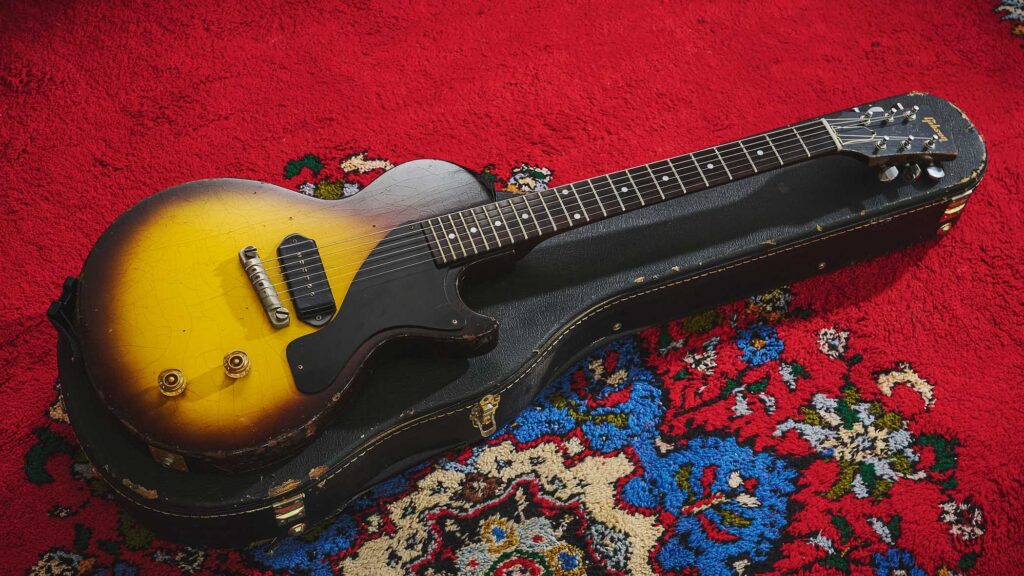
A degree of compromise followed by a series of upgrades is pretty typical with modern entry-level guitars, but things weren’t always like that and Gibson’s 1950s student models are a case in point. In 1954 the Les Paul Junior became Gibson’s second solidbody and it predated the two-pickup Special by a year.
When designing a more affordable version of the Goldtop, Gibson clearly decided to simplify the production process, rather than compromise quality, and that distinction is crucial.
Instead of joining and carving maple pieces into an arch, Gibson dispensed with maple altogether (though some early Juniors with maple bodies are known to exist), opting for a flat and unbound slab of mahogany – much like the approach taken by another manufacturer then coming to prominence out on the West Coast.
Bolt-on necks would have been anathema to Gibson, so the Junior had a set neck attached with Gibson’s regular hide glue. There was no body binding, and simple celluloid dots were installed, but the unbound fretboards were still made from Brazilian rosewood.

Although fixed to a single plate, rather than mounted individually, the inner workings of the Kluson tuners were no different from the ones fitted to the Goldtop. As for the wraptail bridge, it was identical to the one that would feature on Goldtops from 1953 and is considered to be tonally superior to the later tune-o-matic.
Potentiometers varied in value, with 250k sometimes used for tone, but they were the same Centralab units featured in Gibson’s most prestigious models. Depending on when they were made, 1950s Juniors were also equipped with the ‘Grey Tiger’ and Sprague ‘Bumblebee’ tone capacitors.

Most remarkably, Gibson decided to install a P-90. Granted, you only got one, but the Junior’s P-90 was no different from the ones in Gibson’s top-end guitars. Besides a vogue for replacing tired Klusons with cast tuners in later decades, there was nothing about Les Paul Juniors that could be or needed to be upgraded.
Building ‘student models’ to a standard – not a price – could be viewed as shrewd. In the 1950s the thinking was that budding guitarists who had a good experience with their first guitars would stay loyal to the brand and eventually go more upmarket.
Cheap Thrills
During the 1970s there wasn’t a vast variety of quality guitars to choose from, and cash-strapped musicians would often seek out secondhand Fender and Gibson models that had fallen out of favour. With all the ’Bursts and 335s hoovered up by heavy rockers and prog players, pub rockers and proto-punks started buying Juniors and Specials.

Gary Moore cottoned onto Les Paul Juniors early on, maybe having heard what they could do in the hands of Leslie West and Mick Ralphs. Pete Cummings, who was road manager for Gary’s band Skid Row, has told of an incident that occurred in Cincinnati in the early 1970s.
“When we were there Gary saw an ad for a Gibson Les Paul Junior somewhere about 50 miles from the city,” he recalled. “We went to a private house in a rural location and Gary went into the house while I waited outside. About 15 minutes later Gary emerged with the guitar and a battered case. That was certainly his first Les Paul Junior.”
It wasn’t to be his last because Gary acquired this 1955 Junior from Steve Jones of The Sex Pistols. Over a decade on from Gary’s death, Bonhams handled the sale of his guitar collection – The Final Encore – and managed to trace some of its history. According to Bonhams’ lot notes, “Steve Jones of The Sex Pistols left this guitar at Gary’s Hampstead flat for some months before Gary bought it from him”.

In his autobiography Lonely Boy: Tales From A Sex Pistol Steve Jones details some of the gear he acquired before he became famous. According to Jones, the Les Paul Junior he sold to Gary Moore was taken from Mott The Hoople, but it didn’t belong to Mick Ralphs. It was actually one of two mid-50s Les Paul Juniors that his successor Luther Grosvenor – aka Ariel Bender – used on Mott’s 1974 US tour.
When we contacted Luther, he stated that in 1974 after he had left Mott The Hoople and was forming the band that would become Widowmaker, they were “rehearsing on New Kings Road in a basement that lots of people used. I suggested having a break and when we came back, the guitar had gone…”
Unlikely as it may seem, Gary and Steve Jones played together in a band called The Greedy Bastards that was formed by Phil Lynott in 1978. Although the project proved shortlived, black-and-white footage of the band playing a gig at The Electric Ballroom in Camden can be found online. Gary appears to be playing a Les Paul Standard, while the Junior is being wielded by Steve Jones.

In the March 1987 edition of Making Music magazine, Gary said that his Junior “used to be Steve Jones’, but he left it at my house one day… so I gave him £250 for it…”
The Junior was definitely Gary’s by 1979 because there is plenty of photographic evidence of him using it on Thin Lizzy’s Black Rose tour that year. In that same issue of Making Music Gary said that he used the Junior for guitar harmonies on his Wild Frontier album, and it was also the main guitar on Victims Of The Future.
California Dreaming
In November 2025, Bonhams sold the Junior for £40,960 including premium to Matthieu Lucas of Matt’s Guitar Shop in Paris.
“We had sold Steve Jones’ Les Paul Custom a couple of years ago and I really wanted to get another Sex Pistols guitar,” Matt tells us.
“I bought it believing it had potential to go to a Sex Pistols collector, but we were contacted by Will Wallner, who is a professional guitarist and a massive Gary Moore fan. He was disappointed that he couldn’t get the guitar when Bonhams auctioned it, so it’s great that he was able to buy it from us.

“The Junior is a very interesting guitar,” Matt continues, “because it has such a fat neck and the P-90 sounds amazing.
“It was modified by Gary over the years and he tried another pickup at some point, but he went back to the original P-90. It had a typical late-’70s or early ’80s refret with medium jumbo wire, and the tuners were changed for Schallers. It’s not too light or heavy, and more of a riff machine than a lead guitar, but that didn’t stop Gary because he was such a genius player.”

Will Wallner was born in Devon but has been based in LA for most of his adult life. Formerly a member of White Wizard, Will is now a solo artist, session player and currently plays with Seattle-based metal band Sanctuary.
“Gary is my favourite guitar player,” Matt says, “and I may have the largest collection of his gear. I have lots of his guitars and amps, including the amp he used to record The Loner, the ‘Plexi’ that he used on the BBM album [Around the Next Dream], his two main DSL heads, ’70s stuff like 20-watt Marshall heads, and a nice 1959 Gibson combo.
“The main reason I wanted the Junior is the clip of him jamming backstage with Phil Lynott and, of course, he played it with Thin Lizzy. When I first opened the Junior’s case and tuned it up, I played some of Gary’s old stuff, like Victims Of The Future, and it sounded exactly like it did on the album.”
“It’s a beautiful instrument, everything works perfectly and I have no problems with the bridge,” Will tells us.
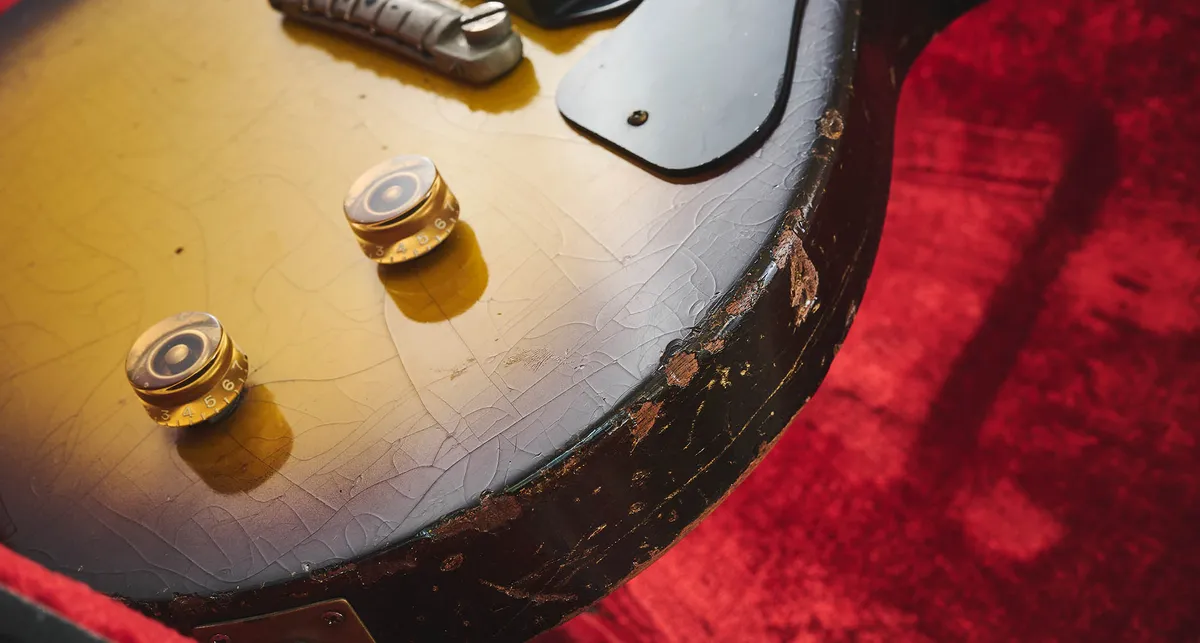
“It’s beaten up, but that makes it more special. I read an interview with Gary describing an [incident] at his flat with Steve Jones. Apparently, Steve threw the Junior against the wall, stormed out and never came back to get it. When I look at the knocks, I imagine one of them must be from the wall at Gary’s place.
“I had never played a Junior before this one, but I’ve been playing it non-stop since I got it and I used it on a recording just a couple of days ago.”
Will assures us that Gary’s Junior will continue to be played live and in the studio, and we can’t help feeling it has ended up in exactly the right place.