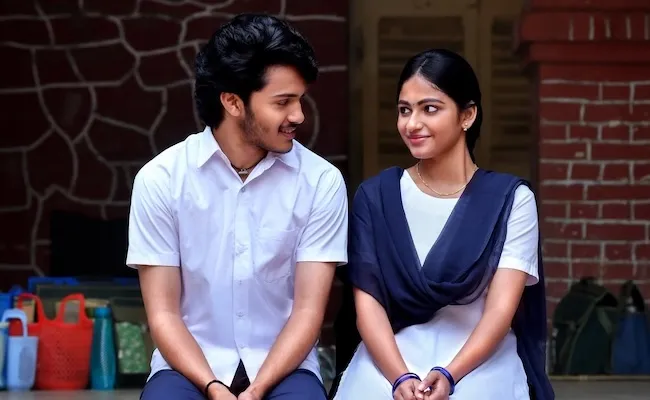

Movie: Thella Kaagitham
Rating: 2/5
Banner: Arunachala Creations
Cast: Harsh Roshan, Nakshatra, Sharanya Pradeep, Deepak, Ajay, Goparaju Ramana and others
Story, Screenplay, Dialogues: Nandu Savirigana
Music Director: Vijai Bulganin
DOP: K. V. Guhan
Editor: Karthika Srinivas
Production Designer: Chinna
Producer: Krishna Kommalapati
Directed by: Ramesh Bandreddi
Release Date: October 2, 2026
Harsh Roshan recently gained popularity with teenage dramas such as Court. The young actor has now come up with another film in the same space.
Let’s take a look at its merits and demerits.
Story
Ramu (Harsh Roshan) and Aasha (Nakshatra), who hail from the same village near Bhimavaram, like each other during their school days and eventually fall in love after entering intermediate college.
Encouraged by someone, Ramu initiates a sexual relationship, and Aasha reluctantly agrees. She soon becomes pregnant. How these teenagers deal with the unexpected pregnancy forms the rest of the story.
Performances
Harsh Roshan is at ease in his role and neatly portrays the innocence and confusion of a rural teenager. Newcomer Nakshatra has good screen presence and does well in her role.
Ajay, as the heroine’s father, is convincing.
Deepak, as Harsh’s friend, and Kasireddy Rajkumar provide some entertaining moments.
Technical Aspects
Vijai Bulganin’s “Chilaka” is the best pick from the album. The song is catchy and visually appealing.
Senior cinematographer K. V. Guhan captures the beauty of rural Konaseema quite well. The editing is just about okay, while the writing remains largely formulaic.
Highlights
The lead pair
The climax
Drawbacks
Old-school writing
Lame jokes
Lack of an engaging screenplay
Analysis
Thella Kaagitham deals with teenage confusion and the consequences of decisions made under peer influence. The film explores how teenagers, driven by others’ opinions and lacking the maturity to understand the implications of their actions, struggle to deal with the consequences.
Nandu has written the story, dialogues and screenplay, while Ramesh Bandreddi has directed the film.
The biggest problem, however, is the writing. Nandu fails to create an engaging screenplay or enough genuinely humorous situations to sustain the narrative.
Instead, the film relies heavily on outdated jokes and dialogues, particularly around “maturity,” becoming a “pedda manishi,” making balloons with condoms, periods and similar themes.
The hero’s friend character is another weak spot, with several jokes coming across as regressive and dated.
The film is set in 2006, which was not exactly a backward era. Even then, the way the teenagers discuss basic matters such as maturity and menstruation feels overly naive and, at times, difficult to sit through. The writing seems to deliberately make the period look far more backward than it actually was.
The film is at its most engaging when the lead pair begin dating and their romance develops. There is some innocence and charm in these portions. However, the film gradually loses steam after that.
Yes, teenagers can be innocent and lack maturity and experience. But several situations involving the youngsters and their village surroundings lack basic logic.
The film’s depiction of 2006 often feels closer to the 1970s. Even the use of public phones for conversations in 2007 feels unconvincing.
Towards the end, the film suddenly takes a tragic turn. The message, however, is relevant: teenagers should be able to talk to their parents about their problems rather than depending on others and getting into situations they cannot handle.
The message and the climax work to an extent, but the narration fails to create the emotional impact required.
Thella Kaagitham attempts to be a simple, message-oriented teenage drama and has a few entertaining portions, particularly in the first half. However, the outdated writing, forced humour and sluggish second half derail the film.
The message is good, but the emotional punch the subject demands is not strong enough.
Bottom Line: Confusion