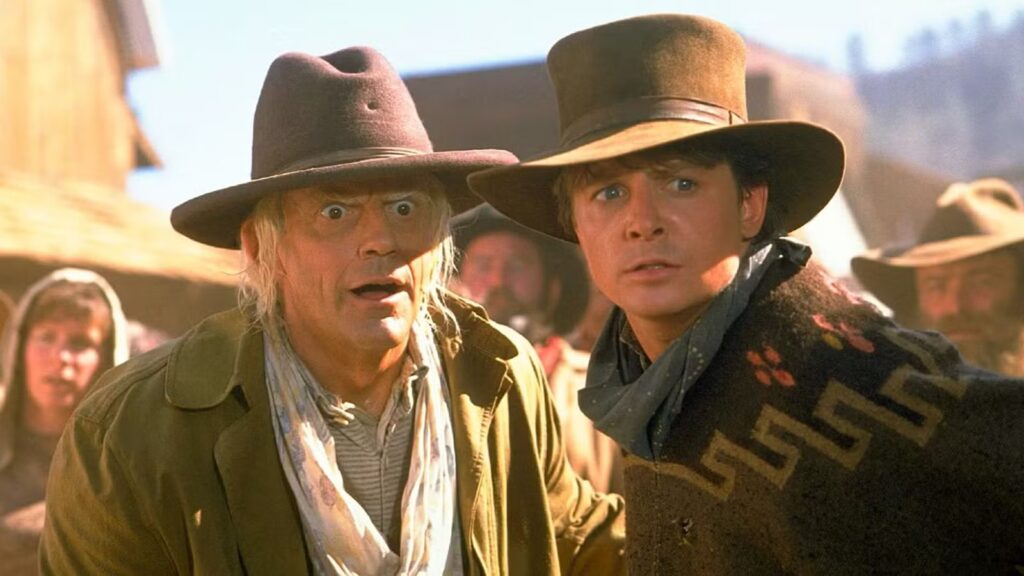

While Hollywood films are mostly known for their entertainment factor and intelligent quips, it is not unknown for them to slide in some profound philosophical thoughts into the script. Oftentimes, these philosophical sentences outgrow their origin and gain popularity of their own accord. One such thought-provoking quote appears in the final segment of Back to the Future III, with the genius scientist Doc Brown (Christopher Lloyd) giving profound advice to the franchise’s hero, Marty McFly (Michael J. Fox).
Following a century-trotting travel repertoire over the span of the three films, Doc appears to understand the ultimate truth of human life, which he shares with Marty. Poignantly, he tells Marty, “Your future hasn’t been written yet. No one’s has. Your future is whatever you make it, so make it a good one.” Even 36 years later, Doc Brown’s simplest, as well as the best, quote is unbeatable in terms of wisdom.
Doc Brown’s Profound Quote About the Future Provides a Thematic Conclusion to Back to the Future Trilogy

Image via Universal Pictures
The quote in question appears at the end of the trilogy’s storyline when Doc, who came back from 1885 with his wife from the past, Clara, and their two sons, Jules and Verne, after powering through a steam-powered time machine train. Marty and his girlfriend Jennifer also come back to 1985 following their sojourn to 2015.
Though Jennifer brought back a piece of paper that initially warned that Marty would lose his job in the future, upon reaching Hill Valley in 1985, she finds the paper blank. Confused, she asks Doc about its implications, and the scientist replies, “It means your future hasn’t been written yet. No one’s has. Your future is whatever you make it. So make it a good one, both of you.”
The line, which is by far the best line the script has given Doc to say, is momentous for more than one reason. And the reason why the quote remains the crowning jewel of the Back to the Future franchise is not because of just its spoken value. Doc’s words wouldn’t have been this impactful if the film had only practiced this wisdom theoretically. Instead, by deleting the words from the fax that Jennifer brought back from the future, the film literally shows that Marty’s, and by that virtue, no one’s future is written yet.
While Marty and Doc spend the better parts of all three movies to rectify the mistakes from their past and secure the future, this quote, in essence, provides a thematic conclusion to the film’s central thesis: no matter what one does, the future is just a blank space. The blank fax, which ultimately becomes a visual metaphor for the theory, becomes the tangible proof.
Generally, out of context, Doc’s words would appear as any conventional inspirational quote. But for the viewers, who have spent the three movies navigating multiple centuries, the quote carries even deeper meaning. After seeing Doc and Marty trying to change the course of set events multiple times, the viewers know that the future could change. But the change might not always be favorable.
This sentence also clarifies the film’s ultimate position on the freedom to change the events of the past and the future. Through Doc’s simple yet wise words, Robert Zemeckis and Bob Gale’s trilogy provides the bottom line: while securing the future might be the end goal, it is not predetermined. Rather, the future is the consequence of all the choices one makes in the present. Thus, securing the present would automatically lead to a better future, and one would not require a cheat code to secure the unknown.
Doc Saying No One’s Has To Marty Elevates The Line From Personal To Universal

Though the scene involves Doc talking to Marty and Jennifer, the moment he declares, “No one’s has,” Doc is breaking the fourth wall to speak directly to the audience. Thus, the rest of the dialogue feels like him also talking to the viewers, as opposed to talking to Marty. His saying, “Your future is whatever you make it, so make it a good one,” feels like the eccentric scientist ultimately realizing the absolute truth. And after spending the three movies trying to control his anxiety about creating paradoxes and messing up the timeline, he has finally found peace with himself.
Simultaneously, it also appears he is sharing that wisdom with the viewers as a concerned elder. It is as if the time-weary traveler has learned the ultimate truth that the future is not pre-written. It only reflects what one feeds it today. So, Doc is urging the viewers, who have also spent three movies with him in his adventures, to choose wisely and shape the present as they want to see how the future pans out.
It also completes the character arc for Doc, who, after spending the entire series worrying about controlling the timeline, finally stops being worried. His fear of uncertainty finally gives way to him accepting it as it is. He is no longer thinking about controlling time, but rather is gladly accepting uncertainty. It is the uncertainty that makes human existence worth living.
Doc’s Quote is Memorable Because of Its Simplicity
The success of Doc’s quote in the grander scheme of things is because of the simple language. Though he imparted profound wisdom, he kept the language simple. Instead of striving for perfection, as they were trying throughout the film, Doc’s impactful speech proves that it is not perfection that one should strive for. But rather, one should go for a “good” life.
Fueled by uncertainty and mistakes, it is imperative for Marty and Jennifer, and by extension, the viewers, to be mindful of the choices they make in life. One does not know what is stored in the future, but they can certainly influence it through the deeds of the present. It is their choices that would ultimately make a good and memorable life, which in turn would reflect in a good future.
Doc’s Quote Finally Puts the Dichotomy of Fate And Free Will to Rest
In Back to the Future III, Doc’s quote functions on multiple levels. As per the narrative, the quote finally addresses the franchise’s long-standing conflict between fate and free will. With Doc finally vouching to “make” a good future, the verdict is now clearer than ever. Fate is in one’s own hands. A person just needs to reach out to make it happen.
Moreover, the words also managed to conclude the emotional arcs of both Marty and Doc. The two weary travelers have now found a semblance of peace after spending much of their time in the three movies trying to manipulate time to secure their lives.
Additionally, by turning time travel into a metaphor for uncertainty, the film’s core thesis has finally found its conclusion. It’s a wide-open world, full of possibilities. One needs to step out to appreciate the offerings of life.
In a time when more and more time travel movies are exploring multiverse theories and their effects on human destiny, this 36-year-old movie provides a surprisingly fresh perspective. Instead of addressing the branch realities as something to be afraid of, the Back to the Future franchise provides a simple solution: the future is still up for grabs. Instead of thinking much, just reach for it, and you might be pleasantly surprised.

- Release Date
-
May 25, 1990
-

Michael J. Fox
Marty McFly / Seamus McFly
-

Christopher Lloyd
Doctor Emmett Brown
-

Mary Steenburgen
Clara Clayton
-

Thomas F. Wilson
Buford ‘Mad Dog’ Tannen / Biff Tannen