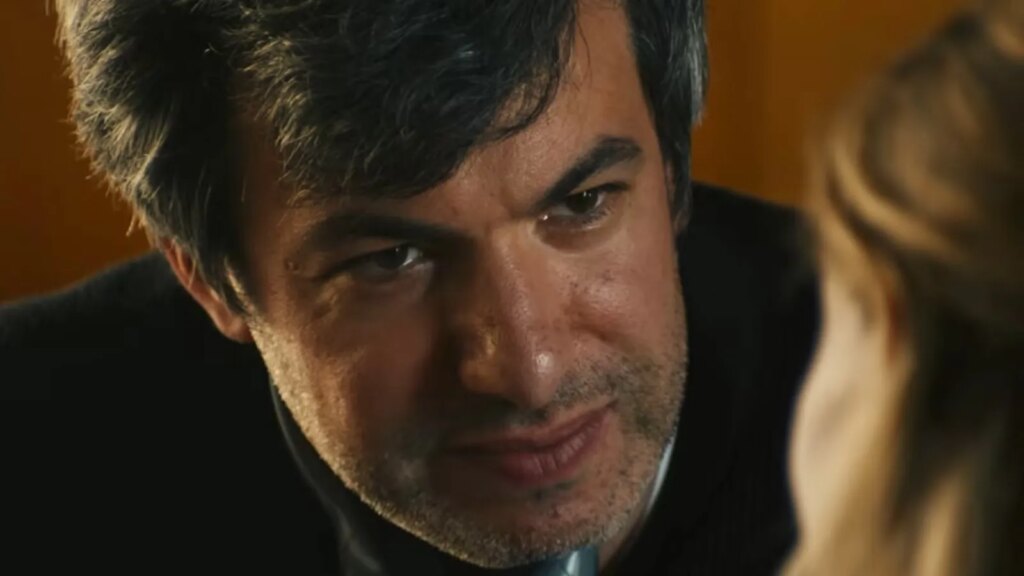

Fielder and Oppenheim eventually reveal the answer in one of their film’s several maddening twists, but well before that, the basic conceit of the documentary is utterly fascinating on its own. On-camera, Fielder gets comfortable in Holmes’ seaside property, immersing himself in her fairly picturesque lifestyle, complete with her two young children and Billy Evans, her fiancé/maybe-husband (the details, like so much with Holmes, are blurry). We observe Nathan observing the quiet moments between Billy and Lizzy that seem clearly staged for the cameras, as well as the rawer interludes that are infinitely more confusing, such as Holmes having her face and body scanned for a hologram that will be placed in her house so her children can grow up with some idea of who their mother is.
Through it all, however, is a hypnotic and unmistakable cat and mouse game. What we have before us is two master manipulators, one an entertainer who likes to blur truth with fiction in order to reveal something much more profound, and the other a very real public figure notorious for lying about technology that could’ve gambled with people’s lives. It’s like if Richard Nixon invited Andy Kaufman to document the most intimate moments of his last days in office. This therefore might just be the slipperiest documentary I’ve ever sat through, a movie where the nature of truth itself vanishes through a looking glass. In every scene, every beat, we watch Fielder grapple with what is genuine and what is manipulation from a woman going to prison for fraud. Some of the artifice can be quite transparent, especially when beau Billy starts talking about how they’re going to rework the idea of Edison, the blood-testing machine that could not test blood, and iterate it into an idea that will work. “Theranos 2.0” are words literally uttered.
What is more elusive throughout much of the movie, however, is why one would give what is clearly intended to be a sympathy-generating puff piece to a guy like Fielder. The actor and filmmaker himself asks out loud if because he’s not a scientist, or a journalist immersed in scientific research, that Lizzy and/or Billy might have thought he’d be a pushover. That eventually seems unlikely though, especially as Billy becomes evermore reluctant to have the cameras on over the course of the documentary, often interjecting on Elizabeth’s behalf when she tries to answer a question.
It might be a prudent wariness, too, considering Fielder’s well-cultivated deadpan proves to be far more dangerous than any “gotcha” question on 60 Minutes. Indeed, being a shock comic of sorts allows Fielder to just directly ask the clumsy, and revealing, questions that politeness can cause any other journalist or filmmaker to tiptoe around. For instance, when the couple each recount how they first met in 2017—after Holmes was under investigation and Theranos was in a death spiral—Fielder just blurt to Billy, “So you saw all this and just decided ‘I want this to be my life? Sign me up!’” Another sequence sees Fielder corner Holmes when she claims to have never seen “Who’s on First?” or ever heard of Abbott and Costello. He then pulls out his laptop and makes her watch the comedy routine, which leads to… an illuminating dialogue.
There are so many other fascinating vignettes and insights in this documentary about a convicted con woman’s last days of freedom. Yet I cannot give away the real reason this documentary becomes a masterful snapshot of our current moment of refracted reality. At a gargantuan 174-minute runtime, You Can See Everything is an epic because it goes well beyond its initial premise of following Holmes all the way up to her 25th hour. It’s after she goes to prison, and Fielder and Oppenheim choose to keep the cameras rolling and consider their subject matter from other vantage points, that the film transmutes into something truly special.
By virtue of standing in the frame as the on-screen interviewer—a role Fielder told a New York Film Festival audience he initially resisted, with the aim originally being that he’d stay behind the camera like Oppenheim—Fielder makes himself a crucial part of the story. It is, in fact, impossible to imagine the early sections of the movie working without Fielder’s deafening reaction shots to Holmes and Evans’ various claims, or his heightened Dracula-like stare as he watches them from the shadows.