
Within The Lord of the Rings, there are numerous powerful weapons, beings, artifacts, and creatures. However, when talking about strength, most people talk about how dominant certain characters are or touch on the One Ring and the other Rings of Power. This is especially true with the new television show The Lord of the Rings: The Rings of Power, found on Prime Video, which shows the creation of the Rings of Power and how they influenced and corrupted entire kingdoms.
However, although the rings are certainly quite powerful, they aren’t the only strong artifacts to consider within Tolkien’s fantasy world. There are other strong weapons, aids, and amplifiers used and seen within the franchise and the Middle-earth histories; some can rival or even surpass the power of the rings!
The Elven Swords Glamdring and Orcrist Have Slain Many Evil Foes

Two sister blades forged by elves in the First Age, Glamdring and Orcrist, were found in The Hobbit, hidden in the cave trolls’ lair. Glamdring, also known as the Foe-hammer, was taken by Gandalf. Orcrist, also known as the Goblin-cleaver, was taken by Thorin Oakenshield.
Originally hailing from Gondolin, the blades will never rust or dull and were imbued with the power to turn blue when orcs or goblins are near. Due to this, they have a fearsome reputation amongst goblins and orcs, able to strike fear into them with just their presence. Thorin carried Orcrist until his death, and Gandalf carried Glamdring into all major battles throughout The Lord of the Rings, and used it to slay the Balrog.
First Narsil, Then Andúril, The Flame of the West Is Both a Powerful Weapon and an Important Symbol

This mighty sword had two legacies. The original blade, Narsil, was forged by Telchar in the First Age. Telchar was a master Dwarven smith who ranks as one of the most powerful and impressive blacksmiths in all Middle-earth history. Glowing with the light of the sun and moon, the sword was a symbol of kings. That is, until Isildur used the blade to cut the One Ring from Sauron’s hand.
This cut famously shattered the sword, but the remnants were gathered and brought to Rivendell, where it existed as a symbol of strength and resilience even in its broken form. This symbolism was important, as the sword was later reforged by the elves into Andúril to be used by Aragorn in the final battles for the Ring. Also known as “The Flame of the West,” the sword represented the true king, hope, and the promise of victory, and the alliance between the dwarves, elves, and humans who handled and created it.
The Sceptre of Annúminas Is a Symbol of a Different Kind of Strength

There are many different types of strength and power beyond physical or magical might. Within The Lord of the Rings, this mainly pertains to symbolic strength and political power, and the Sceptre of Annúminas represents the peak of both of those when regarding the human race in Middle-earth.
One of the oldest surviving human-made artifacts, the sceptre was a symbol of authority for the Numenórean lords of Andúnië. Surviving the fall of Númenor, the sceptre became a confirmed symbol of kingship for the lands of Gondor and Arnor. Holding it guarantees immediate confirmation of a direct heir’s right to rule, and without it, the crown cannot fully be claimed. This is why Elrond kept it in Rivendell until Aragorn’s crowning, handing it to him to confirm his kingship.
Small in Size, the Phial of Galadriel Carries Part of the Power of a Silmaril

Although Galadriel famously said that, “Even the smallest person can change the course of the future,” her quote can also be applied to this small phial. Given by Galadriel to Frodo, the phial contained a fraction of the power of a Silmaril. More specifically, it carried water from her mirror, which was itself imbued with the light of Eärendil’s star.
Due to this, the phial carries light both physically and symbolically/spiritually. It provided light to help guide Frodo and Sam through darkness, but it was also protective, able to withstand or banish evil and dark magic. For example, the phial was used to push back Shelob, the guards of Cirith Ungol, and even repelled a Nazgûl.
The Istari Staffs Act As Conduits and Amplifiers for the Wizards

The Istari (wizard) staffs are interesting artifacts to consider because they both are and are not weapons. They are also magical and yet not magical at the same time. The staffs by themselves are similar to what many wands in fantasy are – mere conduits for the power of the actual magical being.
However, the Istari staffs can also amplify power, as seen in feats throughout the book, but most easily shown in the fear Grima possesses when he realizes that Gandalf’s staff wasn’t taken away from him in Rohan. It also has a symbolic power, as the breaking of a staff is tantamount to taking away the right of a wizard to live within the Istari order. In this, there is a plot hole in the movie, as Gandalf’s staff is broken in battle, but somehow returns later in the movie – neither of which happens in the books.

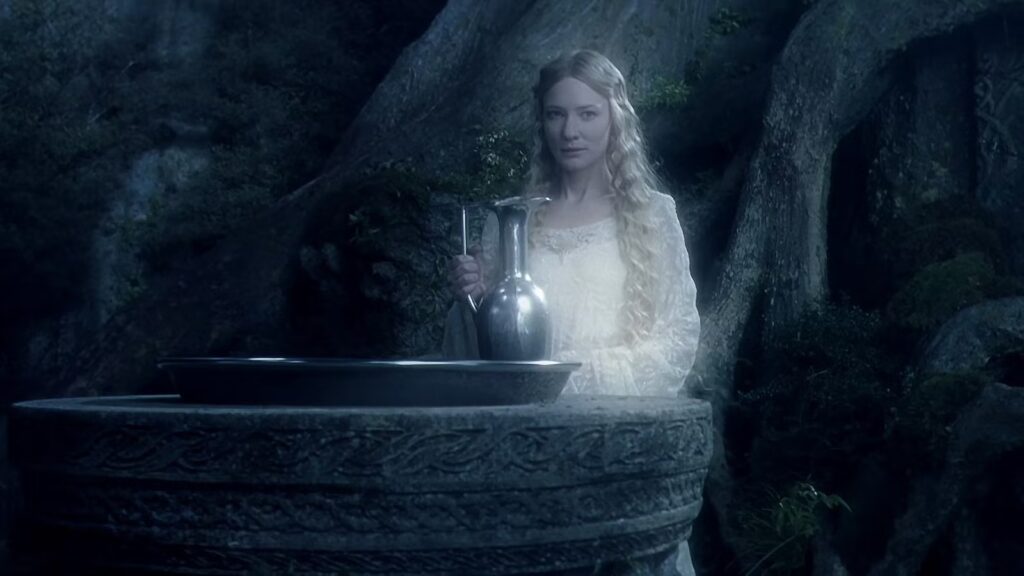
Galadriel’s mirror is fascinating to behold in that it is both a medium and a conduit. By itself, the mirror is a basin that can be filled with water. This becomes a medium as the surface of the water becomes a mirror from which foresight can be drawn. And yet, it is also a conduit, both for Galadriel and for her ring of power, Nenya, and is unable to work without their influence. Additionally, it reflects the light of Eärendil, which contains the power of a Silmaril.
The mirror allows both Galadriel and those who look within the basin to see the past, present, or future. However, these visions are fluid and fleeting, often reflecting subconscious wishes, desires, or fears of the being who looks within. For example, among the visions Frodo sees in the mirror (some of which are different in the book and movie), the Eye of Sauron fixes upon him, exposing Frodo’s fear of the being, but also reflecting how his future is forever entangled with the evil being.
Eight in Total, the Palantíri Are More Powerful Than They Appear

Created by the master Elven craftsman Fëanor in the First Age, the Palantíri are perhaps some of the most subtly devastating artifacts in Middle-earth, although they weren’t created for this purpose. Originally, there were eight of them, and they were created to allow users to communicate over long distances. They also store memories and events from the past, and were given as tokens of friendship to the human race, so the different realms could remain in touch and help defend each other if needed.
However, the seeing stones can have their purpose warped. For powerful beings, their will can be transferred through their communication, allowing them to impose on others. This is especially dangerous when evil beings are involved, like Sauron, as he can use his will through the Palantíri to spy on people and events through the minds of those who touch the orb, like Pippin. This is also how Saruman was corrupted and turned completely to Sauron’s side, and how Denethor went mad.
Grond, The Hammer of the Underworld, Could Shatter the Earth

Grond is the first artifact where this list starts to take a turn, moving from powerful artifacts into objects with enough power to change the world in an incredibly significant way. A massive hammer carried by the dark lord Morgoth, Grond was created in the First Age, and since Morgoth was over 30 feet tall, the hammer was large and heavy in a way that had never been seen before.
When wielded by Morgoth, Grond could shatter the earth or anything in its way. The wreckage it left on the earth’s surface would spit fire, smoke, and ash, as the impact of the hammer seemed to reach the core of the earth itself. Carving a space for itself in history, the use of Grond is one of the main reasons why the elven High King Fingolfin fell at the hands of Morgoth.
Eärendil’s Ship, Vingilot, Became a Divine Vessel

Vingilot (also known as Vingilótë) is powerful for two significant reasons. The first one has to do with the fact that the ship carries a Silmaril. Like all Silmarils, this jewel contained the light of Valinor, and this power allowed Eärendil’s ship to pass from Middle-earth into the Undying Lands so Eärendil and Elwing could ask the Valar to help in the fight against Morgoth.
The Valar agreed, but the cost of entering the Undying Lands was that Eärendil would have to pilot Vingilot in the skies, carrying the Silmaril on his brow. Vingilot was rebuilt and became near-divine before it was cast into the skies. Eärendil and his ship joined the Valar in the battle against Morgoth and were responsible for taking down the dragon Ancalagon the Black. Afterward, he remained in the sky and functioned as a powerful star-like being, flying over Middle-earth and sharing his light.
The Silmarils Are Unmatched in Power
The Silmarils are the most powerful artifacts in Tolkien’s writings about Middle-earth and the lands beyond. Fëanor, the lauded Elven smith, created three of them and put so much of his fëa (spirit/soul) into them that they were ensured to never have an equal in beauty or strength. Derived from a material called silima, they were unbreakable and were infused with the pure light of the Two Trees of Valinor. Even after the trees were destroyed, their light lived on in these creations and could pierce darkness, shadows, or even spell work.
Then, the jewels were blessed. Varda, queen of the Valar, blessed the Silmarils so that no greed, malice, hate, or general evil could ever hold them without being burned. Then, the Valar Námo, also called Mandos, foretold that the Silmarils held enough light to heal the world, and they would rule the fate of the sea, earth, and air. This, of course, did come true, but much horror and bloodshed were wrought at their expense.
- Video Game(s)
-
LEGO Lord of the Rings, The Lord of the Rings Online, The Lord Of The Rings: Gollum, The Lord of the Rings: The Third Age, The Lord of the Rings: The Two Towers, The Lord of the Rings: War in the North, The Lord Of The Rings: Battle For Middle-Earth, The Lord of The Rings: Battle For Middle-Earth 2, The Lord of the Rings: The Fellowship of the Ring
- First Film
-
The Lord of the Rings: Fellowship of the Ring
- Cast
-
Elijah Wood, Viggo Mortensen, Orlando Bloom, Sean Astin, Billy Boyd, Dominic Monaghan, Sean Bean, Ian McKellen, Andy Serkis, Hugo Weaving, Liv Tyler, Miranda Otto, Cate Blanchett, John Rhys-Davies, Martin Freeman, Morfydd Clark, Ismael Cruz Cordova, Charlie Vickers, Richard Armitage
- Latest Film
-
The Hobbit: The Battle of the Five Armies