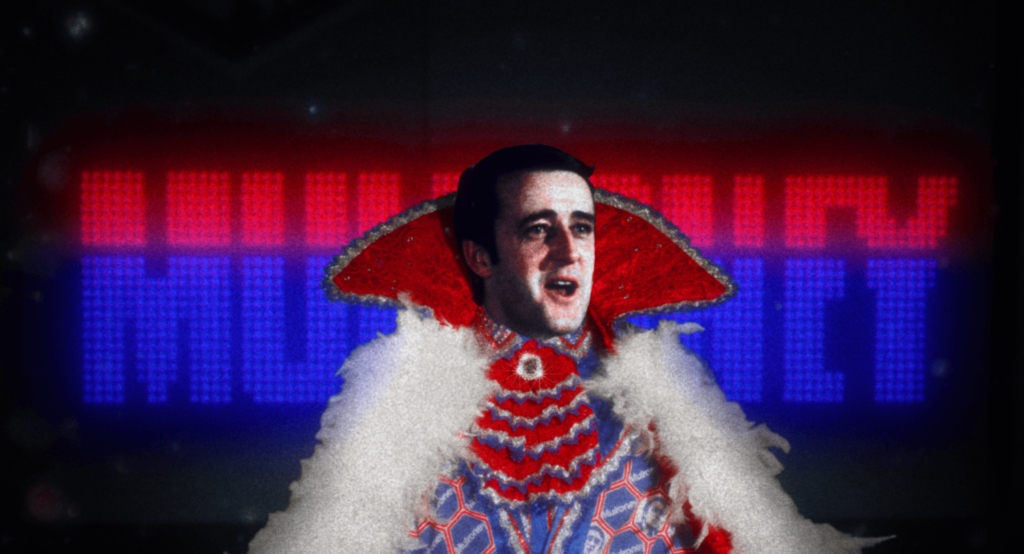

Winnipeg’s finest export Matthew Rankin (Universal Language) returns to skewer the Canadian political class with Ladies and Gentlemen, Brian Mulroney, a mind-bending documentary collage of lost Canadiana, centred on the former Prime Minister.
As the film plays at VIFF 2026, Matthew spoke to FILMHOUNDS about the power of television in politics, wading through thousands of hours of archival footage, and the dying art of satire.
You’ve just wrapped up the Mulroney premiere at TIFF, where it won the People’s Choice Award for Midnight Madness. What’s it been like getting the film out there?
That’s right, we had the world premiere and it’s been going really well, but I’m very tired—it’s like getting run over by a truck. The film is about a very parochial subject, but even people beyond the parochialism seem to be connecting with it, so that’s exciting. We’re definitely happy about how it’s been going so far.
Your previous film Universal Language was well received and got your name out there. Where was your head at after that, and how did it lead to this project?
Well, it’s not exactly like I finished one and started the other. Bizarrely, they were both made simultaneously, if you can believe that. Mulroney was greenlit by the NFB [National Film Board of Canada] around the same time as Universal Language, but I had first started researching it in 2021. In the gig economy generally, and in filmmaking in particular, it’s a game of shells. You never know what’s going to happen. I remember hearing this apocryphal story of John Hughes going to Hollywood with all of his scripts already written and saying, “Well, you don’t like Ferris Bueller’s Day Off? Here’s Sixteen Candles. You don’t like that? I got The Breakfast Club, I got Planes, Trains“, and all this. Eventually, he made everything, and so ideally the game of shells is such that you finish one thing and you start on another.
But, in this bizarre case, both films got the go-ahead at the same time, so I put Mulroney on pause to make Universal Language, and whenever I had any downtime, I would be working on it. I then devoted the summer after Cannes [where Universal Language played] to working on it, and the second we were done with the dog and pony show around the world, I was at my desk working through this footage. I guess my headspace was one of oversaturation from too much promotional touring. That turned out to be a kind of neurological ailment, which was kind of useful when editing Mulroney. It is a very maximalist piece, and so I would want the next one I make to be more minimal.
Why Brian Mulroney? Where did the idea for him as your subject come from, and how far back does it go?
I think it has something to do with the fact that I grew up with the man. I was an infant when he became the Prime Minister and by the time he left politics in 1993, I had developed some nascent understanding of politics, of what Canada was, what the regions meant, what the tensions were. They were all overwhelmingly mediated through this person. I mean, he was the Prime Minister, right? The incarnation of the national will. However, of course, people loathed this man. They absolutely hated him in 1993 and his party was completely destroyed. And out of that emerged the political culture that we have today.
I get into this at the end of the film about how Mulroney’s coalition was improbable and fragmented. It would splinter in a very violent way, somewhere in the middle of his second term, and out of it emerged the Bloc Québécois and the Reform Party, which became the sort of spiritual precursor to the Conservative Party today. The Progressive Conservative Party was annihilated forever, so there is this sense of doom that hovers over the film. I don’t get into Mulroney’s term in politics in this movie, and I feel like that compels a second film focused entirely on that specifically, which I would like to make. This one is about the building of the phenomenon and the fact that this coalition was really held together by the charm of a single person who managed to be credible to very disparate elements in society. That was always going to change and I feel like you feel that at the end of the movie.
Going back to Mulroney, I’m interested in him as a media phenomenon. He was one of the first to approach politics as a branding PR operation, following the parochial age where people did stump speeches and maybe they were telegenic or not. The key for Mulroney was his use of television, and that’s how I understood him as a child, as a character on TV. It was this idea of the politician as a product, as a package, as a brand, and that was used to rebrand a vast population. That is something that interests me. And of course, I feel like that has ramifications today, in that we’re having this strange reckoning with conservatism writ large across the Earth. Conservatism today in Canada means something very different than it did in the time of Mulroney and I think it’s interesting to look at that. Mulroney is a measure of how we have devolved, if I may be so bold.
You waded through thousands of hours of footage to assemble Mulroney. What was it like to trawl through the archives, and how did the film come together from it?
It was very tricky. Purely out of self-pity, I looked at the editing department credits in Moonage Daydream, a film by Brett Morgen about David Bowie. He’s editor of the film, but he had a fleet of 30 editors working with him. He had one editor credited as crowd editor, so one person working just on crowds. I didn’t have any of that. I’ve never had a smaller creative team and we were all doing too much work, so I edited everything myself. If I were to do this again, I would insist on having more of a crew to take it on. It was a process of going through the material and identifying things which sparked ideas, which created connections and patterns. I started mashing it together, but what made this particularly complicated is the fact that it was not straightforward journalism.
I was really inspired by experimental collage and the whole purpose of this film was to be like a collage. I think of Soda Jerk and Racer Trash and Arthur Lipsett. The sound project Negativland is a big influence on this. Most of that work is very abstract and formal. It might be very funny and very atmospheric, but it’s usually not telling you a story. I wanted to mobilise that language to tell the story of Mulroney through culture jamming. I had to go above and beyond the footage and there’s other stuff that I’m jamming it together with to create new meaning. That is why there’s so much material.

What gems did you unearth in the archive? Did you have a favourite?
There was a propaganda film that Mulroney had commissioned for himself in 1975, while he was gearing up for the leadership race. I found not only the film, which was never released, but all the rushes, all the outtakes, and everything they had shot. It’s really interesting to see Mulroney at the very, very beginning of his political vocation. It’s his first step into politics. And you really see the degree to which he’s aping John Diefenbaker and John F. Kennedy a little bit, though he is not nearly as articulate as he would become. He’s learning and becomes an absolute master of everything, but it’s interesting to go through this stuff and see his tentative early steps.
I found other stuff too, digging through the Canadian archives, which are poorly funded and in chaos. There’s very little knowledge about what’s in them. There’s gold, but you really have to dig. For example, I found a gorgeous 35-millimetre black-and-white recording of the 1966 Progressive Conservative Convention, where John Diefenbaker was usurped, and it was beautifully photographed by the CBC [Canadian Broadcasting Corporation]. But the CBC didn’t have it. They have a bad dub on VHS, which they’ve digitised, and it looks terrible, but I found the original reel at the national archive of Canada. The CBC had no clue that they had ever shipped that stuff off. It’s incredible that it exists, but it does speak to the fragility of this material, and it’s something we have to remember.
When Thomas Edison invented the phonograph, people flipped out at the idea of suddenly hearing the voice of their dead ancestors for eternity. That had never happened, throughout all of human memory, until the phonograph. Then suddenly in the 20th century, particularly during its second half, we were recording history in that way. It’s not just diaries and letters and government documents. We have recordings of events as they happened in real time, the people and the characters, and it’s amazing, but we’re really bad at protecting the material. I learned while I was going through all of this, how fragile it is.
Did you alert the CBC to the footage you’d found?
I should do. It still technically belongs to them, but the thing is, if you were to search their database, you wouldn’t find it. When I dug it up at the archive, it was spliced together with a science fiction movie. It was weird; there was the end of a science fiction movie, and then the rest is all Diefenbaker.
Your work has long been associated with Canadian political satire. What keeps you coming back for more?
I’m interested in people who are attracted to power. I grew up in Winnipeg, which is a very anti-establishment city, very punk rock, and so I have an unhealthy relationship with power and people who are drawn to it; people who aspire to control established systems, who wish to pull the great levers of history. Those people are very perplexing to me. I don’t entirely understand them and so I’m interested in that. I also think satire is something a little bit on the wane. We live in a time that is more and more authoritarian every day. One thing that authoritarians hate is satire. These public institutions, which used to produce satirists, don’t anymore because they feel beholden to the ebb and flow of government. That is nerve-racking to me, and I think it’s a real measure of authoritarianism when democratic society starts to fear political repercussions for, say, making fun of politicians.
It’s like the Supreme Court. It’s like regular elections. It’s like a free press. Satire is a check on power. It’s a method of course correction. We choose our politicians, but that opens up an unending dialogue about what it means, what they’re doing, and we comment on it. That’s how democracy works. So I think of satire as essential to a healthy democracy and to healthy democratic citizenship, but it’s something that we’ve largely abandoned. Satire used to be sharp-edged; nobody got a break. But that doesn’t exist anymore. Coming from Winnipeg, I relate to the world through irony, but I also think it’s a matter of citizenship and I don’t think it’s necessarily good citizenship to be uncritical. I think it’s better to engage critically with the phenomena that exert enormous power over our lives.
It’s all pop culture and that’s entirely what this film is built upon: stuff that empowered itself by being omnipresent in culture. Like a politician amasses power by being extremely visible and being extremely public, filling the public consciousness with images and sound bites and catchphrases and so forth. It’s the same with commercial culture. All of that power is amassed by filling our consciousness. Katy Perry is part of my consciousness. It’s not like I licensed part of my brain to Katy Perry and said, “Yes, you can occupy this, it belongs to you”, but it does anyway, whether I want it or not. But for those people to turn around and say, “No, actually this stuff doesn’t belong to you. I’ve amassed all my power by filling your brain with these images, but they don’t belong to you and you can’t comment on them”, that’s something I reject absolutely.
Do you have any new projects in the pipeline?
I have a bunch of things on the go, but I’m not beholden to anything right now. Well, I am, but not in an urgent way like I was with Mulroney. Ila Firouzabadi—my collaborator on Universal Language—and I are working on a project about Esperanto, the artificial language of world peace. I’m also working on an Antarctic disaster movie and a kind of anti-western, I guess you could call it, and I would really like to make the second Mulroney movie. As oversaturating as this film is, bizarrely, the response I’ve had the most from people so far is that they want even more. This movie is essentially a setup for what follows, so I would like to do it, and I’m even thinking about a third film to complete a trilogy about conservatism. It’s something that preoccupies me and I want to go deeper with it.
Are there any new Canadian films you’re excited for or filmmakers you’d like to shout out at VIFF ’26?
Carol Nguyen is a brilliant young filmmaker, and she’s presenting her first feature film, Still Night, Burning House, which I’m really excited about. I haven’t seen it, but her shorts are spectacular, so I can’t wait for that. I think it’s going to be amazing. I’m really curious about the Terry Fox movie that Sean Menard directed. It’s another one that is entirely archive-based and I’m really excited to watch it. And of course, Terry Fox is such an interesting character, as he is one of only a few legally non-negotiable icons. I mean, there’s no haters for Terry Fox, right?
I think that this is a moment where Canadian cinema is realigning and doubling down. Canadian parochialism, if I may be so bold. I think of Sophy Romvari’s film [Blue Heron] and Nirvanna the Band the Show the Movie. Clearly, these films were intended very much for a local audience, and they have touched something universal. I think that’s a real lesson. I feel like this “grow the economy” pathology has actually done the opposite where Canadian films are concerned. The idea that any Canadian would be interested in watching a low-budget imitation of an American film with no celebrities or distribution—that’s not going to work. I feel like people show up when they connect with the material and this recent resurgence in Canadian film really strengthens that. It is a moment where cinema can really serve an important role here.
Ladies and Gentlemen, Brian Mulroney plays at VIFF 2026 from 4 October.