
Even in the 23rd century, social distancing protocols must be observed.
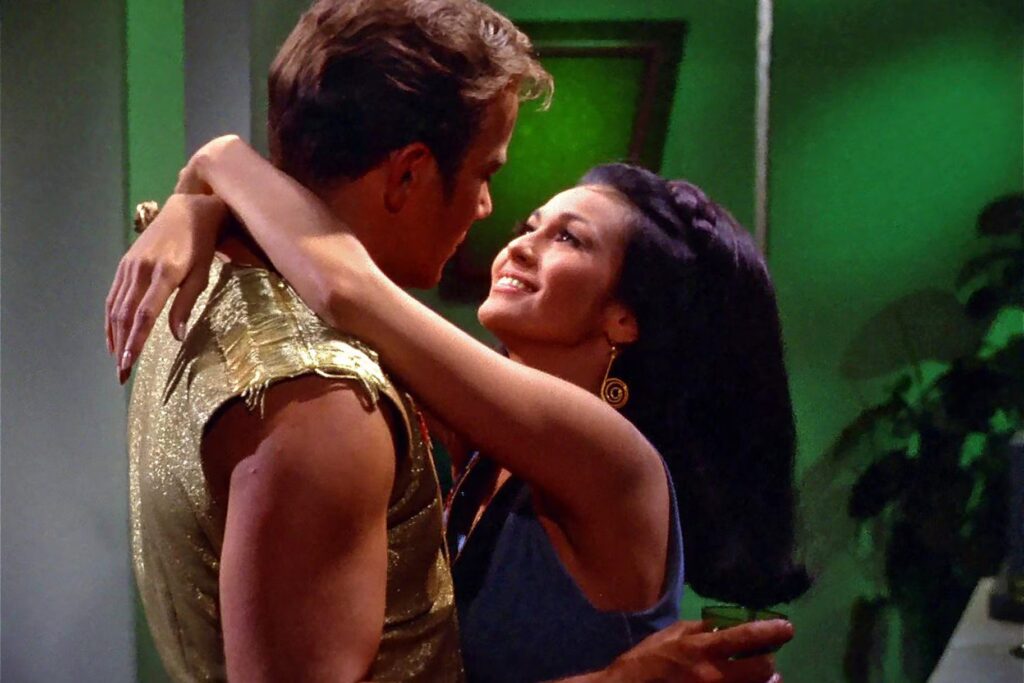
Such was the case for the original iteration of Star Trek when “Mirror, Mirror” guest star BarBara Luna woke up with strep throat on the day her character Marlena was supposed to smooch William Shatner (Captain James T. Kirk).
Classic Star Trek Episode “Mirror, Mirror” Shut Down Because of Strep Throat
“I somehow got myself to the studio [where] they looked at me and said, ‘She is so contagious, that if she just looks at anybody, you’re not gonna have anything,'” Luna recalled to SYFY Wire at the Sep. 25 premiere of The Sixty Year Mission: How Star Trek Changed Television and the World in Los Angeles. “The last scene we were supposed to shoot was the kissing scene between Marlena and Kirk.”
“They sent me home and actually shut down and went on to do another show,” she continued. “About six weeks later, we did the kissing scene and I don’t know why, but we had to keep doing it over and over. Mr. Shatner was a lot of fun. He just says ‘Hello’ and I fall down laughing.”
Written by Jerome Bixby and D.C. Fontana, “Mirror, Mirror” aired as part of the show’s second season in October 1967.
The episode established one of the most iconic recurring elements of the Star Trek canon, a topsy-turvy reality known as the Mirror Universe where the Enterprise crew is evil and Mr. Spock (Lenard Nimoy) rocks a pretty badass goatee (later parodied by Danny Pudi’s Abed Nadir via Community‘s “darkest timeline”).
Just one of many moments that cemented Gene Rodenberry’s creation as one of the greatest franchises of all time.
“It’s just a great bold adventure,” Denise Crosby (Tasha-Yar/Sela in Star Trek: The Next Generation) told us on the red carpet. “It speaks to our best nature, our truest selves. It’s inspiring, it’s fun, it’s creative. I think the world had to catch up to it. I think it was way ahead of its time.”
Added Todd Stashwick (Talok in Star Trek: Picard): “I want it to always surprise us, but always be there when we need it. I can’t wait to meet the next Starfleet captains. It’s a wonderful table to be able to have a seat at. There’s some 6-year-old out there right now—he, she, they that may someday be a Starfleet captain, have their own ship and be able to tell their stories and boldly go!”
The Sixty Year Mission: How Star Trek Changed Television and the World hits theaters Oct. 9. Tickets are on sale here.