
If reports are to be believed, Naughty Dog is bringing back Uncharted. That’s a tall order considering 2016’s Uncharted 4: A Thief’s End served as a pretty satisfying conclusion to Nathan Drake’s story. How in the world, fans must be wondering, do you follow that up? Thankfully, Naughty Dog has reportedly tapped Shaun Escayg for the revival. Escayg is the perfect person to lead Uncharted into a post-Nathan Drake future, because he’s already done it once before.
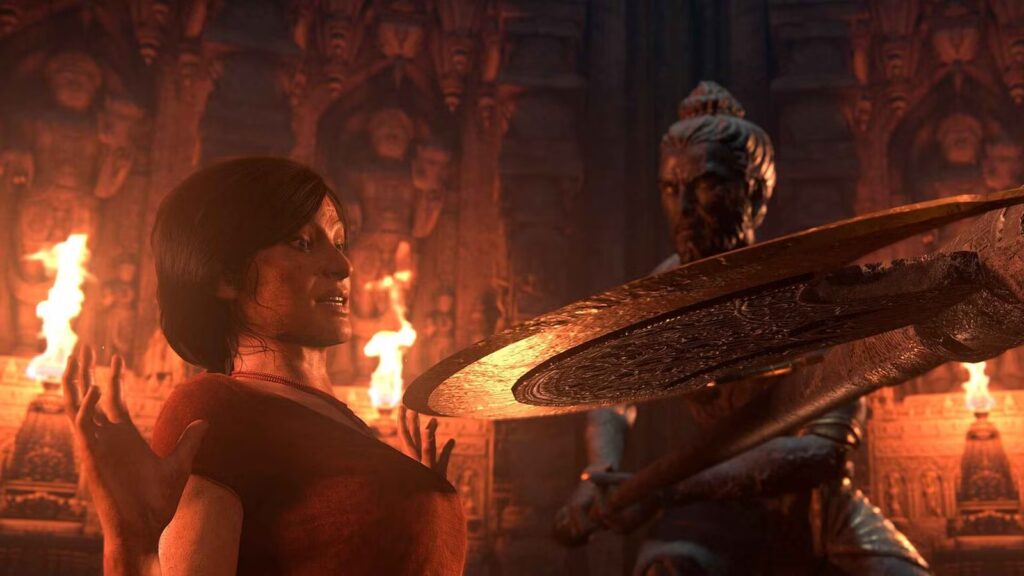
Uncharted: The Lost Legacy is a 2017 standalone spinoff developed by Naughty Dog in the immediate aftermath of Uncharted 4‘s release. The game follows supporting character Chloe Frazer (Claudia Black) and former antagonist Nadine Ross (Laura Bailey) on a treasure-hunting adventure complete with witty banter and action set-pieces. Lost Legacy was co-directed by Escayg and Kurt Margenau, game director of Naughty Dog’s forthcoming Intergalactic: The Heretic Prophet. The expansion’s ability to preserve the series’ formula without its iconic protagonist is impressive. What’s more impressive, however, is how Lost Legacy transcends every other game in the series in the absence of Nathan Drake.
Scope might be the single most important aspect to consider to understand just why Lost Legacy succeeds to the extent it does. As a standalone expansion, the game’s runtime is roughly eight hours, according to the data-tracking site How Long to Beat. By comparison, that’s just about half the time it takes to play Uncharted 4 at a relatively brisk pace. The numbers alone may make you think that Uncharted 4 must be a sprawling epic worthy of Nathan Drake’s finale, while Lost Legacy is the game equivalent of a nice snack between meals. That couldn’t be further from the truth.

Uncharted 4 is more of an outlier than the norm. Lost Legacy is more comparable to the other entries in the series. Uncharted 1, 2, and 3 all run roughly 810 hours. While Lost Legacy is still the shortest game, it recontextualizes just how meaty it still is. Furthermore, it allows Naughty Dog to learn from one of Uncharted 4‘s biggest failures: pacing.
By drawing out the adrenaline-pumping action of the series, the highs of Uncharted 4 remain high, but the lows feel far lower. Environments are too large for their own sake and plot points you can see coming a mile away approach at a snail’s pace. And those interminably long flashbacks to Drake’s teenage years? Please. Lost Legacy, on the other hand, is all killer and no filler. The game’s propulsive start — set during a job gone wrong — grips the player and never lets them go till the credits roll. Though that isn’t to say that Lost Legacy doesn’t know how to let itself breathe.
One of the game’s best sections is the Western Ghats, a semi-open area that feels like a playable interlude between the story’s two acts. This level is an improvement upon the often dreary car sections of Uncharted 4. Chloe and Nadine find themselves in the middle of a large landscape with a handful of towers spread across the map that they must go to. The player can approach these in any order and the map is also scattered with optional puzzles and collectibles to seek out. Smartly, this is the only level of its kind in Lost Legacy. Because of its singularity, it is the perfect change of pace while not overstaying its welcome or becoming tedious in its own right.

It also solves the Nathan Drake problem with ease. Chloe Frazer is equally as roguishly charming as Drake, if not more so. Fans got a taste of her in Uncharted 2 and 3 but Lost Legacy shows that she always had leading lady potential. Much like Drake, that is in large part due to the stellar performance at the heart of the character. Claudia Black is electric in the role and Bailey expertly props her up by playing Nadine as the proverbial straight man of the relationship. The evolution of the pair from begrudging partners that can’t help but butt heads to a dynamic duo is a delight. The story of Lost Legacy is also one of the more ambitious narratives in the series and even addresses some of the perpetual questions about treasure-hunting narratives.
As a follow-up to Uncharted 4, it is visually gorgeous and mechanically sharp in a way the earlier games could never dream of. Though like the original trilogy, Lost Legacy understands the value in letting a story be as long as it needs to be and not a minute more. It strips the series down to its core pillars and builds a complete experience around them by learning from the successes and failures of the past. Lost Legacy stands on the shoulders of every other Uncharted game — it just so happens that also means it towers above them.
Get Polygon’s Wishlister newsletter
A weekly cheat sheet to what you’ll eventually love to play. No buying, no
commitment — just saving for later.
Free. Unsubscribe anytime.