
Adam Page looks back at 1995’s Judge Dredd…
There are some failures in the world of moviemaking that don’t really announce themselves straightaway. They don’t crash the plane into the mountain. They just, quietly and incrementally, over the course of eighteen months and several hundred script pages, replace the thing you were supposed to be making with something else entirely. It ends up a thing wearing the original’s skin, walking around at the premier and smiling for the cameras, while the corpse of the original idea is zipped into a body-bag somewhere in post-production then wheeled out the back.
That’s Judge Dredd. The 1995 version. Stallone and his jaw like a longshoreman’s fist, swaggering around Mega-City One in a costume that cost more than my last two apartments combined in a movie that is, and I want to be really clear here as it’s the whole ballgame, a movie about the erosion of individual identity under a fascist bureaucracy, made by systematically erasing the identity of everyone who wasn’t the fifty-year-old action star who was holding the chequebooks lead.
You can’t write irony like that; you’d be laughed out of the writer’s room. But there it is, sitting on a shelf at your local second-hand DVD graveyard, usually between Tank Girl and Waterworld, a real artifact of a system eating its own children in real time with the cameras rolling.
I need to back up a little, because you have to understand just what got killed before you can appreciate how completely they killed it.
Carlos Ezquerra and John Wagner didn’t create Judge Dredd to give action figure manufacturers something to sculpt. They created him in the pages of 2000AD in 1977 as a Dirty Harry style tough cop taken to its extreme, a satire of Nixon-era law-and-order politics filtered through the visual language of British punk and American superhero comics, a character who was meant to be terrifying because in his own system, he was correct one hundred percent of the time, not because he was cool. He was Judge, jury, and executioner rolled into one armoured mannequin who never, not for the length of a single panel, stepped out of his uniform to remind you there was a person under there.
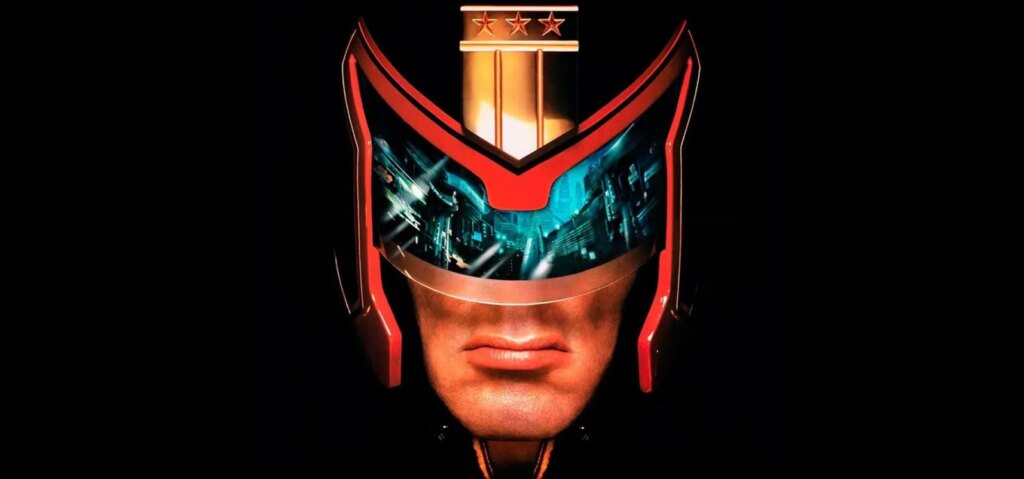
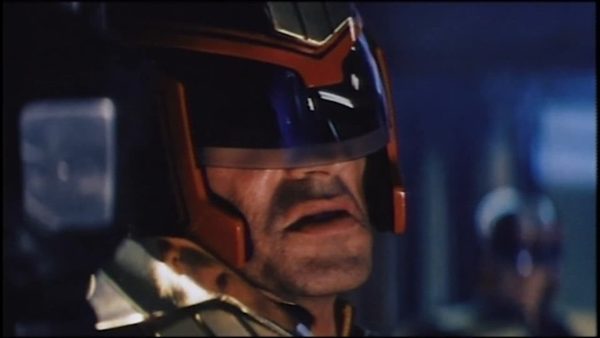
That’s the whole mechanism of the satire. The helmet isn’t a costume choice, it’s the argument. Dredd has no face because Dredd isn’t supposed to have a face; the minute you give the fascist enforcer a face, or a wink, a soft spot, you’ve done the thing every soft authoritarian apologist since the beginning of time has done: you’ve said well he’s not so bad once you get to know him. The whole nasty little joke Wagner came up with is that you’re never allowed to know him. The system doesn’t have an inner life; that’s kind of the point. If you take that away you aren’t left with a diminished version of the satire, you’re stuck with its complete opposite. You have a movie that accidently endorses the very thing it was meant to skewer, like a documentary about a cult accidently recruits three new members.
I love this stuff. I love it like I love a perfectly butchered pig or how I love watching someone who actually knows what they’re doing take something and reduce it to its essential and correct form. Done right, Dredd is mean. Done right, Dredd has nearly no character arc, because an arc like that would imply the system is capable of change and the whole black comedy of the comic strip is that it isn’t. It’s Kafka with a big gun and a bigger bike.
So, naturally, Hollywood looked at this in the early nineties and said: sounds like a great vehicle for a movie star.
Here is where the story turns from tragedy to farce which, fair warning, is where most good stories about the movie business turn.
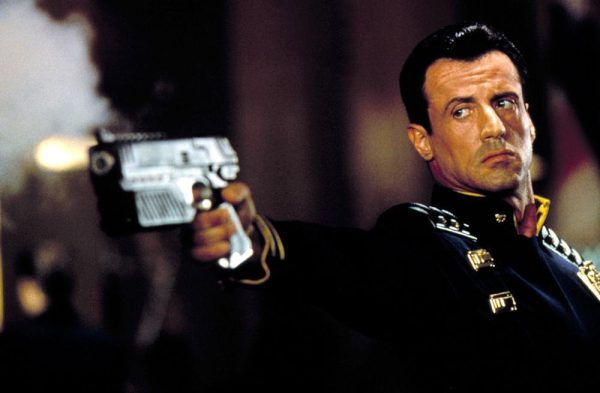
Danny Cannon was a young British director, a guy who had grown up on 2000AD the same way I grew up pouring over them every week, and he got the job. By every account, he wanted to do something faithful; satirical and grim, a little cruel and true to the strip’s DNA. What he got instead was Sylvester Stallone, an actor of real and considerable talent who had, by 1994, spent around a decade and a half building a persona running on exactly the opposite fuel from what Dredd needs. Stallone’s whole career-long project; Rambo, Rocky, all of it, is the little guy fighting against the machine, the little guy’s face and voice and wounded eyes carrying us along. I don’t mean that as a criticism; it’s genuinely a hell of a body of work. But structurally, it’s totally incompatible with a character whose whole meaning depends on having no face and no arc.
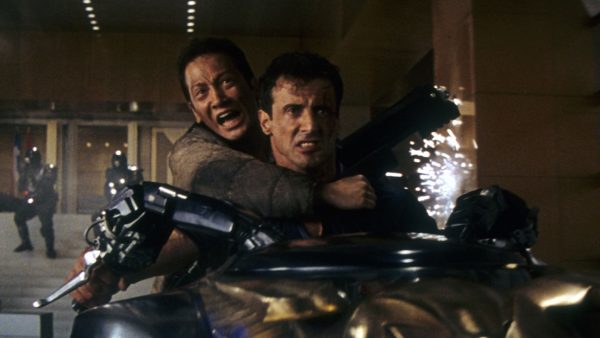
And Stallone being Stallone, a man who doesn’t arrive on set in order to disappear into somebody else’s vision, did what stars with contractual leverage do: started pushing. He wanted the movie funnier, he wanted quips, by various accounts he wanted the thing softened into something closer to action-comedy, with plenty of room for Stallone-the-person to shine through Stallone-the-Judge, and the movies own credited screenwriters and director have said as much in the preceding years, that what ended up on screen bore only a passing resemblance to what Cannon thought he was shooting. And for his part, Cannon came away from the whole experience so burned that he swore off ever working with what he diplomatically called “self-absorbed” actors again. There’s a director using the mildest possible language for what seems like several months of miserable trench warfare, fought one script revision at a time, the sort where nobody wins and everyone just wants to go home smelling of smoke.
And then, the part I can’t get over and which should be taught in every film school as the platonic ideal of an unintentional self-own, about 16 minutes in, Dredd takes off his helmet.
Just sit a second and think about that, because it’s really this essay’s whole point in one gesture.
The single most sacred piece of iconography in the comic strip, a visual rule so ironclad that in over two thousand issues the creators basically never broke it, and on those rare occasions they did, they still refused you a clean face, hiding it behind a censor bar like the thing was too dangerous to look at directly. In Judge Dredd, it gets discarded in act one, reel one, pretty much the first thing that happens once the plot clears its throat. Not for a gut-punch moment of vulnerability around the mid-point, where it possibly could have landed as a tragedy; a Judge stripped of the armour that makes up his whole selfhood and forced to exit as just a man. No. Just…off it comes, because you paid to see Stallone’s face and dammit you are going to see Stallone’s face, to hell with the budget and subtext, to Hell with the thematic architecture.
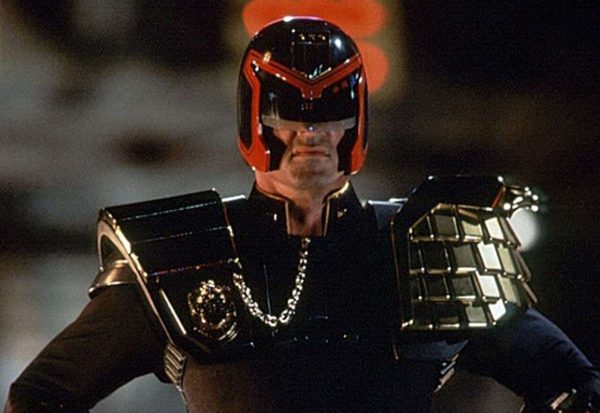
You want to talk about institutional control eroding individual identity? Well here’s the real version, the one which happened off-camera, with an entire creative apparatus; director, writers, decades of literal source material, unable to survive contact with one man’s understandable, completely explainable desire to be seen. Stallone wanted his face in his own movie. On the face of it, that’s not an unreasonable thing for a movie star to want. It is, however, a total and direct contradiction of the thing that made the character worth adapting in the first place. The individual ego didn’t bend to the system. Instead, it walked into that system, looked around and said, nah, we’re doing it my way, and the system; production, studio, the whole process built and staffed to create a coherent piece of satire, all folded like a lawn chair.
Which means the movie, whether anybody involved clocked it at the time or not, became a document of exactly the dynamic it was supposed to be critiquing, except inverted. Judge Dredd-the-character exists to show you a world where the institution crushes the individual until there’s nothing left but a badge. Judge Dredd-the-production exists to show you a world where one powerful individual crushes the institution until there’s nothing left but the star. Same machine, opposite grinding. And nobody wrote that as a joke, it just happened, like a marriage just ends, quietly then all at once and then everyone is standing around in the wreckage wondering just how they got there.
And it gets worse, in the way these things always get worse, which is: incrementally, one “reasonable note” at a time.
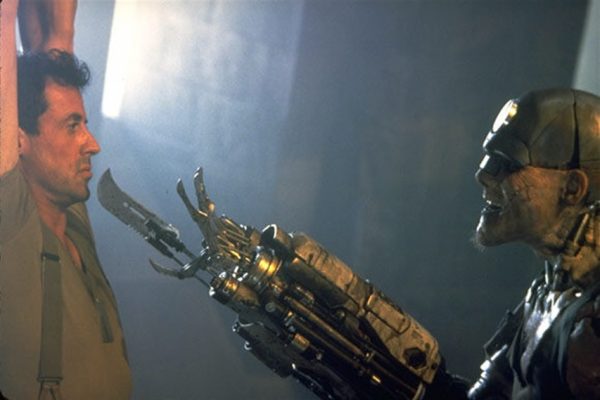
Because Stallone wanted more than his face. He wanted, as these things go, an emotional journey. A wronged man and a conspiracy. A framing, a friend-turned-villain in Rico. A love interest, or at least something close to one and, I still can’t believe I have to type this in this essay, a kiss at the very end between Dredd and Judge Hershey, two career law-enforcement fascists sharing a tender moment like they just wrapped a regular romantic thriller instead of a movie ostensibly about the total abdication of human individuality to a militarised judicial state.
None of that is a betrayal of a script. Scripts get changed, that happens all the time and in my younger days I watched enough dishes come back from enough pass stations to know that sometimes the guy putting his name on the plate has opinions about the plate. The betrayal here goes deeper than that; it’s more structural. A redemption arc needs a person capable of being redeemed, someone with an interior life and doubts, a wound that can heal. Correctly rendered, Dredd doesn’t have a wound. He is the wound, a self-inflicted wound on a whole society, worn as a badge mistaken for virtue. You can’t give that figure a character arc without unmaking him. It wasn’t a difficult adaptation choice gone wrong, it was more like creating a vegetarian dish and deciding halfway through that it needed a whole roasted animal in the centre and then wondering, with real confusion, why the critics say it doesn’t taste like what you promised.
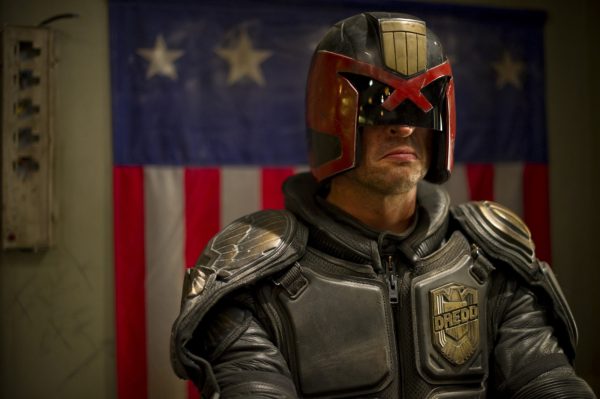
The movie made its money back and some change, more or less, on an $85 million budget. Not the bomb people misremember it as, just a largely unloved, publicly disowned thing that even its own star would call, on the record, one of the biggest mistakes of his career. Danny Cannon went on to create a very respectable career in television, on shows that not coincidentally, prize plot and craft over the care and feeding of a single ego. John Wagner, the comics creator, watched from a distance and delivered his verdict years later with the flat and weary precision of a man who’s had a long time to think about it: they tried to tell too many stories, he said, and told none of them well. “Judge Dredd wasn’t really Judge Dredd.” When Karl Urban made the much leaner, much meaner Dredd in 2012, helmet on, no kiss or redemption arc, no quips and a budget a fraction of the size, it was deliberately a course correction. Urban reportedly wouldn’t take the helmet off. That’s something more than a footnote; it’s an entire subsequent generation of moviemakers looking at the wreckage of 1995 and correctly concluding that the mistake had a name and the name was ego, and the fix was structural discipline. Take the face away and let the badge be the character. Trust in the bleakness.
What I keep coming back to, scowling into my third whiskey and thinking about a 30-year-old B-movie that made 11-year-old me angry in a way I couldn’t articulate then: the tragedy of Judge Dredd isn’t that it’s a bad movie. There are plenty of bad movies out there and cause no metaphysical distress at all. The tragedy is that it’s a bad movie for the single most instructive possible reason: it’s a perfect and un-intentional re-performance of its own thesis, not staged on the screen but in its production offices, contract riders, reshoots, and in every “can we lose the helmet for this scene” note that nobody had the power to refuse.
Satire about the erosion of the individual under institutional control, itself eroded by one individual’s refusal to be controlled by the institution built to make it. You couldn’t make that on purpose; it had to happen by accident the way all the best and worst stories about human vanity happen by accident. Nobody sits down and decides to become the joke, they just keep making small, reasonable-sounding choices, one contractual demand at a time, until one day they look up and the helmet’s off, Dredd has a redemption arc, there’s a kiss at the end and the thing they set out to make is unrecognisable. And it’s been replaced, quietly and professionally with everyone still smiling for the trade press, by the thing the star wanted all along.
That’s a lot more than a production going wrong. That’s a system working just as systems full of unchecked individual power always work.
Dredd would have understood that better than anyone in the building.
Shame nobody let him keep the helmet on long enough to say so.
Adam Page