
Picture it: a suited exec walks onto a stage and announces a new game about influencing and controlling people, about good and evil. And the clincher: it’ll all be driven by machine learning. In 2026, that game has to be a dystopia. That’s where our imaginations go now when we hear anything about AI and social control. There’d be a grim synthwave drone underpinning scenes of trench-coated cyberpunks. There would be absolutely no apes casting spells.
But 2001 was a very different time, and Black & White took those exact elements, simian wizards and all, and turned them into a joyful sandbox without even a whiff of the sinister about it. In many ways it was a natural extension of Peter Molyneux’s favorite themes, and by the turn of the millennium his particular fingerprint was already familiar.

Bullfrog’s back catalogue had consistently offered compelling power fantasies throughout the ’90s, and they often had a quietly amoral aspect. Theme Park famously empowered you not just to build an eponymous theme park, but also to lead thrill-seekers to their demise – at least gastrointestinally – on your rides. Dungeon Keeper made that motif explicit, more or less inviting you to build torture chambers for heroes to navigate. Even the more straight-laced Bullfrog series, Populous, featured throwaway human sacrifice and wanton destruction of rival tribes’ villages. Above all, in every Bullfrog game, the kick was in controlling people, according to whatever personal moral compass you decided to adhere to.
Latest Videos FromGamesRadar+
When Molyneux began to work on a new project with a team of nine in February 1998, his ambition was to take those notions further than his previous games had been able to: Black & White would be a toybox in which the player felt that they could do anything. But it would also call upon deeply specific and personal references from Molyneux’s own childhood and pop-culture kinks. In a 2000 GDC keynote, he told the audience how he “wept like a baby” at the end of King Kong and felt like a god in an alien land the first time he found an anthill. Those threads can be picked up in the final release of Black & White, but along the way many ambitious concepts fell to the cutting-room floor or were radically retooled.

Among these ideas from the newly formed Lionhead Studios was the ability to pick up any creature in the game and rear it into a giant. Buildings and environments would take on a different visual aspect depending on your alignment to good or evil, while the characters within them would be fully lip-synced. And at the centre of it all would be a tale of powerful wizards vying with the player for control of a set of islands.
Eventually, the creatures you could control would be limited to just a handful, lip-sync was jettisoned, and the wizards’ robes were tossed in the bin in favour of warring gods. But it would be the personnel, rather than the premise, that would make Black & White special.
Calling in the gods

One of that team of nine, and working out of Molyneux’s own house for the early part of Black & White’s development, was Richard Evans. He’d been Molyneux’s colleague at EA and now co-founded Lionhead with him. A young chess prodigy called Demis Hassabis joined shortly afterwards, reuniting with Molyneux after leaving Bullfrog to earn a double first in computer science at Cambridge University. Much later, Hassabis would go on to found DeepMind, the deep-learning AI research project bought by Google in 2014, which taught a computer to beat any human Go player. Then it was constantly working on cures for terminal disease, but subsequently merged with Google Brain in 2023 to become Google DeepMind, which now claims to be building “safe artificial intelligence systems”. Evans would also take a job at DeepMind, on the research team. But as has been established, 2001 was a different time. And in that time, these two artificial intelligence luminaries coded a chimp that learned where it was allowed to excrete.

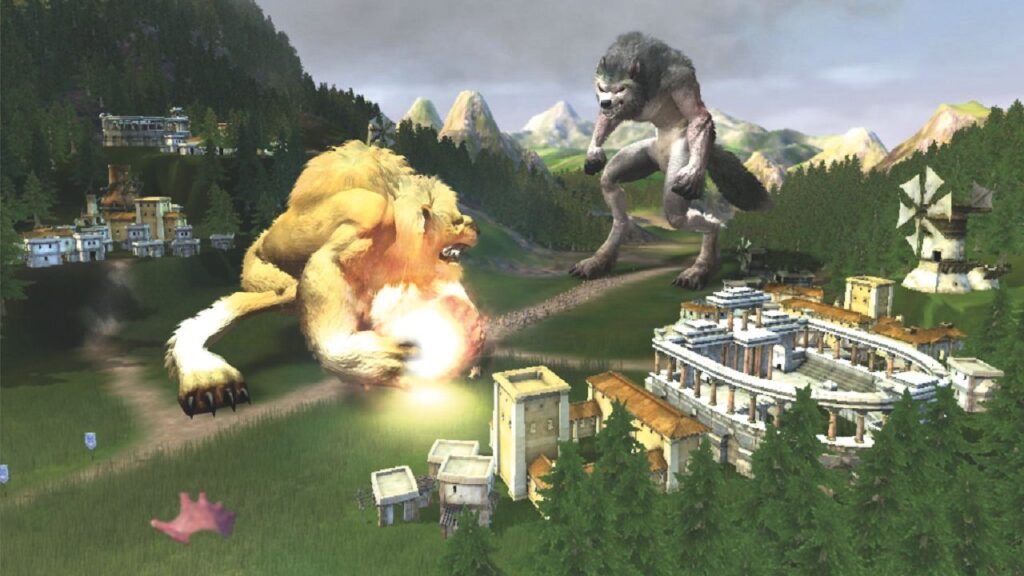
That is to say, they built the phenomenal machine learning AI of Black & White’s creatures. This was and remains the game’s secret sauce, never to be bettered by 25 years of subsequent releases in any genre. Black & White’s release was still within reaching distance of the late ’90s Tamagotchi craze, so there was plenty of interest in even its creatures’ need for food and water to survive, and their ability to grow over time. But of their own volition, they’d imitate you. They’d cast spells they’d seen you cast. Interact with villagers either benevolently or like a monster in a Godzilla film, tossing them casually to their deaths or snacking on them. Eat, sleep, and excrete where you told them to, however bizarre or impractical. Thanks to its incredibly intelligent creatures, Black & White is a video game of blink-and-you’ll-miss-it revelations. At the time of its release, the AI seemed wondrous. Replaying it now, all these years later, it’s veritably fearsome. Then and now, creature AI is the defining element.
Not that the game’s in any hurry to display it. There’s over an hour of build up before Black & White rolls out its party piece in its trainable creatures. In that time, you learn you’re regarded as a deity on the fantasy island over which you preside. Tiny, ant-like denizens rush to fall at your floating hand and worship. As well they might: you are immediately free to pick them up and chuck them into the sea to their deaths, or bludgeon their homes with boulders if the moment takes you. And to many gods, particularly the adolescent ones who’d never been given this kind of freedom before in a game, the moment surely did.
The clarity of black and white

Even now, the elegance of the frontend feels contemporary. It’s not completely HUDless – spellcasting gesture prompts creep into the bottom-right later in the game – but it’s remarkably close. The crucial information such as resource levels and worshipper needs are indicated very neatly by flags on the village stores: the more your people need food, the higher they’ll raise the flag. And they’ll tell you about it too as you pass over. “Worshippers need food!” Incessant, but effective. Hearing that, casting a spell to produce food and dropping it into the village store while a crowd of people gasp and cheer, feels much more like being a god than hitting the ‘food’ button in a build menu and watching a bar replenish.

Such is the chocolate-box charm of Black & White’s opening that you suspect it might even succeed without the creatures. Here you are, governing sheep farmers with a West Country twang who implore you to scan the rolling hills for members of their lost flock, and listening to the sea shanties of a group by the beach who want you to build them a boat. Like Lionhead’s later Fable games, the people in Black & White are quintessentially British in a way that other games never seem to quite harness, speaking in regional accents and Monty Python nods. There’s a strange dissonance to it all if you’re playing as an evil overlord.
Not many games would dare to wait so long before putting their USP in your hands. And even when Black & White finally – finally – introduces you to Sable the creature trainer and lets you pick out a pet, it doesn’t oversell the moment. Sure, this animal will learn spells by watching you perform them, you’re told. No big deal, but it’ll also change in appearance depending on its moral alignment and its owner’s. Then you’re left alone with it without explicit instruction or objectives, like the terrified parent of a newborn child.
Perhaps a necessary byproduct of Black & White’s devotion to being a sandbox more than a strategy game, pacing issues are constant and pronounced. Just as you’re starting to feel as one with the world map and a growing number of villagers who all worship you and produce the spiritual currency by which you cast powerful miracles to exert godly powers – just as you start to feel at ease with the loop of performing impressive feats in nearby settlements to convert their populace and extend your influence – everything changes. You’re torn away from one world that you’d carefully tended to like a zen garden and spat out through a portal into another. Worse: your creature’s been taken away from you.
This isn’t a quick plot twist for effect, either. There are only five islands in Black & White, although its later Creature Isle expansion would add another, so you’re left to endure separation anxiety for about a fifth of the total gamespan. For better or worse – almost certainly for better – games just wouldn’t bury their lede like that now, for fear of a userbase backlash. That bizarre decision does serve to dilute Black & White’s enigma as time goes by, though. In every sense, it’s an entertainment product driven by its own strange passions, fiercely resistant to outside influence or wisdom, like so many of the best-remembered titles from that era each side of the new millennium. With Hassabis and Evans now putting their AI expertise to solving the world’s great problems, it’s also become a few other things. An indictment of the videogame industry’s waning ability to pull in the brightest minds in programming. An unanswerable series of questions about the possibilities of releasing such a game now, and crowdsourcing player data to refine the AI behaviour. And, sitting least comfortably, a monument to our collective naïvety about AI’s power to change almost every aspect of modern life.
This Black & White article was first published in issue 338 of Edge Magazine. To get more like this delivered straight to your doorstep (or digital device) consider subscribing to Edge.