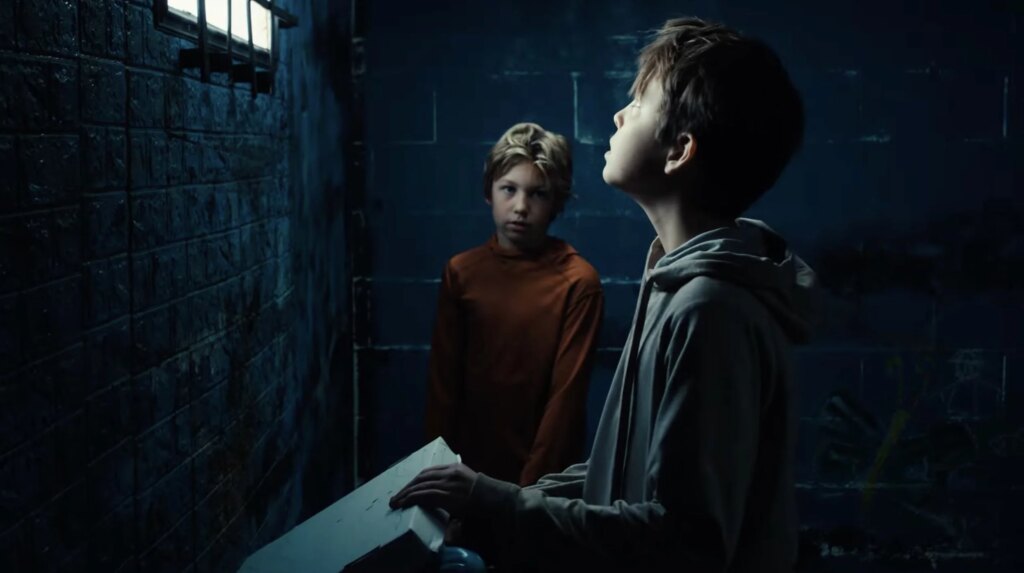

The trailer for The Man Upstairs drops us into a disturbing situation where childhood, captivity, and the idea of family become tangled together in some seriously dark ways.
Written and directed by Wendy Wang, the psychological horror short follows two kidnapped boys trapped in the basement of a man who expects them to accept him as their father. What starts as a fight to get out becomes more complicated as manipulation changes how the children see their captor, each other, and the possibility of escape.
The short also serves as a proof of concept for a feature film that Wang has already written. Rather than leaning on a supernatural threat, Wang builds the horror around control, Stockholm syndrome, and the damage a person can cause while claiming to act out of love.
This trailer is shared in collaboration with the FilmQuest Film Festival, where we are looking to expose some of the great indie genre films and shorts that filmmakers are creating. I’ve included an interview with the director of the film below.
When asked to explain the story without giving away its secrets, Wang told us: “The Man Upstairs began as a feature script before I adapted it into a short film as a proof of concept. After being kidnapped, Julian wakes up in a stranger’s basement, where another child, Corey, already lives.
“In this new home, survival means playing along with the man who calls himself ‘Dad.’ As the boys form a fragile bond, they plot an escape from a twisted domestic nightmare. The film explores the dark psychology of Stockholm syndrome, what happens when manipulation runs so deep that its victims begin to question whether they even want to escape.”
That psychological angle comes from Wang’s interest in true crime as well as experiences from her own childhood. She also found an unexpected structural influence in a classic story.
“The seed for The Man Upstairs came from my fascination with true crime, and inspired by my own personal experience of growing up in an environment defined by fear and control. The structure of the story takes loose inspiration from The Prince and the Pauper, reimagined through a psychological horror lens. Instead of a tale of curiosity or privilege, the exchange of identities becomes an act of survival.
“I focused on the horror and survival aspects of the kidnapped children, and layered with the psychological manipulation and Stockholm syndrome. Rather than external monsters, I’ve always been drawn to the kind that wears a familiar face. Just like in many true crime stories, oftentimes the people who hurt us the most are the ones who claim to love us the most. It’s about the mental gymnastics we perform to stay safe, and the bravery it takes to finally see the truth.”
Wang is a Los Angeles-based writer, director, and producer who studied directing and producing at USC Film School. Her experience also includes film distribution, post-production, music videos, and narrative shorts.
“I’m a writer, director, and producer based in Los Angeles. I studied directing and producing at USC Film Schoo. I am particularly drawn to character-driven thrillers and horror. After graduating, I worked in film distribution and post-production, where I had the opportunity to work with companies that worked on some internationally renowned projects (i.e. Iron Man 3, Looper) I was able to see first hand how audiences respond to different stories internationally.
“I eventually transitioned into freelancing, directing and producing music videos and narrative shorts that allowed me to experiment with tone, visual style, and collaboration. Now, I’m focused on developing feature projects like The Man Upstairs as well as materials from other talented filmmakers. I care deeply about the process behind and in front of the camera. It is my priority to build an inclusive, emotionally safe set where both the story and the people telling it can thrive.”
Horror gives Wang a way to examine human behavior through monsters of every variety, including the ones who look completely human.
“I’ve always been drawn to horror and thriller because they let us confront and study the things we’re most afraid of but from a safe distance. I love most of the subgenres of horror and thriller films, but I have a particular soft spot for monster movies. I am fascinated by the different shapes monsters can take, and the sides of humanity they reveal.
“I love the process of creating different types of monsters and trying to understand what makes them unique and terrifying, but somehow relatable. Even in The Man Upstairs, we explore the monsters within humanity. They are not supernatural, but they are born out of control, manipulation, and the need to survive. I like to explore the tension between fighting the monster externally, and the efforts it takes to not become one ourselves. So often in horror, we realize the truth: “I created a monster, but I am the monster.””
For The Man Upstairs, much of that psychology had to come through performance and visuals. Wang worked closely with cinematographer SungKuong and young actors Mark and Eric Jr., while Kennedy Taylor took on the role of “The Man.”
“From writing to production, I truly loved every step of making The Man Upstairs. But one of my favorite parts was collaborating with the cast and my DP to bring the story’s psychology to life through blocking, movement, and design. Working with our young actors, Mark and Eric Jr., was especially eye-opening.
“They brought raw, unpredictable energy to the film. Each little quirks and reactions are treasured details that no adult could replicate. Kennedy Taylor, who played “The Man,” was also incredible. He’s a true thespian with the precision of a union AD. He is deeply disciplined, yet endlessly creative. He added so many layers to his performance that elevated the entire film. My DP, SungKuong, and I spent countless hours refining our visual language.
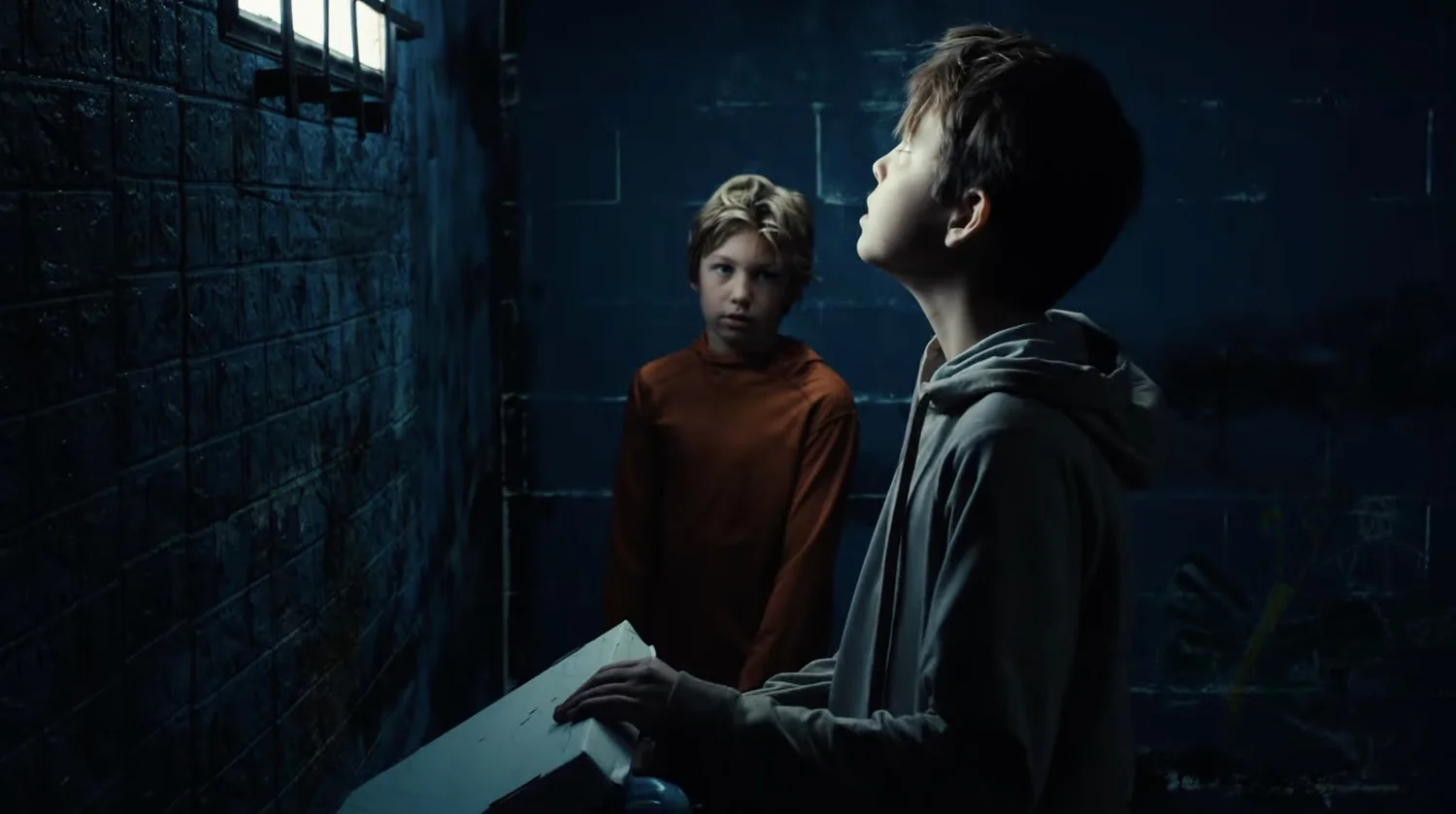
“Because our shot list was extremely ambitious, every choice had to be intentional. We even reversed the traditional color palette. Our darker, blue-toned Basement scenes are where the characters feel safest, which is why the camera movements are more freely and fluidly. Meanwhile, the warm light of the “Upstairs” becomes unsettling, almost deceptive.
“This inversion mirrors the story’s “happy family” façade. And the stillness of the shot choices also helps heighten that tension. Collaborating with talented artists to craft meaning through image, movement, and emotion is the pinnacle of joy for me as a director. With the right team, we are able to turn every creative decision into part of the storytelling.”
Wang is proud that those elements came together to create the uncomfortable atmosphere she had envisioned. Taylor’s performance became a major piece of it, while composer Robert Mai helped give the character his own musical identity.
“What I’m most proud of with The Man Upstairs is how fully it captures the tone and emotion I set out to create. From the very beginning, I wanted the audience to feel a chill and suffocating kind of terror; intimate yet deeply unsettling, that makes you want to hold your breath and feel the discomfort rising from the pit of your stomach.
“When Kennedy Taylor sent in his audition tape for “The Man,” I knew instantly he was the one to embody that fear. Kennedy carries this eerie detachment from reality that made the character both terrifying and strangely grounded. Kennedy brought precision, discipline, and layers of complexity that the audience can’t help but wonder what’s inside his head, but even more afraid to find out. Another highlight was working with composer Robert Mai to craft The Man’s musical identity. We wanted a theme that felt sacred yet sinister.
“It took us months to find the right sound. Once Robert learned about the Man’s backstory and his religious past, he was able to draw inspiration from the structure of hymns and created a haunting four-note motif. He even deconstructed his guitar and played directly on the metal strings to produce a gritty, unnerving tone. From performance to sound, every creative risk we took spoke the same emotional language. That unity of vision is what I’m most proud of, and it’s what makes the film uniquely ours.”
Despite the dark subject matter, working with the young cast produced some of Wang’s funniest memories from production. Apparently, fake dead bodies are pretty exciting when you’re a kid making a horror movie.
“Everyone knows working with kids on set comes with its own unique challenges, but for The Man Upstairs, it turned out to be one of my favorite parts of the process. They reminded all of us why we love making scary movies in the first place.
“The Man Upstairs’s subject matter is quite dark, and the kids were directly involved in almost every scene. From the very beginning, my producer Annalea and I were transparent with their parents about the story, the stunts, and the SFX makeup involved. Our priority was to make sure the kids felt safe, supported, and never overwhelmed by the material.
“But to our surprise, they were fearless, and honestly, hilarious. The moment they arrived on set, they were excited to do their stunts and kept asking when they’d get to “see the dead bodies.” They were even disappointed to learn they wouldn’t be the dead bodies! While I’d never expect that from every young actor, and I am forever going to advocate priotizing mental health of cast and crew, it was such a joy to see how resilient and enthusiastic they were about creating something scary. (I’m sure the chocolate cake on set didn’t hurt, either.)”
Production also faced a much more serious challenge when the Palisades fire broke out in Los Angeles during the week the team planned to shoot. With crew members in evacuation zones and access to the location affected, postponing became the only responsible option.
“The week of production, the palisades fire broke out in LA. A. We watched the updates anxiously, trying to decide if filming that weekend was still possible. By Thursday, the only freeway leading to our location was closed due to nearby fire with no signs of slowing down, and several of our cast and crew were in the evacuation zone.
“Everyone’s hearts were with the people affected, so we made the tough but necessary call to postpone the shoot. It was a stressful moment, but as a team, we believe that the mental and physical well-being of everyone on set always comes first.”
The film continued to evolve creatively as well. A major event from the feature screenplay originally wasn’t going to appear in the short, but feedback convinced Wang that it belonged there.
“In the feature version, there’s a character death I never planned to include in the short. But after getting notes from a few trusted friends, I realized that death defined both the tone of the story and the protagonist’s psychological shift. I rewrote the ending, and it became one of the film’s most defining moments.
“One of the perks of indie filmmaking is the creative freedom, fewer cooks in the kitchen. But that also means less built-in accountability. Moving forward, I always want to put my ego aside and actively seek out feedback, even when it’s uncomfortable. We can’t default back to “they just don’t get the story”. Sometimes the best creative decisions come from listening to the notes beneath the notes.”
Producer Annalea, cinematographer SungKuong, and production designer Fabio Del Percio were among the key collaborators who helped Wang shape the project.
“I worked with my producer Annalea for a couple of years. We were producing partners on a few projects prior to The Man Upstairs and I couldn’t be happier having brought her with me on this journey .She’s a very kind producer who always keeps an eye on the human side of things, which was essential for a story this dark and intimate. I first met my DP, SungKuong, a few years back when he was working as a gaffer.
“We immediately clicked as filmmakers and discovered we share the same work ethic and visual instincts. He has this rare ability to find beauty inside fear, and his eye for contrast and shadow brought an eerie elegance to the film that I absolutely love. Fabio Del Percio is one of the best production designers I’ve ever worked with, both as a director and as a producer.
“He’s creative, pragmatic, and collaborative. He listens closely to a director’s vision and still manages to infuse everything he touches with his own sense of style. I’ll always be grateful that I didn’t scare him off when I asked him to build me a basement. As for the actors, I met them all through Breakdown Express. We went through an extensive casting process to ensure the chemistry felt real and dynamic, especially under pressure. I’m incredibly proud of the cast we assembled and the trust they brought to every scene.”
One piece of filmmaking advice has followed Wang since her first music video gig, and it boils down to two words: “No excuses.” For her, it doesn’t mean pretending problems don’t exist. It means treating those problems as something that needs solving.
“A long time ago, an executive producer who gave me my first music video taught me a lesson I still carry: ‘No excuses.’ It was literally the password to the production computer. Back then, I used to argue: ‘It’s not an excuse, it’s a reason.’ But over time, I realized what he meant: don’t let external factors stop you from moving forward. Maybe you don’t have enough money for your production – that’s a reason. But it’s not an excuse to give up, but the beginning of problem solving.
“Filmmaking has always been about finding creative solutions when everything seems impossible and pushing your project forward no matter what. That’s the real spirit of what we do. On a practical level, I’ve also learned how critical post-production is to storytelling. It’s less glamorous, and it doesn’t come with the adrenaline of being on set, but it’s where your film truly takes shape.
“I now involve my entire post team (editor, sound designer, composer, etc.) before we even shoot. Their insight often changes how we approach scenes and coverage. Even if you don’t have a big team, bring a post-production mindset early. It’ll make you a stronger and more intentional filmmaker.”
The Man Upstairs has already traveled through the festival circuit, including screenings at Charlotte Film Festival and FilmQuest. It received a Best Short nomination at Atlanta Underground and won Best Thriller at HorrOrigins. The next goal is turning the feature screenplay into a reality.
“Our festival run so far has been incredible. The Man Upstairs has screened at both celebrated genre showcases and broader film festivals, traveling from Charlotte Film Festival to FilmQuest, earning a Best Short nomination at Atlanta Underground and winning Best Thriller at HorrOrigins. It’s been deeply rewarding to see the film resonate not just with horror fans, but with audiences beyond the genre as well.
“Making the short was always the first step toward the feature version of The Man Upstairs, which is already fully written. Expanding this world has been part of the plan from day one, and we’re now looking for the right producing and financing partners to help bring it to life. I can’t wait to pull audiences deeper into its dark, unsettling world, where fear runs deep, but ultimately leads to an unexpectedly hopeful ending.
“Writing The Man Upstairs helped me solidify my creative voice as a writer-director. I discovered that I love telling stories from a child’s perspective, especially in pre-teen years when they are beginning to form their own moral compass and sense of agency. Putting them in impossible situations forces both the characters and the audience to confront uncomfortable truths about choice, survival, and identity.
“Alongside that, I’m producing several feature projects, both genre and non-genre, staying deeply involved in shaping the stories from the ground up and making sure every project reflects strong, character-driven storytelling.”
Wang is already developing another project that continues her interest in horror stories seen through a child’s eyes, this time drawing from Asian culture and a dark Chinese cultural tradition.
“My next project is another horror story told through the eyes of a child, set within Asian culture. This is the first time I’ve explored this as a narrative filmmaker. Inspired by a specific dark cultural tradition in China, the story is reimagined through a supernatural lens.
“At its core, it examines the roles and value of women in the culture, and the courage it takes to defy predestined expectations. Tonally, it’s a bit like Ready or Not meets the darker, more surreal side of Beetlejuice; tense, a lot more gore, and eerily strange. I’m finishing the feature script this year and plan to adapt it into a short as a proof of concept. We are aiming to move into production in the latter half of next year, and hoping to bring the genre audience a fresh, gory story set in a brand-new world.”
For anyone who wants to see more of Wang’s work or get in touch, she says: “You can check out most of my past work on dbunnypictures.com and follow me on instagram: @wenderscolor Contacting me through Instagram dm would be the easiest.”
Of course, we couldn’t finish without asking about the movies that helped turn Wang into the filmmaker she is today. Her all-time favorite is Jurassic Park, with one particular sequence burned into her childhood memory.
“Jurassic Park is hands down my all-time favorite film, and I still watch it to this day. I watched it for the first time when I was 7 and I still remember watching the T Rex/water cup scene from under the coffee table.”
Another movie played an even more personal role. Wang learned English by repeatedly watching A Bug’s Life, while films including Knives Out, Edge of Tomorrow, Cloud Atlas, Nope, Prey, and A Quiet Place have become movies she studies as a filmmaker.
“I actually learned English at 12 years old by watching A Bug’s Life on repeat, and it literally changed my life. Even then, I knew that storytelling was what I wanted to do. In more recent years, there have been so many films that I watch and study almost religiously: Knives Out, Edge of Tomorrow, Cloud Atlas, Nope, Prey…It’s impossible to pick just one favorite. I especially love the design and world-building of A Quiet Place. If I ever make a film that makes an entire theater hold its breath like that, I can die happy.”
The Man Upstairs takes a familiar kidnapping nightmare and pushes it toward something more psychologically complicated, where escaping a locked room may only be part of the battle. With Wang already planning to expand the short into a feature, this disturbing little family nightmare could eventually become something much bigger.
Check out the trailer for The Man Upstairs and let us know what you think.