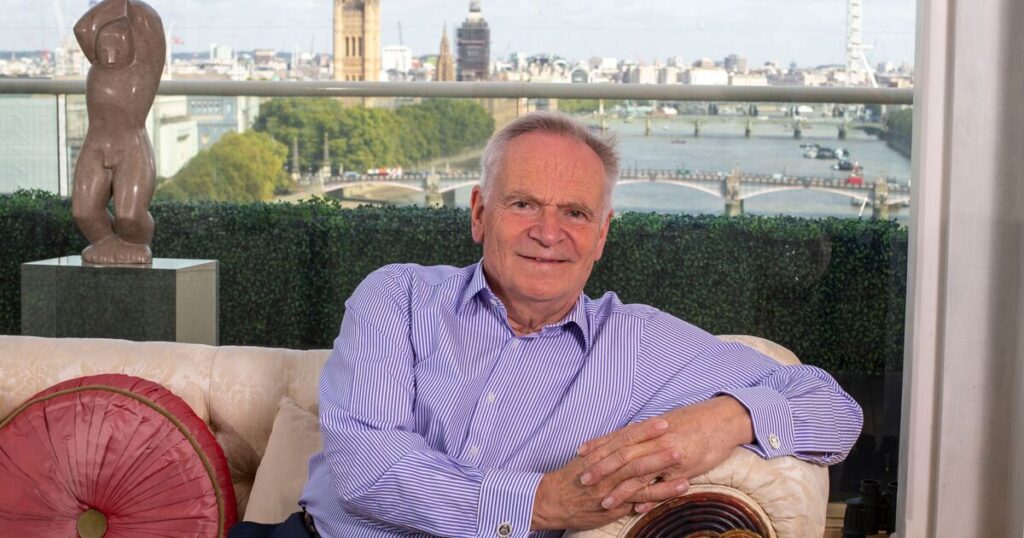


Jeffrey Archer [photographed by the Express in his Thameside apartment (Image: Steve Reigate / Express)
It is somehow fitting that the great literary and political showman Jeffrey Archer died in the midst of a marketing campaign the day before his final novel was published – thus assuring his passing, and his newly posthumous book, maximum publicity. His sudden death aged 86 on Monday – in between writing sessions, needless to say – provided the ultimate twist in the tale for an author who left the critics cold yet sold more than 300 million copies of 32 novels in 119 countries and 49 languages.
Having spent a staggering 14 years and five months on the Sunday Times bestseller lists, and five-and-a-half years occupying the New York Times charts, there are few writers who could match his sales let alone his prolific output. The same could be said about his political sway and sense of mischief, which saw him pinball between Westminster’s corridors of powers and Belmarsh Prison.
Yet he remained, even revelled in being, one of the most Marmite characters in modern public life – adored and admired by friends for his boundless energy, generosity and good cheer, as evidenced by the tributes, while derided as a scoundrel by his enemies. Even Queen Camilla expressed her sadness yesterday, describing him as “not without flaw” but an “irrepressible life force through all the many differing chapters of his life”.

With Queen Camilla in 2018 (Image: John Stillwell/PA Wire)
Three political careers as MP, Tory deputy chairman and prospective Mayor of London ended in calamity. But every time he got up, dusted himself off and carried on. In person he could be great fun – endlessly interested in people and an avid collector of stories and experts whose knowledge helped him craft his plots.
His boyish enthusiasm was on display in September 2023 as he barrelled around the Tower of London with the Daily Express on the eve of publication of Traitors Gate – the sixth volume in his ambitious eight-book William Warwick police series that began in 2019 when he was 79 – which featured the theft of the Crown Jewels. When we had previously met in 2019, he admitted: “I’m not a believer, though I do have a tendency to ask, ‘Can I do another book, please?'”
Despite such self-confessed atheism, he must have charmed someone because he completed the series last year with End Game before going on to write Adam and Eve. Though he told me then: “I’m 83 and I’ve lost 35 people in the last year… It makes you think about it.” By “it”, I assumed he meant his own mortality? “Don’t put sentences in my mouth, Matt,” he barked. “You’re a wicked man.”
His very first novel, Not a Penny More, Not a Penny Less, appeared in 1976 and it’s fittingly Archer-like that his final book, Adam and Eve, published yesterday, marked his 50th anniversary as a writer and bookended his career so aptly. It shares a premise with one of his most popular works, 1979’s Kane and Abel, which has reputedly sold more than 34 million copies around the world.
Both feature two children born within hours of each other who enter a world divided by everything except their date of birth – a theme common to Archer’s work being the gap between where people come from and where they end up. This interest almost certainly reflected his own life which, with its succession of improbable highs and crushing lows, soaring success and calamitous disasters, was as extraordinary as anything he dreamed up in fiction.
Not that it stopped him trying. His own story took him from a modest birth in 1940 in London – his mother Lola by then living apart from her confidence trickster husband William Archer – to the West Country shortly thereafter, first Bristol and then to the shabbily genteel seaside resort of Weston-Super-Mare where he grew up in straightened circumstances.

With wife Mary after being released from prison in July 2003 (Image: Geoff Robinson/Shutterstock)
In 1951 aged 11 he won a scholarship to Wellington School near Taunton, later declining to correct the mistaken assumption he had been at the famous Berkshire public school, Wellington College, although last Friday he returned to his alma mater to be interviewed in the library which he credited as a source of early inspiration.
Having left school in 1958 he spent a few months at Sandhurst Military Academy, embarking on short-lived careers as a police constable in the Met Police and as a PE teacher, before three years at Oxford studying for a diploma in education. While he never graduated, Oxford set him on the path to fame and fortune when he threw himself into athletics, running for the university, and fundraising – famously being photographed with The Beatles while championing Oxfam.
It was also at Oxford that he met his future wife Mary Weeden, an undergraduate reading chemistry at St Anne’s. They married in 1966 and celebrated their 60th wedding anniversary earlier this year at the family home, The Old Vicarage in Grantchester. “Life with Jeffrey is never dull,” she once admitted, as well she might.
Pursuing a career in politics, Archer was elected to the Greater London Council as a Conservative member for Havering in April 1967 and, two years later in December 1969, won a by-election for the safe Tory constituency of Louth in Lincolnshire.
He was in the Commons for less than five years but earned his spurs as an articulate and confident speaker with a streak of independence. At this point, had things worked out differently, he might have enjoyed a long and possibly distinguished political career and now be long-retired and all but forgotten.
Instead, as so often happened in his books, hubris and the need for ready cash preceded a dramatic fall from grace when he found himself £250,000 in debt, after pursuing a get-rich-quick share tip that turned out to be fraudulent. Forced to stand down from Parliament in 1974, and with a young family to support (by now he and Mary had two sons, William and James, all of whom survive him), he turned to fiction.
He was charming, warm and humorous, by Leo McKinstry
The flames of Lord Archer’s creativity remained undimmed at the time of his death. Full of boundless energy, driving ambition and ideas for new projects, he still had a phenomenal capacity for work, as indicated by his habit of rising at 5am. Typically, he was working right to the end. What gave added poignancy to this final burst of dynamism was its focus on the imminent launch of his new book, Adam and Eve, a love story set in the build-up to the Second World War, with a gripping climax that centres on Hitler’s plans to invade Britain in September 1940.
The book has all his trademark verve and will inevitably become a bestselling monument to his genius as a storyteller. Even before his death, he had decided this would be his final novel because he believed that he could never produce such a compelling tale again. His claim fills me with a special sense of pride because I was lucky enough to be involved in the development of the manuscript, for Jeffrey was amazingly generous in declaring that my own non-fiction book on Operation Sealion, published more than a decade earlier, had been one of the primary inspirations behind Adam and Eve.
I had met Jeffrey a few times over the years but I cannot say I knew him well. Then one afternoon last year I was sitting in my office at home when the phone rang. “Jeffrey Archer here,” he barked in that inimitable Sergeant Major-style. He explained that he wanted me, supposedly the expert on Operation Sealion, to give my verdict as a historian on the early draft of his novel. It seemed absurd that I should be advising one of the world’s best selling authors, but as soon as I started to read the manuscript I was mesmerised.
Subsequently he and I had several meetings to discuss the draft in his famous penthouse at Westminster where he also displayed his magnificent French art collection. Throughout our discussions, he was charming, warm and humorous, full of stories about politics and history, though neither could resist talking about our favourite subject: cricket, with a particular focus on his beloved Somerset. As it turned out, there was not much advice I could give him since the draft was already superb, though he lavished praise on my contribution, which was characteristic of his spirit.
The great sadness is that he will not be here to see the final crowning glory of his career. The literary world has lost one of the shining stars. But it was an honour to know him.

Irrepressible Archer at Tower of London promoting Traitor’s Gate in 2023 (Image: Jonathan Buckmaster / Express)
Not A Penny More, Not A Penny Less, featuring not by chance four ordinary men stung in a share fraud who team up to get revenge on the conman, was published in 1976 after several rejections and became a huge hit – today having sold some 30 million copies worldwide – and he was up and running as a writer. It was followed in short order by Kane and Abel, The Prodigal Daughter, First Among Equals, A Matter of Honour, Honour Among Thieves, Shall We Tell the President? among many others, each commanding a greater advance and winning new readers.
He was newly rich, the proceeds funding the purchase of not only his Grantchester home but a luxurious two-storey Thameside penthouse apartment overlooking Parliament which housed an incredible art collection. Visitors might look up while washing their hands to find themselves face-to-face with a Hockney.
His own story would undoubtedly have turned out quite differently had Archer settled on the life of an author. But he hankered after a return to politics and, in 1985 despite warnings from confidantes, Margaret Thatcher made him deputy chairman of the Conservative Party where his oratory made him a huge hit on the fundraising circuit.
Once again, he crashed calamitously when in October 1986, the News of the World accused him of paying off prostitute Monica Coghlan.
A libel action against the Daily Star, which followed the story less carefully, saw Archer triumph, winning £500,000 in damages after the judge, Mr Justice Caulfield, improbably suggested no man married to the “fragrant” Mary Archer could ever cheat. That triumph, a hollow victory if ever there was one, laid the foundation for his most damning fall from grace.

Lord Archer shows Express Associate Editor Matt Nixson round the Tower of London (Image: Jonathan Buckmaster / Express)
Having befriended John Major, he was knighted as Lord Archer of Weston-super-Mare in 1992 and plunged once more into politics. He shrugged off another shares scandal involving Anglia TV to win the Tory nomination for the newly created post of elected mayor of London. But by now he had fallen out with a former friend, Ted Francis, who had provided a false alibi during the Monica Coghlan case, and he was caught on tape by the News of the World admitting his deceit. This time there was no escape and in 2001 he was convicted of perjury and perverting the course of justice and jailed for four years.
As ever with Archer, tragedy begat triumph with the three volumes of prison memoirs, all bestselling, before once more picking up his career as a novelist.
There was sadness and some disbelief in January when he revealed Adam and Eve would be his last novel, even while admitting: “I can’t quite imagine putting my pen down for good.”
But as it turned out, it was his last. No doubt another nailed on bestseller for the master storyteller. He remarked memorably of his 2023 heist book, Traitor’s Gate: “It’s the one type of thriller where we almost want the baddies to get away with it… and in this case, they do.”
Perhaps they weren’t alone. RIP Jeffrey Archer.