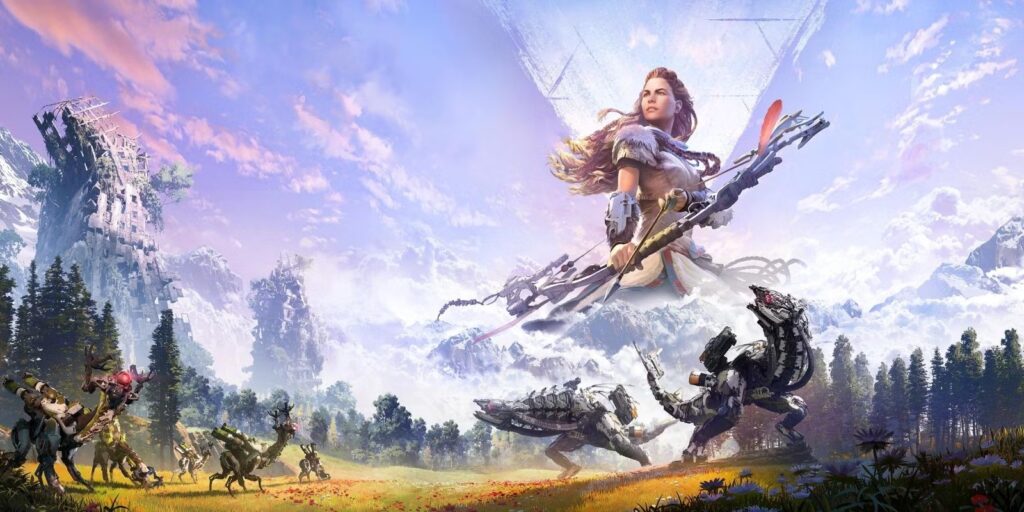

Hollywood has spent years struggling to turn video games into cinematic franchises, but Horizon Zero Dawn has the potential to overhaul the post-apocalypse subgenre of science fiction. Featuring a future Earth where tribal societies hunt Transformer-esque machines that resemble animals both extant and extinct, this live-action adaptation was announced by Sony and PlayStation Productions in early 2025.
Very little is known about the Horizon Zero Dawn movie, with no cast or director announced, but the very premise makes the comparisons to Transformers and Jurassic Park almost inevitable. And yet, the video game’s richly innovative world-building, expressive storytelling, and poetic hybrid of hard sci-fi and tribal fantasy promises a cinematic adventure to define the 21st century. The bones are there; what matters is how they’re fleshed out on film.
Horizon Zero Dawn Reinvents the Post-Apocalyptic World

The popularity of the post-apocalypse in 21st-century entertainment stems in part from genuine anxieties about the future. From the poignant analysis of the human condition in Children of Men and the brutal meaninglessness of survival in The Road to an endless list of zombie shows and movies that transform societal collapse into visceral horror, the genre repeatedly elevates contemporary fears into speculative nightmares.
Post-apocalypse fiction usually begins with destruction before interrogating the fate of humanity, but Horizon Zero Dawn immediately flips that familiar perspective. The world-ending event happened a thousand years before the story even begins, so those living in its aftermath have no real understanding of what broke their ancestors.
Instead of ruined cityscapes serving as decaying monuments to catastrophe, nature has engulfed the past almost entirely. Tribes of every ilk hunt, trade, worship, fight, and build fledgling societies amid the rusted remnants of a technological civilization so advanced that relics are often interpreted as supernatural or divine. The game’s tagline — “Earth is ours no more” — captures the strange paradox of tribal humans surviving alongside the so-called machines.
Horizon Zero Dawn is set in the vast geographies of North America, allowing its visual identity to evolve as the player takes Aloy between locations. Lush forests, snow-capped peaks, sandy deserts, grassy plains, and other natural environments are on full display, each region populated by distinctive “breeds” of machine that make everything look simultaneously prehistoric and high-tech. That said, it’s important to note that these machines aren’t just monsters to destroy in an open-world RPG.
The wide array of machines essentially reflects and maintains the New World’s ecological architecture. To name a few examples, Striders and Lancehorns graze, Watchers and Longlegs patrol, Ravagers and Snapmaws threaten, Scrappers and Glinthawks scavenge, and enormous entities like Thunderjaws and Stormbirds function as apex predators. Aloy studies their behaviors, identifies vulnerabilities, learns to override them, and gradually understands the complex network undergirding this artificial ecosystem.
And Horizon Zero Dawn doesn’t limit its atmospheric complexity to the machines and the secrets surrounding them, with Aloy interacting with a remarkable assortment of peoples across tribes and cultures. The Nora, the Carja, the Oseram, and the Banuk feature a motley of beliefs, traditions, and histories, not to mention an equal level of diversity in terms of clothing, cuisine, craftsmanship, and custom. In the end, however, everything comes back to the robots.
Transformers derives its spectacle from the collision between machinery and modernity, and Horizon marinates in the profound coexistence of nature and technology, but both of them perceive machines as elements of combat. Much like in Jurassic Park, where humanity’s greed directly leads to the creation of dinosaurs, Horizon presents science itself as the source of the apocalypse. And yet, Sony’s iconic RPG stands above both comparisons by eventually reframing technology as an instrument of true evolution.
The upcoming adaptation has the potential to transcend the standard post-apocalypse formula — Horizon Zero Dawn doesn’t command its viewers to mourn the corpse of the Old World, but rather to discover what blossomed from its bones. Sony needs to preserve that important distinction: a fictional universe that needs no rebuilding because it has already recontextualized itself into something bizarre, beautiful, and almost completely beyond original human memory.
Any Horizon Adaptation Must Preserve Its Mystery and Humanity
The easiest mistake a Horizon Zero Dawn movie could make is treating its premise as the selling point instead of the story. Massive robotic animals roaming a future Earth is enough to fill a trailer, but they are simply one aspect of Aloy’s incredible journey through the game and its sequel, Horizon Forbidden West. Ultimately, what matters is how a seemingly straightforward tribal adventure morphs into an archaeological mystery about extinction, technological hubris, motherhood, and humanity’s relationship with its forgotten past.
Aloy’s adventures are framed as investigative mysteries, gradually revealing the jigsaw pieces that explain why her world exists the way it does — and offers her a path toward preventing a second apocalypse. She begins with remarkably little knowledge, even less than her Nora peers, surviving as an outcast with only Rost as her safety net. But Aloy soon discovers the value of her own existence, far beyond the society that once rejected her.
The audience must experience the truths of the Old World alongside Aloy, sharing her pace and her emotions as she digs through the centuries. Sometimes, she doesn’t even understand what she’s seeing, and that only makes the story feel more mysterious and fascinating. That said, a film adaptation demands the process be accelerated, with a two-hour runtime not being nearly enough to cover the sheer wealth of information scattered across Horizon. This is especially important if Sony plans to incorporate elements from Forbidden West‘s much larger canon.
Pacing aside, maintaining the tension of the unknown also protects the movie from the Chosen One archetype, which Aloy technically belongs to. She was indeed selected by a “higher power” for a grand mission that will “save the world,” but her enduring relationship with nature means that her destiny will never overshadow her identity. Like Horizon Zero Dawn itself, Aloy is a blend of the tribal and the technological, faith and logic, myth and reality, the perfect symbol of a world that remains split between the past and the future.
And she could never truly straddle entire timelines without compassion — even if Aloy’s empathy occasionally resolves into admittedly harsh moments of tough love, that just makes more sense considering her survivalistic nature. A movie that focuses too much on action shots of Aloy taking down Thunderjaws and Behemoths would lose that dimension of humanity, a cardinal sin committed by the worst installments in the Transformers and Jurassic Park franchises.
Instead, Horizon Zero Dawn should feel as epic and energetic as the original Jurassic Park while drawing from Transformers‘ mastery of mechanical spectacle — and without reducing its monstrous entities to mere instruments of war, which both franchises have been guilty of. The promise is clear; the game is a triumph of storytelling. But will Sony break the “curse” long experienced by cinematic adaptations of video games?
In the last few years, television has adapted a number of sensational video game masterpieces into equally sophisticated shows, with The Last of Us, Arcane, and Fallout standing at the exemplary top of that list. Meanwhile, there has not been a single film adaptation that can be described as impressive, let alone reach the groundbreaking heights that Horizon Zero Dawn has the potential for.

- Released
-
February 28, 2017
- ESRB
-
T for Teen – Blood, Drug Reference, Language, Mild Sexual Themes, Violence
- Developer(s)
-
Guerrilla Games
- Publisher(s)
-
Sony
- Engine
-
Decima
- Steam Deck Compatibility
-
Verified
- PC Release Date
-
August 7, 2020