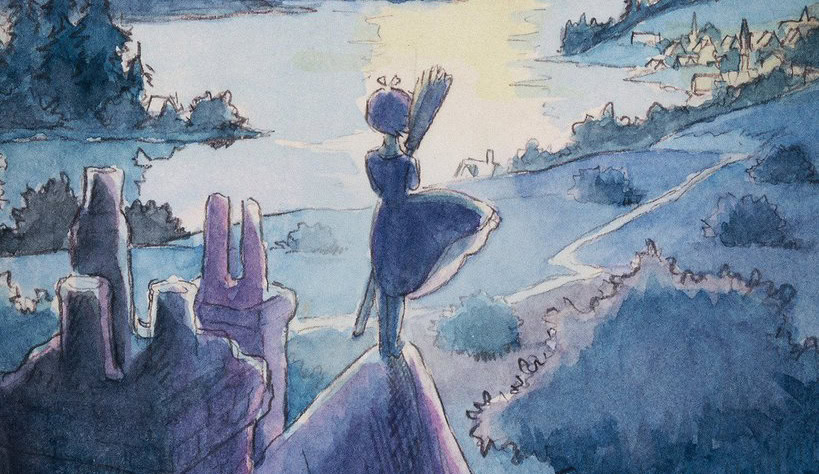

As part of his “Great Movies” series, Roger Ebert described Hayao Mitazaki’s My Neighbour Totoro as a film “based on experience, situation and exploration, not on conflict and threat.” Of all Miyazaki’s subsequent films, the one that best captures this essence is Kiki’s Delivery Service. Like Totoro, it has little traditional conflict; instead, its drama comes from simply being young and trying to find your place in the world. What sets Kiki apart though, is the way Miyazaki combines this with a tender coming-of-age story, one that gently tugs on the heartstrings without ever feeling heavy-handed.
Kiki’s Delivery Service has been a lifeline for Studio Ghibli twice over now. Upon its original release, it became a huge commercial success, helping turn the studio around after the disappointing box-office returns of My Neighbour Totoro and Grave of the Fireflies. Now, it’s the first Ghibli film to be released under the GKIDs banner, following former distributor Elysian Films going into insolvency. It’s a canny choice, capturing both the innocence and loose storytelling of early Ghibli and the vivid characterisation and meticulous animation of Miyazaki’s later work. With an IMAX release followed swiftly by a 4K release in cinemas, this is undoubtedly the best opportunity to see it on the big screen.
Based on Eiko Kadono’s novel, the film follows Kiki, a headstrong young witch who, according to tradition, leaves home at 13 to complete her training, accompanied only by her sardonic black cat Jiji. Settling in the port city of Koriko, Kiki turns her ability to fly into a delivery business, quickly establishing herself as a conscientious and reliable member of the community.
Anyone expecting something like Sabrina the Teenage Witch or The Worst Witch may be surprised by how little magic there actually is. At heart, this is a film about growing up: taking your first steps towards independence, discovering what you are good at and figuring out what kind of person you want to be.
The most poignant illustration of this is Kiki’s relationship with Jiji. Initially inseparable, Jiji is her companion, confidant and snarky conscience. But as Kiki grows up, she can no longer understand him. It’s never spelled out but it’s suggested that her childhood is slipping away. Kiki begins the film as a carefree, wayward teen, and through the film gains independence, but this comes at a cost, having to navigate the world without the comforting voice that has always been beside her.
The character work is some of Miyazaki’s best. Kiki herself is one of Miyazaki’s most likeable, relatable protagonists, an outgoing, determined character who’s sweet without ever tipping over into annoying. Meanwhile, Jiji remains one of the most iconic Ghibli characters, with only Totoro and Spirited Away’s No-Face more recognisable today. He’s a dryly comic, beautifully animated character, full of personality that balances nicely with Kiki’s defiant optimism. Even the minor supporting characters are instantly lovable, from the brawny, taciturn baker to the plodding old dog who takes a liking to Jiji. All of them are full of character without uttering a word.
The animation is sublime, with the soaring vistas and beautiful cityscapes up there with Princess Mononoke in terms of scale, albeit a lot more metropolitan, with Kiki often dwarfed by soaring man-made structures. Miyazaki’s fascination with aviation and flying machines is also out in full force, embodied in Tombo. There’s something unbearably sweet about a character obsessed with planes who falls for a broomstick-flying witch, and Miyazaki depicts their relationship with the same earnestness and warmth that defines the film.
Unlike My Neighbour Totoro or Spirited Away, which contain natural points in the story that feel almost calibrated to bring you to tears, Kiki’s Delivery Service has no obvious tear-jerking moments. Instead, it accumulates tiny character beats, and moments of humanity that prove unexpectedly, almost intangibly, moving. In this way it’s a markedly more mature film than Miyazaki’s previous work, dealing with sophisticated themes like loneliness, loss of identity and feelings of inadequacy.
More than 30 years after it’s original release, Kiki’s Delivery Service remains one of Miyazaki’s most touching and heartfelt films. It retains the humanity and optimism of My Neighbour Totoro, adding greater depth of character and a more cohesive narrative, without sacrificing the loose, playful personality that has made Miyazaki’s films endure so well,
Kiki’s Delivery Service is in cinemas in IMAX from 21 August and in 4K nationwide from 28 August.