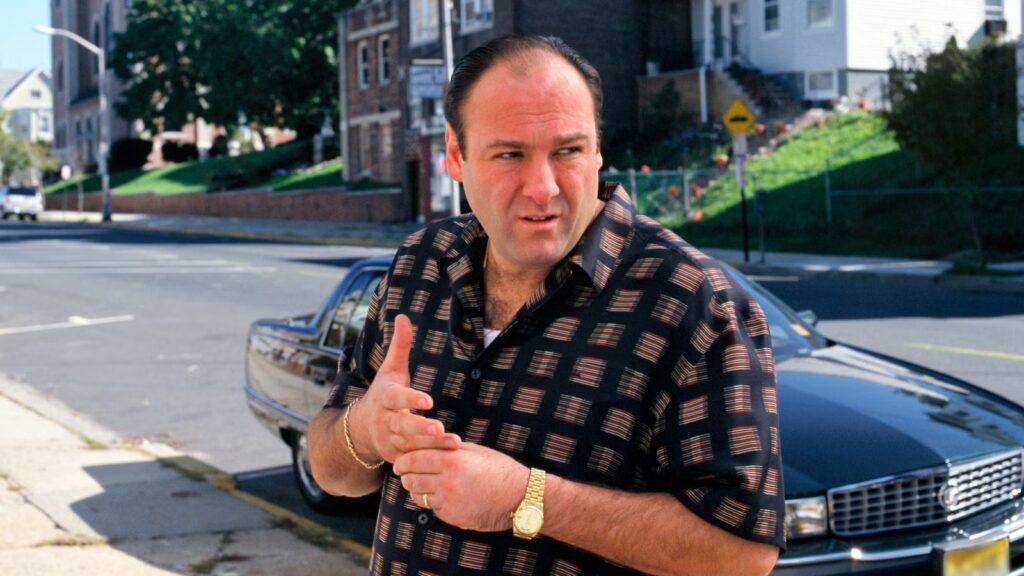

The Sopranos is a deftly crafted drama that features a magnetic leading character. James Gandolfini was clearly bringing a piece of himself to a role that was intensely personal and confronted the shallows in a visceral way that extended far beyond regular gangster stereotypes.
Solidifying the series’ status as a beloved, legendary piece of TV is a memorable cast of supporting characters as well. Who could forget Paulie and Christopher’s foray into the Pine Barrens? Their dynamic culminates in a bizarrely memorable episode that reads more like an existential stage play, yet still perfectly fits within The Sopranos universe and long-form narrative.
Understandably, there are a lot of fans of the series who’ve watched it, and watched it again, and kept watching it long after the series finale’s credits rolled. While it’s difficult to fault anyone for finding comfort in a favorite show, they may want to heed Kimo from Forgetting Sarah Marshall‘s advice when he tells Peter: “It’s like The Sopranos. It’s over. Find a new show.”
And just like Segel’s character was able to move on from heartbreak and into another relationship, there are plenty of other crime/gangster dramas fans of The Sopranos can enjoy. Despite being fantastic watches, they aren’t given the same fanfare as the early 2000s mafia series.
Boardwalk Empire

This one feels like cheating: Boardwalk Empire was a massive success for HBO and featured a slew of top talent, but still doesn’t get the same love as The Sopranos. Plus, it helped to turn throngs of actors into bona fide stars, and gave established talent free rein to flex their creativity. Bobby Cannavale wasn’t just known by NY theater lovers for his performances in “The Motherf***er with the Hat.” He chilled viewers with his on-screen portrayal of the sadistic Gyp Rosetti.
Charlie Cox also secured his role as the MCU’s Daredevil thanks to his portrayal of Owen Sleater in the HBO series. Steve Buscemi did a phenomenal job as the series driving force, demonstrating a variegated, performative excellence throughout. Jack Huston’s Richard Harrow, Michael K. Williams as Chalky White … the list of talent goes on.
With 56 episodes, cinema-quality production value, intriguing twists and turns, and surprising deaths, this period piece details what crime was like in New Jersey well before the Goodfellas era arrived.
Gomorrah

While The Sopranos romanticizes mob life a bit (in between brutal murders, anyway), Gomorrah does no such thing. In fact, this type of bleakness doesn’t just dictate the pacing and plot points of its 5-season narrative, but it permeates its aesthetic as well. Gomorrah is primarily filmed in Naples housing projects on a primarily blue and gray camera lut. Whenever violence is portrayed in the series, it is brutal and performed without pomp and circumstance.
One intriguing theme that Gomorrah presents is that of an inversion of the prodigal son parable. Gennaro Savastano is transformed from a spoiled rich kid who spends his entire existence partying. After being sent to the Honduran jungle by Dona Imma to either get killed or toughen up, Gennaro returns as a beast of a crime boss.
Gomorrah, like The Wire, is also rooted in serious investigative reporting of the drug trade at large. When watching the show, if you feel like its depiction of cocaine distribution, money laundering, and political corruption feels a bit too real, it’s because it is. Its source material is derived from years of research conducted by journalist Roberto Saviano.
Animal Kingdom

One of Ben Mendelsohn’s most talked-about performances was in 2010’s Animal Kingdom, a film that took inspiration from the infamous Melbourne, Australia, Pettingill crime family. While this version of Andrew “Pope” Cody doesn’t appear in the US TV series of the same name, the two do share thematic DNA.
Mendelsohn’s Andrew “Pope” Cody’s oppressive, looming control over his family is supplanted by Ellen Barkin’s depiction of Smurf as a matriarch who uses every toxic trick in the book to rule the lives of her sons. Seeing her pit them against each other and string them along to conduct a series of high-pressure heists. Unlike other mafia/gangster shows, Animal Kingdom‘s main characters don’t primarily earn their money through extortion.
They don’t exactly lead lavish lifestyles, either. Smurf controls all of their finances and launders everything through legitimate real estate ventures. This leaves her boys constantly turning to her for money. While some viewers were bummed out with Scott Speedman’s exit from the series, others thought the way the show concluded more than made up for it.
Bad Blood

Bad Blood uses the 2015 book Business or Blood: Mafia Boss Vito Rizzuto’s Last War by journalists Antonio Nicaso and Peter Edwards as the basis for its source material. Starring the always excellent Kim Coates, the series follows the Rizzuto crime family’s rise to power in Montreal, Quebec, Canada.
While the DNA of Martin Scorsese’s sex and religion-addled themes can be found in The Sopranos, Bad Blood‘s lens presents a slightly more corporate side of organized crime. It excels at effectively splitting the difference between old-school, mob loyalty tropes and business dramas. That’s not to say it doesn’t sport its fair share of action and violence, especially in its second and final season.
Godfather of Harlem

If you like watching dramatized depictions of criminals in slick suits and carrying the threat of violence with every step, then Godfather of Harlem won’t disappoint. Throw in a blend of 1960s period-piece backdrops, along with historically influenced scene work where Forest Whitaker’s Bumpy Johnson interacts with Malcolm X, Muhammad Ali (when he still went by Cassius Clay), Adam Clayton Powell Jr., and the Italian mob.
What makes Godfather of Harlem such an interesting watch is how deftly it incorporates shifting cultural mores in America under the incendiary social changes ignited by the Civil Rights movement. But the series doesn’t feel like the Ken Burns documentary your elementary school teacher rolled out on the VCR cart. Malcolm X and Bumpy’s relationship in the show serves as a compelling narrative focus.
Seeing the two men entirely devoted to their communities but serving them in entirely different ways is brilliant two-hander writing. Bumpy’s rival in Chin Gigante also makes for great dramatic TV. Seriously, the lengths Chin’s character goes through to avoid going to trial is an absolute joy to watch.
Snowfall

When journalist Gary Webb reported on the CIA’s involvement with LA’s crack-cocaine epidemic, he was demonized as a sensationalist journalist drumming up tenuous connections for a series of scintillating articles. But Father Time has exonerated Webb, long after his reported suicide, and Snowfall‘s narrative is intrinsically tied to the work many believe Webb was killed by the CIA for.
The sprawling geopolitical stakes of clandestine drug operations are the backdrop for what is effectively a fall from grace for Franklin Saint. Viewers watching his journey from a small-time weed dealer looking for a way to get rich to a full-blown calculating cocaine kingpin makes for a terrific character arc.
Like any good gangster drama, Saint flies too close to the sun, and his drug empire becomes too unwieldy to handle. What sets Snowfall apart is that it dramatizes the discovery of drug peddlers crafting a new economy from scratch with the discovery of crack cocaine. If you’ve never watched the FX series, there’s a total of 60 episodes across 6 seasons to stream, as well as a new spinoff titled The Drop: A Snowfall Saga.
Snabba Cash

There probably hasn’t been a more effective first episode at setting up character stakes while conveying what an entire show’s world and tone is about better than Snabba Cash‘s opening. It expertly presents a bifurcated, juxtaposed narrative in a modern, sleek, utilitarian aesthetic that still manages to brim with humanity.
Two primary character arcs dominate the show’s narrative: Laya and Salim’s. Laya is a single mother fighting to secure funding for her tech startup business, Target. Salim is a highly profitable drug outfit’s hitman who’s tired of the constant violence and looming threat of death everywhere.
These two worlds converge in satisfying ways, and the show’s fast pacing, brilliant photography work, and incredible performances will make you wish there were more than two seasons.
Narco-Saints

This six-episode miniseries dramatizes the astounding real-life story of Cho Bong-Ha, a Korean businessman working out of Suriname in the late ’90s and early aughts who finds himself wrapped up in a high-stakes entrapment scheme with Jeofrey Chang, a profitable drug dealer who worked alongside Surinamese politicians.
Because Narco-Saints tells its entire narrative in a relatively short amount of time, not a single second is wasted. It blazes through its narrative, giving its characters and audience little room to breathe.
Gangs of Oslo

Another six-episode miniseries, Gangs of Oslo is set in a brutal, cold criminal underground of one of Scandinavia’s most affluent cities. The show’s tone is injected with a heightened sense of claustrophobia and panic amongst its characters. It also heavily deals with the themes of redemption and reconciling with one’s past. Moaz Ibrahim’s character came up as a gangster who is now trying to leave that life behind.
However, ties to childhood friends still in the game have him constantly worried about his former life coming to light. And this illegal past is being weaponized against him, as he attempts to balance his new life as a keeper of justice and being manipulated by a gang leader who demands Ibrahim swear fealty.
My Name

Revenge is a massive theme in Korean cinema, and the eight-episode limited series My Name furthers this trend, but there’s a bit of a twist: the show follows Kim Jin-min, a young woman who witnesses her father’s murder on her birthday. Instead of talking to a therapist, she joins South Korea’s most powerful drug cartel in the hopes of discovering who ended her dad’s life.
This path leads her to become a double agent after she tracks down her dad’s killer in the police force. Kim takes up detective duties, feeding the cartel information the entire time she attempts to learn the identity of the murderer.
Watching Kim transform from a grieving young woman into an absolute savage hitwoman in the action-packed series is a delight to watch. And there’s plenty of nail-biting moments as she strives to keep her intentions from coming to light.