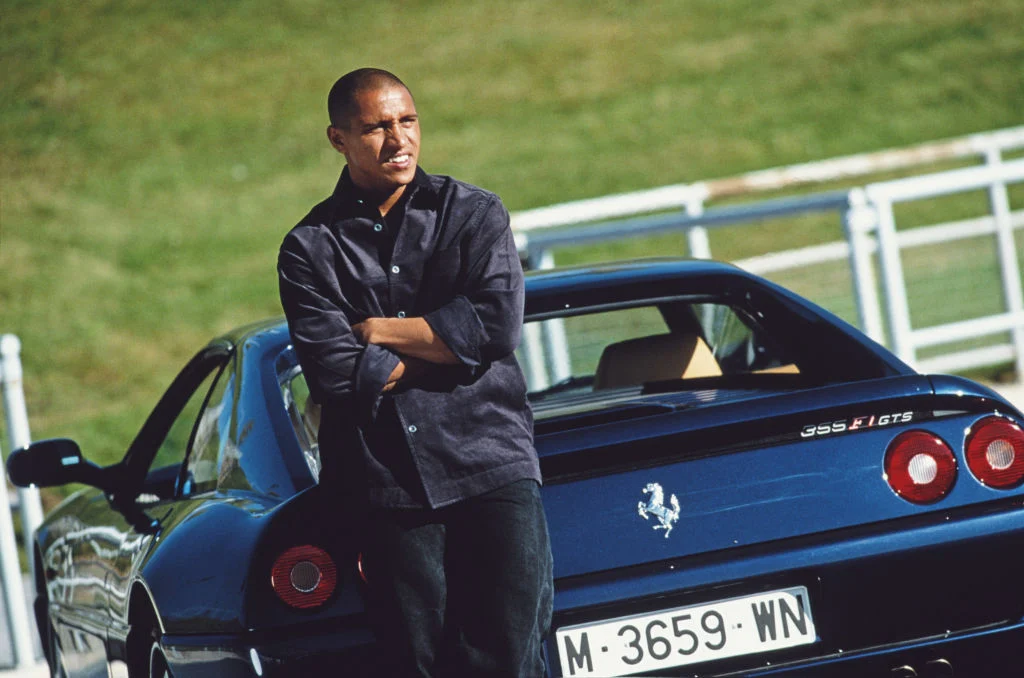

For a stretch of the late 1990s and early 2000s, Roberto Carlos was one of the most famous and electrifying soccer players on the planet.
Roberto Carlos technically played defense, but his speed, explosiveness and ability to attack made the normal limitations of his position almost irrelevant. He could race the length of the field, blast shots from distances where most players wouldn’t even consider shooting and bend free kicks in ways that looked physically impossible.
His most famous example came during a 1997 match between Brazil and France. Carlos lined up a free kick from more than 30 yards away and hammered the ball toward goal. At first, it appeared to be sailing hopelessly wide. Then it curved violently back toward the net and slipped inside the post. The goal became one of the most famous free kicks in soccer history and eventually inspired physicists to study how a ball could move that way. Here’s a video of the legendary shot:
But Carlos wasn’t merely a human highlight reel. He spent 11 seasons with Real Madrid, appearing in 527 matches and helping the club win four Spanish league titles and three Champions League trophies. He played alongside superstars including Zinedine Zidane, Luis Figo, Ronaldo and Beckham and became one of the defining players of Real Madrid’s famous “Galácticos” era.
For Brazil, he played in three World Cups and helped his country win the tournament in 2002 after reaching the final four years earlier. He made more than 120 appearances for the Brazilian national team and, at his peak, was considered not merely the best left-back in the world but one of the best soccer players on Earth. In 1997, he finished second to Ronaldo for FIFA World Player of the Year. Five years later, he finished second to Ronaldo again, this time for the 2002 Ballon d’Or.
His life away from the field was nearly as colorful. Carlos has 11 children with seven different women and has been married twice. He was especially close with Ronaldo during their playing days, and the pair became fixtures of the glamorous and occasionally chaotic social scene surrounding Brazil’s national team and Real Madrid. Carlos once joked that he had spent more nights sleeping alongside Ronaldo during their years traveling together than he had with his two wives.
His success on the field made Roberto rich. Extremely rich. Especially by late-1990s/early 2000s soccer standards.
When Roberto Carlos renewed his Real Madrid contract in 2000, he received an $8.5 million signing bonus on top of a $5.1 million annual salary. Real Madrid also covered the rent on his home and six trips to São Paulo every season. After leaving Madrid in 2007, he signed with Turkey’s Fenerbahçe, where he earned €4.2 million net per season.
Even in the twilight of his career, the massive paychecks continued. In 2011, at age 37, Russian club Anzhi Makhachkala gave him a contract paying €6 million — then $9 million — per year. Carlos eventually played into his 40s, making his final appearances as a player-manager in India in 2015.
By the time his playing career was over, Roberto Carlos had earned $180 million from soccer. Unfortunately, a combination of personal spending, those 11 children, two marriages, bad investments, and bad agents wiped 99% of his fortune away.

(Photo by Clive Brunskill/Getty Images).
Agents And Family Problems
Carlos made the stunning admission at the Portugal Football Summit in September 2026 during a discussion about building a personal brand and preparing for life after soccer. He said people he trusted had effectively emptied his bank account.
“Because of agents and family issues, I lost 99% of everything I had earned in footbal.”
If you apply that percentage to $180 million in career earnings, Carlos is describing the loss of more than $178 million. He did not provide a complete accounting of where every dollar went, but he pointed to two major areas: a serious dispute involving a former agent and what he described as an extremely serious family problem.
That second part is especially intriguing considering the complexity of Carlos’s personal life. Again, he has 11 children with seven women and has been married twice. Carlos did not identify the family members involved in his financial problems, so there is no basis for blaming his children, wives, ex-wives or any particular relative. But his description makes clear that his financial collapse was tied not only to business relationships but also to problems within his personal life.
Carlos described discovering the extent of the damage with almost cinematic suddenness. On a Thursday night, he went to bed at midnight. The next day, he says, he was presented with a stack of documents he didn’t even know existed.
“There I lost my whole history,” Carlos recalled.
Carlos also accepted some responsibility for what happened. He told the audience that he had made mistakes and now shares his experience with younger players in hopes that they will not repeat them. What makes that warning especially striking is that Carlos says he actually did think seriously about life after soccer. Before retiring, he obtained a sporting director’s license, cultivated endorsement relationships and tried to build a career that could continue long after his playing days ended.
According to Carlos, the problem wasn’t simply a failure to plan for retirement. It was trusting the wrong people.
The $1 Million Soccer Club Disaster
Carlos’s latest revelations become even more interesting when you go back nearly two decades. In a 2008 interview with Brazilian news outlet UOL, Carlos publicly accused his former agent, Élio Oliveira Júnior, of mishandling his assets and putting properties in the agent’s own name.
According to Carlos, Oliveira told him that his fame made it preferable for certain assets not to be registered directly in Carlos’s name. Carlos said some property was eventually returned to him, but he still lost significant sums of money.
Then there was the soccer club.
Carlos wanted to acquire Ituano, a Brazilian club based in São Paulo state. To fund the deal, he says he went to Real Madrid and obtained a $1 million advance. One of the biggest stars at the biggest soccer club in the world was essentially borrowing $1 million against his compensation so he could become involved in owning a soccer team back home in Brazil.
Carlos believed he had bought Ituano. Then he took a closer look at the paperwork.
According to Carlos, the entity controlling the club was in the name of his agent’s wife. “I asked for a $1 million advance from Real Madrid and bought Ituano,” Carlos explained in the 2008 interview. When he investigated the arrangement, he said he discovered the club was instead in the name of Oliveira’s wife.
Carlos described his former agent as having treated him maliciously. The ownership history gives weight to the central part of his story: in 1999, a company headed by Érika Sheila Adrigo Minelli, Oliveira’s wife, took control of Ituano’s soccer operations. The original club retained just a 1% interest.
For Carlos, the experience became an early warning about athletes surrendering too much financial control to advisers. In that 2008 interview, he said the ordeal could have left him with nothing.
At the time, that apparently hadn’t happened. Nearly two decades later, Carlos says it did.
$180 Million Down To 1%
The scale of the collapse is difficult to comprehend. This wasn’t an athlete who enjoyed one or two good seasons and signed a single life-changing contract. Roberto Carlos played professionally for more than two decades. He spent 11 years at Real Madrid, won the World Cup, won three Champions League titles and played more than 500 matches for one of the world’s richest and most famous sports organizations.
He earned millions of dollars per season before modern soccer salaries exploded into another stratosphere. His earning power also extended beyond his club salary. Carlos’s unmistakable appearance, famous left foot, association with Brazil and Real Madrid and worldwide popularity made him an extremely marketable athlete. Even after he stopped playing, his name and image retained significant commercial value.
Yet Carlos says agents and family problems wiped out 99% of everything he earned in soccer.
There is a happier ending to the story. Carlos says businessman Paul Brighten and Entourage Sport & Entertainment helped him restructure his financial and family life. He remains involved with Real Madrid as a club ambassador and continues to benefit from the global fame he built over three decades. More importantly, Carlos says he is happy today.
He now uses the financial disaster as a cautionary tale for younger players. His message is not simply that athletes should earn more money or invest more carefully. Carlos earned an enormous amount of money. He planned for retirement, developed business interests and built one of the most recognizable personal brands in international soccer.
None of that was enough to protect him when control of his financial life became entangled with people he trusted.
Roberto Carlos’s career produced 11 children, relationships with seven women, two marriages, a World Cup, three Champions League titles, more than 500 games for Real Madrid and $180 million in soccer earnings. According to Carlos, agents and family problems ultimately left him with just 1% of the fortune.
Roberto Carlos spent decades building one of soccer’s great careers and a $180 million fortune. He now says the hardest lesson came after the money was earned: trusting the wrong people can make even an enormous fortune disappear.