
Most action heroes don’t have much of an inner life, as moviegoers aren’t paying good money to watch James Bond contemplate the nature of his existence beyond concluding which secret base he needs to blow up to perpetuate it. Sure, John Wick misses his wife and dog, and Ethan Hunt likes a little recreational mountain climbing, but it’s hard to separate any of these people from their raison d’etre of piling up bodies for our amusement. Do you think John Wick goes bowling on the weekend or loses himself in his coin collection?
Ryan Gosling doesn’t go bowling in Drive, but you can certainly picture it. Gosling features as either the Kid or the Driver, depending on who’s addressing him — aside from raising questions about whether a man who’s 31 and looks it can still be considered part of kid-dom, he’s a mechanic by day and a stunt driver also by day, both under the supervision of good-natured schlub Shannon (Bryan Cranston). But by night, he’s a getaway driver for anonymous clients, getting them safely from their robberies and into the vast LA night.
Shannon’s also scheming to get the Kid behind the wheel of a stock car, giving them, and his financial backers in the LA underworld, another legitimate source of income. The Kid, meanwhile, is busy getting to know his neighbor, Irene (Carey Mulligan, who we all have to pretend looks poor and frazzled), and her young son. He also, more reluctantly, gets to know her husband (Oscar Isaac), who’s hounded by debtors upon his release from jail. The Kid offers to help him pull off one last robbery so he can get a clean start, and if you’ve ever seen a movie before, then you can guess how that goes.
It’s a lot to cram into a 100-minute movie, and there are moments where the plot almost unravels into a confused skein. But while Drive is stylish enough to coast along on its own vibes, what makes it most interesting is its attempt to examine what a hero in a bloody, neo-noir world would actually look like.
For a while, Drive gives you the sense that the Driver is above the criminal realm he moonlights in. He doesn’t carry a gun, he’s quiet and methodical when everyone else is chatty and impulsive, and there’s certainly something on his mind as he cruises around town at night, staring off at the lights like he’s perpetually in a cologne commercial. But then he threatens to kick someone’s teeth in as a way of saying “beat it,” and you realize that he’s almost as nasty as everyone he meets.

Gosling does some contemplating.
FilmDistrict
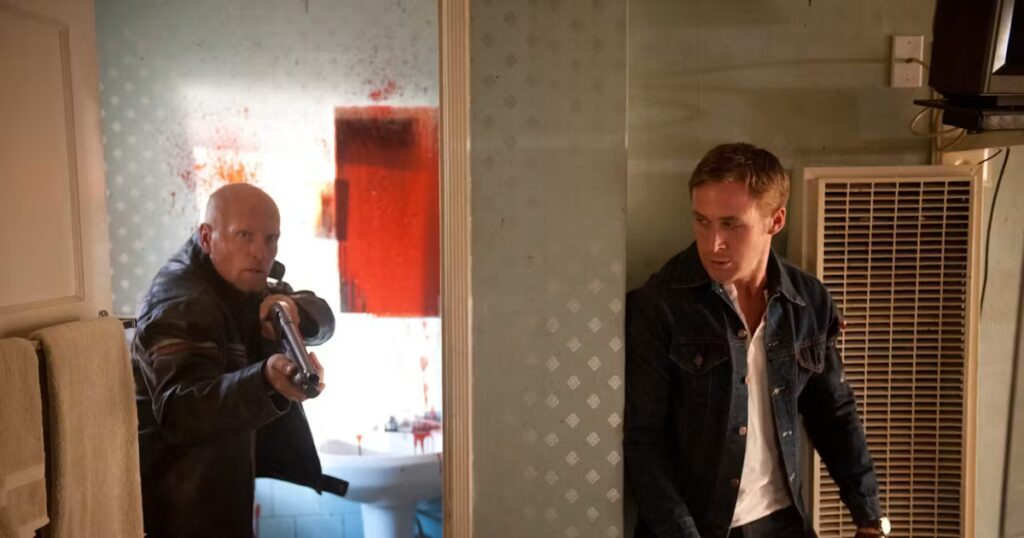
Sporadically but disgustingly violent, Drive received some criticism for its graphically creative use of forks and hammers, but the sudden, shocking nature of the bloodshed is the point. The Kid may be thoughtful, but thoughtful doesn’t necessarily mean good; this is still a man with a hair-trigger for violence, and an alarming capacity for executing it. Director Nicolas Winding Refn shows us what Irene sees when the Driver eventually stomps a man to death to protect her, and what she sees, regardless of the fact that they had a nice picnic earlier, is horrific.
The image of the thoughtful, honorable thug is largely a Hollywood invention; in reality, people who go around busting legs and knocking over pawn shops for a living don’t have the richest and most empathetic interior lives imaginable. They’re still human beings capable of doing good or changing their ways, but criminal organizations aren’t full of Lefty Ruggieros rueing that they’ve wasted their lives committing violence. Even Albert Brooks’ gangster, portrayed as the relatively thoughtful and restrained foil to his Ron Perlman-played partner, doesn’t hesitate to start icing old acquaintances with razor blades the moment his back is against the wall.

You’re going to want to wait for the next elevator.
FilmDistrict
Drive may be outlandish, but its nasty streak is realistic. The Kid tells Irene that the time he spent playing house with her was the best thing that ever happened to him, and he means it, but there’s still a reason the movie ends with him driving away alone instead of getting a big smooch. Once you show someone your violent side, there’s no hiding it away again. Gosling is quiet and subdued to the point that the movie’s sparse dialogue was mocked in memes, but he can’t contain his rage forever, and rage is ugly no matter how deserving its victims may be.
Still, you have to feel for the Kid; everyone he meets is a liar or a brute or just kind of a screw-up, and his attempt to do the right thing devolves into an ugly mess for all concerned. That’s the typical fate of a neo-noir protagonist, who’s forever destined to take justice into their own hands. Sometimes, it works out. But as Drive is smart enough to reveal, it usually doesn’t. At least, as the Kid drives off to an unknown fate, he leaves you with the sense that he might be one criminal who really is self-reflective enough to turn his life around, if he doesn’t bleed to death first.
Drive is streaming on Prime Video.