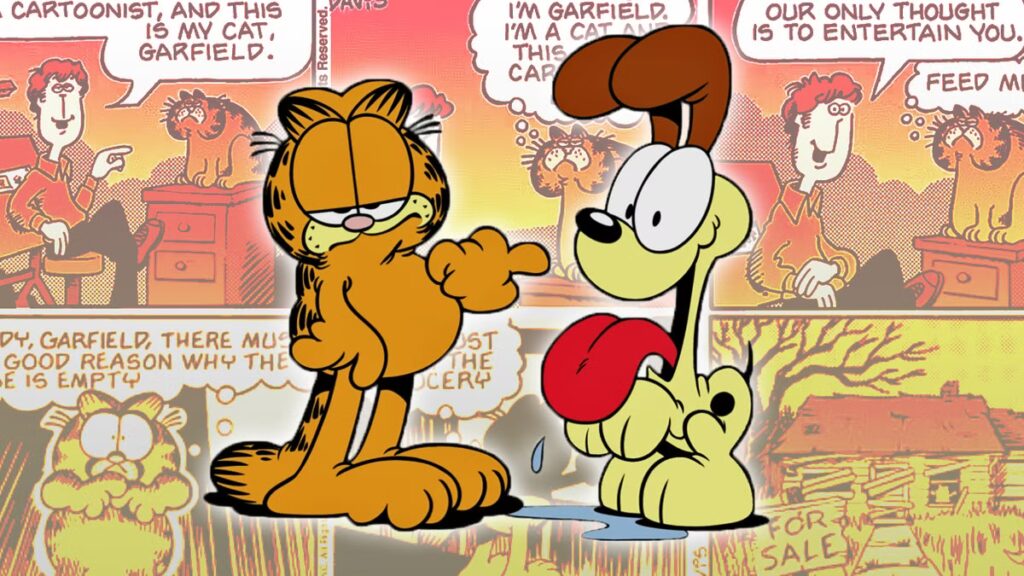

Despite the many iterations of Garfield comics in entertainment media, many fans will be interested in checking out the classic Garfield comic strips that led to the world’s most famous cartoon cat appearing on the big screen time and time again. Jim Davis’ classic and popular Garfield comic strip has been running non-stop since 1978, so there are a slew of comic strips for fans of the funny feline to enjoy.
In the decades since Garfield first appeared in newspapers, many details of the comic strip have been absorbed into the common knowledge of the general public, both in the United States and around the world. It’s commonplace to know that Garfield loves lasagna and hates Mondays, and his disdain for his owner, Jon, and Jon’s dog, Odie, is notorious. However, some details about the Garfield comic strips might surprise many fans.
Jim Davis Had to Apologize for an Unintentionally Offensive Garfield Strip

On Veteran’s Day in 2010, the above strip ran, about a spider who taunts Garfield, suggesting that while Garfield might kill him, the other spiders will hold a day every year honoring him and his sacrifice. As it turns out, the other spiders “honor” his death by celebrating “National Stupid Day.” Well, as you might expect, a number of readers saw this as a sharp attack on veterans on their holiday. This was despite the strip clearly just being part of a recurring series of strips that week featuring Garfield killing spiders…
Jim Davis still apologized, though, explaining:
Dear Friends, Fans, and Veterans:
In what has to be the worst timing ever, the strip that runs in today’s paper seems to be making a statement about Veteran’s Day. It absolutely, positively has nothing to do with this important day of remembrance.
Regarding today’s Garfield comic strip, it was written almost a year ago and I had no idea when writing it that it would appear today — of all days. I do not use a calendar that lists holidays and other notable days, so when this strip was put in the queue, I had no idea it would run on Veteran’s Day. What are the odds? You can bet I’ll have a calendar that lists EVERYTHING by my side in the future.
My brother Dave served in Vietnam. My son James is a Marine who has had two tours of duty, both in Iraq and Afghanistan. You’d have to go a long way to find someone who was more proud and grateful for what our Veterans have done for all of us.
Please accept my sincere apologies for any offense today’s Garfield may have created. It was unintentional and regrettable.
Jim Davis
Garfield Very Nearly Didn’t Get Past Its First Year

It is difficult for any comic strip to launch, so it is always a surprise whenever ANY comic strip manages to hit it big, and Garfield was no exception. Jim Davis had been rejected by the first two syndicates he had applied to syndicate Garfield.
Even after finally being picked up by a syndicate, Garfield started slowly. The way syndicates typically work is that they offer newspapers a new strip on a “test basis,” and after a few months for free, the newspapers can decide whether to keep it going or not. Garfield‘s biggest client by far was the Chicago Sun-Times. When the test run ended, not only did the Sun-Times drop Garfield, but so did newspapers in Little Rock and Salt Lake City. This was a very bad sign. This could have been the end of Garfield.
Luckily, fans wrote in to all three papers and complained, and the newspapers relented, and cut deals to keep Garfield. Davis created a special strip that ran only in the Chicago Sun-Times.

Within a few years, Garfield was one of the most syndicated comic strips in the country!
Jim Davis Once Turned Garfield Into…Galactus?!

In the comic book series, The Unbeatable Squirrel Girl, writer Ryan North came up with the idea of Squirrel Girl putting together a magazine with stories done “by” famous Marvel characters (but actually, of course, each of the stories would be drawn by guest creators). For a story done by Galactus, of all beings, North enlisted the help of Jim Davis!
Davis recalled, “Ryan North sent me an email last winter about this idea to do a special Squirrel Girl issue drawn by the cartoon characters themselves, with different artists for each style. He explained Galactus seemed like a logical one for me, because of Garfield — having the appetite of the planets, and being one of the biggest and oldest of the Marvel characters. Garfield will be 40 next year, and is himself reaching iconic status.”
The first strip is an exact repeat of the dialogue in Garfield’s first strip!
Viewers Incorrectly Blamed Jim Davis for a Cartoon All-Stars Video Disappearing From TV

A relatively little-known cartoon oddity was Cartoon All-Stars to the Rescue in 1990, an anti-drug TV special that starred basically every notable cartoon character then appearing on TV, including Winnie the Pooh, Alvin and the Chipmunks, ALF, Bugs Bunny, Daffy Duck, Huey, Dewey and Louie, Michelangelo from the Teenage Mutant Ninja Turtles, Tigger, Papa Smurf, Brainy Smurf, Hefty Smurf (Smurfette was oddly not in the special despite being on promotional material for it), Baby Kermit, Baby Piggy and Baby Gonzo (from Muppet Babies).
The special ran a few times, and also had a home video release, but has not been released since, and the popular legend was that it was because the producers had not gotten permission from Jim Davis ahead of time to use Garfield, and while he allowed it to still run, he insisted that it have a limited run. That was not the case, as it turned out. It was almost certainly just because the contracts for the use of ALL the characters were just limited in scope.
Jim Davis Had to Explain to Readers That Jon Didn’t Do Something Unspeakable

In May 1990, Jon took Garfield to the vet, and Jon proceeded to flirt with Garfield’s vet, Liz (eventually, Jon and Liz DID become a couple). The trip to the vet took up a week’s worth of strips. At one point, Jon drinks what he believes is Liz’s coffee, but it is instead something that involves puppies. This, naturally, led readers to believe that Davis was implying that Jon just drank dog semen.
Years later, Davis denied it, stating, “On the farm, we used to give first-calf heifers a high-protein supplement to help them deliver healthier calves,” he said in a statement to BuzzFeed News. “The supplement was provided by our vet.” Since Liz is a vet, “I assumed that there would be a similar supplement for dogs,” Davis said. “So Jon is drinking a protein-enriched drink formulated for a pregnant dog.”
That’s why Liz mentions the “healthy” litter Jon would have — because he had just drunk a supplement for pregnant dogs, not dog semen.
“There you have it!” Davis said. We’ll let you decide whether you buy Davis’ explanation.
Jim Davis Had a Set Pattern of Jokes He Would Try to Tell Every Week in Garfield
Jim Davis believed that part of the reason why Garfield became so successful was because of how universal the strip was (there weren’t jokes that you could only get if you were an American, for instance), and also for how FAMILIAR the strip was. Davis wanted readers to know that they could always rely on Garfield to do a certain type of joke each week, and he even had it more detailed than that.
He once explained, “I like to go for one or two big laughs a week. Usually those are the sight gags. Garfield getting hit over the head or hitting Odie over the head. Then I like to go for a couple of nice thoughts. Where he’s making some broad statement on life that’s nice or humorous. It ought to get a smile. Then I like to go for what I call a quotable quote. Something people can take to the office or to school.” As you can see by the sample strips from a randomly chosen week in 1982, there really were three broad sight gags, one “nice thought,” one “quotable quote,” and one recurring “Mondays” joke.
Snoopy Helped Garfield to Walk

When the Garfield strip began, Garfield walked like a regular cat, on all fours. Over time, of course, Davis evolved Garfield to the point where he began to walk on his hind legs. This allowed Davis to have Garfield star in more anthropomorphic-type stories beyond what a regular cat would be able to do.
Davis credited Charles Schulz for the design changes necessary to make Garfield walking upright look “normal.” He recalled, “I was working on Garfield’s first special at Bill Melendez’s studio in Los Angeles, and Sparky was working on one of his specials in the next room. I wanted Garfield to get up and dance through the opening credits, and he looked terrible standing up. He just didn’t look natural…He said, ‘That’s because you gave him these little cat feet.’ He told me what he did with Snoopy’s. Snoopy used to walk on little dog feet, ‘and when I stood him up, I made his hind feet really big like human feet, and it looked natural.’ He said, ‘Here, do this,’ and he took my pencil and drew over the top of my drawing with these big feet like [Garfield] has today. He said, ‘So there! Now he’s standing.’ I go, ‘That’s it!’ I was blown away. Here was Charles Schulz drawing on my drawing. When Garfield got the big back feet, then he could walk.”
Odie Wasn’t Jon’s Dog Until Five Years Into the Strip

Early in the strip’s history, Davis decided that he wanted Jon to have a second person to talk to besides just his cat, Garfield, so he introduced Jon’s friend, Lyman, who was forced to move in with Jon after suffering some setbacks. Along with Lyman came his beloved dog, Odie. Well, pretty quickly, Davis realized that he really didn’t NEED another human, and after awhile, Lyman was pretty much non-existent in the strip until finally, at the end of April 1983, he made his last appearance in the regular comic strip.
Odie, though, stuck around, and eventually was just retconned so that he was Jon’s dog the entire time. Amusingly, Davis once joked about the disappearance of Lyman by saying, “People better not look in Jon’s basement.” Luckily for Lyman, he WAS seen alive in future strips, just very, very rarely.
Garfield and the Teenage Mutant Ninja Turtles Had a Team-Up

In the early 1990s, the Teenage Mutant Ninja Turtles reached a level of popularity rarely seen in American popular culture. Their hit animated TV series in the late 1980s led to a blockbuster toy line, and that led to a live-action movie in 1990 that saw several sequels released in the early 1990s. The Turtles were EVERYwhere. Kids’ bedsheets, kids’ T-shirts, kids’ playground equipment. If a kid was involved in something circa 1992, the odds were high that the Turtles were on SOME product that they owned.
So Jim Davis got in on the fun in 1992 when he had Garfield meet the Teenage Mutant Ninja Turtles in the Winter 1992 edition of Teenage Mutant Ninja Turtles Magazine. Davis wrote it, and penciler Gary Barker drew the one-page crossover between Garfield and the Turtles, with Peter Laird inking the Turtles’ figures.
Garfield Was Jim Davis’ Second Regular Comic Strip

The first time that Jim Davis had a regular comic strip, it was about a group of bugs, and it was called Gnorm Gnat, which only ran in Davis’ local newspaper, The Pendleton Times, from 1973-75.
Davis was told that his jokes were good but that no one would want to read stories about an insect, so he set about trying to come up with something that would be more endearing to a wider audience, and I’m sure you can guess what he came up with! Amusingly, though, even after Davis centered on a comic strip about a cat, he wasn’t quite up to Garfield, as you’ll see later on this list. Contrary to popular belief, the strip did NOT end with Gnorm being stepped on and killed.
Garfield is Set in a Real City
Most Garfield cartoons occur within Garfield and Jon’s home, often with Garfield perched on or standing behind a table or countertop and Jon standing nearby. As a result, it would be easy to assume that the location of the Garfield comics is never explained, and readers are allowed to imagine the scenes could be taking place anywhere in America.
On the television special Happy Birthday, Garfield, however, the true location of the Garfield comics was revealed. Garfield takes place in eastern Indiana, in the small city of Muncie, which is where creator Jim Davis was born and raised. Davis grew up on a farm that was filled with many cats, and those cats became the inspiration for Garfield.
Garfield Was Not Named After the American President

Many people assume that the character Garfield was named after James A. Garfield, the 20th President of the United States. The truth, however, is slightly more complicated. Garfield is actually named after creator Jim Davis’s own grandfather, James A. Garfield Davis. However, Davis’ grandfather was named after the president.
Garfield is not the only character whose name has interesting origins. Garfield’s owner, whose full name is Jon Q. Arbuckle, was named after a character in a coffee commercial from the 1950s. Coffee seems to inspire Jim Davis, who has also written Garfield to have an intense love of the caffeinated beverage.
Jim Davis No Longer Draws Most Garfield Comics

Jim Davis began writing and drawing the Garfield comic strip in 1978 and was intimately involved in its production and many of the Garfield TV shows and specials for over a decade. Davis still retains creative control over the Garfield franchise, but he no longer does the art for the comics himself.
Since the late 1990s, most of the art for Garfield comics has been done by Davis’ long-time assistants, Brett Koth and Gary Barker, while the inking and coloring are done by other artists. Davis still writes and does rough sketches for the strips, meaning all the best Garfield comics are still written by Davis himself.
Garfield Is the Most Widely Syndicated Comic Strip in the World

Garfield is a household name, not just in the United States where it was created, but around the world. With such extreme popularity and recognition, it should be no surprise that Garfield is history’s most widely syndicated comic strip. The record was even verified by the Guinness Book of World Records.
At its peak, Garfield was syndicated in over 2,500 newspapers. The number has dropped a small amount since then, but that is largely due to the newspaper industry’s struggles, as opposed to a decline in the comic’s popularity. Garfield comics remain incredibly popular to this day, leading to the release of The Garfield Movie this year.
Garfield Has Occasionally Gotten Surprisingly Dark
Most Garfield comics are fairly light in tone. Although Garfield can be somewhat abusive to his owner Jon or Odie, the comics largely rely on simple gags and recurring themes like Garfield’s love of lasagna or hatred of Mondays. Every once in a while, though, Garfield comics can get quite serious.
In one series of surprisingly dark Garfield comics, Garfield wakes up to discover that he is alone in the house and that it has been abandoned. He frantically searches for Jon or even Odie but finds that he is completely alone. Terrified by his solitude, Garfield shows uncharacteristic affection for Jon after the relief of discovering that it was all just a terrible dream.
Garfield Has Inspired a Musical Theater Production

Garfield comics have spawned many different entertainment properties over the decades. There have been three different Garfield TV shows and twelve TV specials (all nominated for Emmys), and three feature films. There are also multiple video games, from an early Atari game to modern web-based educational games on the Garfield website.
However, the most unusual entertainment production to result from the Garfield comics is undoubtedly a live stage musical. Garfield, Live! debuted in creator Jim Davis’s hometown of Muncie, Indiana, before touring North America and Asia. Jim Davis wrote the story, and Michael Dansicker and Bill Meade dreamed up the music and lyrics.
Garfield is Not Named Garfield In Some Countries

Creator Jim Davis named Garfield the cat after his grandfather, who he described as “a large, cantankerous man.” Throughout most of the world, everyone knows the famous ginger tabby cat as Garfield. There are four countries, however, where Garfield has a different name. Those countries are Sweden, Finland, Norway, and Iceland.
For some reason, the publisher renamed the famous cat when Garfield was exported to Scandinavia. Garfield retained his hatred of Mondays, but in Sweden his name became Gustaf, in Finland it’s Karvinen, Pusur in Norway, and Grettir in Iceland. The reason is unclear, but the most likely reason is that Garfield’s name sounds unusual in the local languages.
Garfield Originally Had a Different Title

Although Garfield is certainly Jim Davis’ most popular comic strip, it took him a few tries to get his formula right. Having grown up with many farm cats, Jim Davis designed a comic strip about a man and his cat. That comic strip was Jon, and it, like his earlier strip, Gnorm Gnat, only ran in Davis’ local newspaper.
When Jon was picked up by a publisher for national syndication, the title was changed to Garfield, and it became the comic strip millions of people know and love today.
Garfield Has a Book Format Named After Him

Anyone who shopped for book collections of comic strips in the 80s and 90s knows exactly what Garfield comic collections look like. When Garfield comics were collected into volumes, they were published in an unusual format, nearly twice as wide as tall. Publishers refer to this book shape as “Garfield format” as a result.
The new shape employed by Garfield comic collections allowed Garfield comics to be published with the panels in a straight line, just like they appeared in newspapers. These collections of the funniest Garfield comics stood out on shelves thanks to their different and innovative shape, and many of the collections reached the New York Times bestsellers list.
Garfield Was Designed for Marketability
Certain comic strips, like Calvin and Hobbes, completely avoided commercializing their characters, allowing the comics to stand independently. However, many other comics rely heavily on marketing and merchandising to expand the comic’s appeal and earn more money. Garfield was created specifically with the marketability of the lead character in mind.
The iconic comic strip Peanuts by Charles Schulz influenced Garfield in several ways, one of which was certainly the marketing of the animal characters in the comics. Like Snoopy before him, Garfield has appeared on every product imaginable, from telephones to the iconic suction-cup car window ornaments that can still be seen driving around the roads today.
- First Film
-
Garfield: The Movie
- First TV Show
-
Garfield and Friends
- Latest TV Show
-
Garfield Originals