
The cinematic movement that would eventually be called film noir doubled as a Trojan horse, showing audiences subject matter and ideas in direct opposition to the conditions imposed by the Hays Code. In the 1940s and ‘50s, when the genre was at the height of its popularity, the Motion Picture Production Code was at the height of its censorial power, forcing filmmakers to work with guidelines that required simple black-and-white morality and forbade on-screen depictions of sex, queerness, and interracial relationships, among other touchy subjects.
Noir gave filmmakers an avenue to use implication and symbolism to subvert the Code’s rigidity, and many explored topics subtextually that mainstream films weren’t allowed to tackle directly: female resentment towards the unkept promises of traditional domesticity, institutional corruption, social issues like misogyny and racism. When neo-noir emerged in the ‘70s, it pushed the envelope further, expanding what was acceptable in terms of sex, violence, and transgressiveness. And 30 years ago today, the Wachowski Sisters bridged the gap between the two movements with a film that poked the bear of America’s latent lesbophobia, while also introducing the world to their influential kinetic visual style — and gifting audiences one of the greatest noirs of all time in the process.
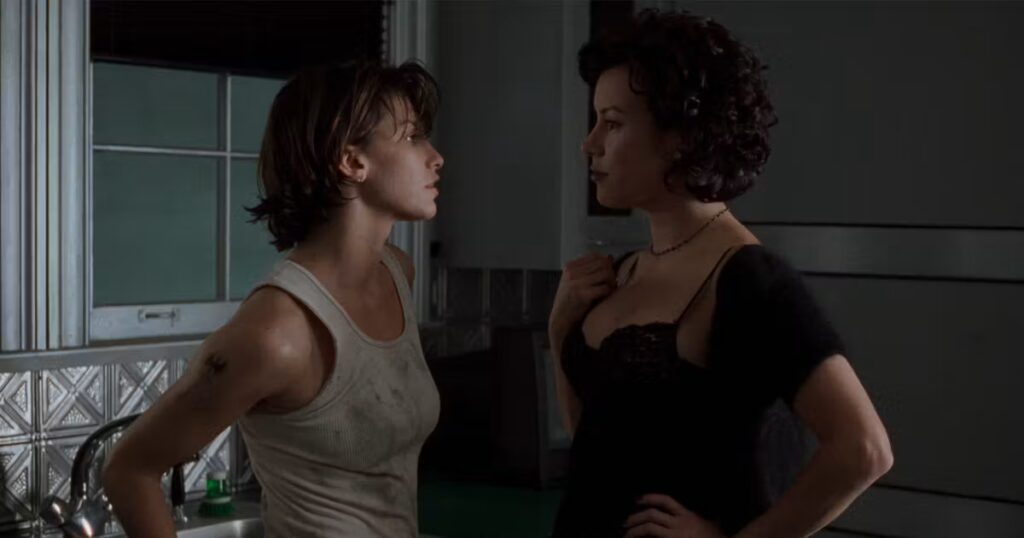
Much like the characters in Bound are trapped in their own metaphorical prisons, the film also leads you to believe it’s locked in the framework of a traditional noir. Corky (Gina Gershon), our stoic and guarded lead, is hired fresh out of prison to help renovate a Chicago apartment complex, which is where she meets Violet (Jennifer Tilly), the mousy, alluring wife of low-level Mafia money launderer Caesar (Joe Pantoliano). You know from the moment they lock eyes that a passionate affair is brewing, and by the time their mutual lust inspires them to steal $2 million from Caesar’s powerful Mafia friends, you almost feel it coming; it’s familiar by design, a common plot structure for a genre that understands money as the key to freedom from crime or domestic servitude.
But Bound isn’t a traditional noir. While films of the past, like Double Indemnity, recognized how discontented a generation of women were with the docile, stay-at-home wife archetype after tasting real economic and social agency during World War 2, they also presented female sensuality as manipulative and dangerous, the birth of the femme fatale archetype. Bound’s lesbian love affair (and the controversial scene in which it’s consummated) represents the exact opposite — Corky and Violet’s queerness is presented as a liberatory escape from the suffocating lives they lead. Gina Gershon and Jennifer Tilly’s chemistry is the film’s pulsing heart, and the irresistible pull between them lets Corky be lovingly vulnerable while Violet envisions a life for herself beyond the machinations of the men she has to perform femininity for. It’s an on-screen depiction of lesbian intimacy so unarguably positive that it was outright confrontational at a time when America had just legally defined marriage as being “between a man and a woman.”

Despite mostly being confined to a claustrophobic apartment complex, Bound’s plotting is explosive and unpredictable. Corky and Violet’s plan to frame Caesar’s rival Johnnie (a pre-SVU Christopher Meloni) goes off without a hitch, but it works almost too well. Soon enough, Caesar is intent on either extracting the truth from Johnnie or implanting a bullet in his brain, two choices that don’t bode well considering that Johnnie is the son of Mafia boss Gino Marzzone (Richard C. Sarafian). The hierarchy of the Mafia is presented as another kind of prison, one where outsized male egos compete to be the alpha, a trap almost as suffocating as the shackles of heteronormativity Violet is trying to escape. In a classic noir, we might follow Caesar as he slowly realizes his beloved has betrayed him, but here, we’re encouraged to root for that betrayal, because the heist symbolically destroys a patriarchal system that still tries to control how women express their identities.
Bound was shot by frequent Wachowski collaborator Bill Pope, and it gives viewers a taste of the revolutionary visual style that would soon explode into the mainstream with their collective work on The Matrix. As a once-simple plan is beset by dizzying complications, Pope’s never-stationary camerawork reflects the complex dynamics at play: he presents Caesar’s rising paranoia with a vertigo-inducing tracking close-up, and literalizes the barriers separating Corky and Violet, as well as their unbreakable connection, using erratic inserts of phone lines and grand pass-through shots showing just how close they are despite being in adjacent rooms. Even the film’s single shoot-out sequence reflects a visual approach to action that they’d fine-tune in their follow-up: gun violence as a moment frozen in time, instant death rendered across what feels like an eternity.
Bound is proof that, from day one, the Wachowski Sisters had an ingenious visual eye and a disregard for safe, established storytelling methods. It took one of Hollywood’s archetypal genres, a movement that paved the way for modern cinema, and made something truly radical in form and text. Film noir’s legacy has always been one of subversion and transgression, and two of the century’s most influential filmmakers used that legacy to tell a deeply entertaining, celebratory story of unabashed lesbian romance and liberation.
Bound is available on Prime Video.