
4 Rivers 6 Ranges finds its strongest moments in the moral conflict between non-violence, survival and the fight for freedom, observes Sreeju Sudhakaran.

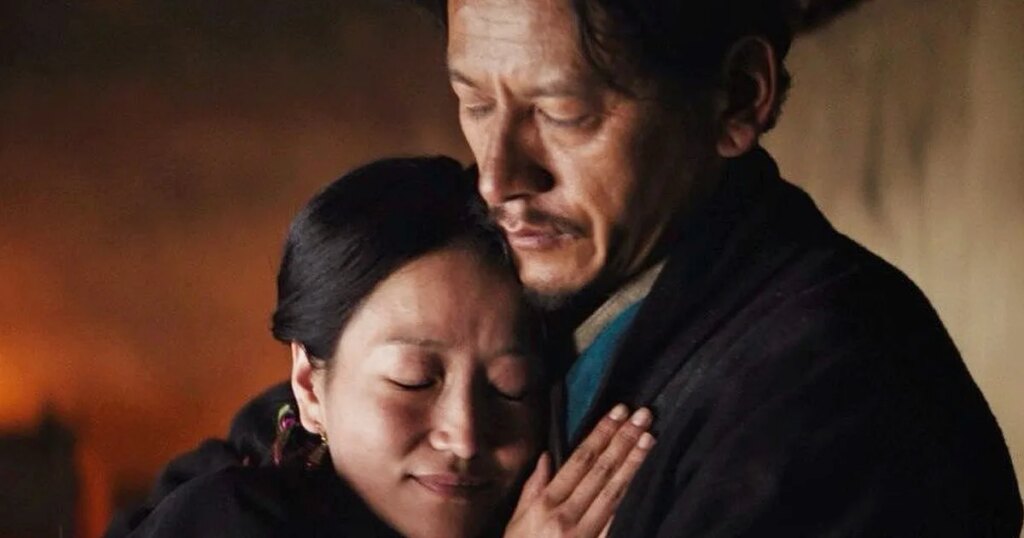
IMAGE: Tenzin Choden and Thupten Chukhatsang in 4 Rivers 6 Ranges.
Key Points
- 4 Rivers 6 Ranges chronicles the Chushi Gangdruk guerrilla group’s fight for Tibetan freedom against Chinese aggression, set during the 1959 uprising and the Dalai Lama’s exile.
- It explores the moral conflict between the Dalai Lama’s commitment to non-violence and the rebels’ choice of armed resistance to defend their culture and identity.
- The movie highlights the personal toll of the rebellion on fighters and their families, showcasing resilience and hope.
The title of Shenpenn Khymsar’s 4 Rivers 6 Ranges comes from the English name of the Tibetan rebel guerrilla group Chushi Gangdruk, whose members put their lives on the line for Tibet.
Their struggle is not merely about resisting the might of the Chinese army, but also about defending their language, culture, identity and religion. Set during the 1959 Tibetan uprising and the Dalai Lama‘s subsequent exile to India, 4 Rivers 6 Ranges tells this turbulent chapter firmly from a Tibetan perspective.
As an Indian, there is plenty to relate to in their fight. We won our freedom from invaders nearly 80 years ago; they are still actively fighting for theirs.
Many among us carry the generational trauma of displacement from Partition. They intimately know what it means to flee their own homes to a different country just to survive and rebuild. Perhaps this is exactly why India welcomed the Dalai Lama with open arms back in 1959.
The Uprising And Moral Dilemmas
4 Rivers 6 Ranges drops us right in the middle of the Tibetan uprising against violent Chinese aggression. The movie opens strikingly well with a long, possibly single-take tracking shot of two Chushi Gangdruk revolutionaries blasting their way through a burning village while fighting a Chinese army unit.
It is a tersely staged sequence that aptly harnesses the tension of the situation, simultaneously giving us a clear view of the devastation the enemy is inflicting, even within the film’s limited budget.
This is the moment where 4 Rivers 6 Ranges hits its technical peak. Not that the rest of the film is a total letdown; the final skirmish is sharply filmed within the scope of the movie’s ambitions, but it never quite reaches those opening heights again.
We are soon introduced to the Chushi Gangdruk outfit itself. Their leader, Gonpo Tashi (Tenzin Dhondup), discovers that their armed rebellion lacks the blessing of the 14th Dalai Lama (Tashi Kalden). Their spiritual leader firmly believes violence goes directly against the core tenets of their religion.
Exploring this moral conflict is where 4 Rivers 6 Ranges becomes truly fascinating. The film introduces Chushi Gangdruk and the Dalai Lama in parallel, contrasting a sequence of the group plotting their next strategic attack against the Dalai Lama deep in prayer with his disciples.
In another striking moment, the Dalai Lama praying with his holy beads is intercut with a fighter loading his gun.
Ideological Clashes And Resilience
In a pivotal scene, Gonpo Tashi and his men argue the ethics of violence as a necessary form of defence with a Tibetan minister. Gonpo states he is no longer a Buddhist because he is forced to accept violence as his new way of life, a grim necessity to resist the invaders and fight for those who have already died for their cause.
The dialogue also touches on how humans are the worst of the six realms of birth, yet they are the only ones who thrive on ‘hope’. And that hope is exactly what fuels their burning resolve to keep fighting. Gonpo even points out that while the Dalai Lama argues for non-violence from a place of pure religious enlightenment, not everyone preaching those ideals harbours the same pure intentions.
Yet, you cannot miss the heavy irony within Dalai Lama’s story that folds afterwards. Despite refusing to bless their violent rebellion, the young Dalai Lama eventually has to rely entirely on their protection to escape from Lhasa to India as Chinese aggression intensifies. To top it off, he is even has to carry a rifle for his survival.
There are other moments where this ideological clash effectively takes centre stage. Like a fighter offering a prayer for forgiveness right in the middle of a brutal gunfight. Or an almost dialogue-less sequence where a monk discovers his monastery members mercilessly butchered. He tears off his robes in front of Buddha’s portrait, fully embracing the path of armed resistance.
These scenes tread the delicate discourse of how even strict non-violence must adapt when facing an aggressor who only understands brutality and respects absolutely nothing else.
Filmmaking Approach And Performances
Shenpenn Khymsar takes a multi-faceted approach here. He is not just the director; he is the writer, producer and even co-composer alongside Rohit Shakya (notice the mesmerising use of traditional Tibetan instruments in the score). He presents the struggles of Chushi Gangdruk respectfully yet quite cinematically as well.
Cinematographer Brandon Cox’s frames even lend a distinct Western feel, particularly in the striking shots of fighters on horseback riding across mountain slopes. But there is no denying that the screenplay often feels perfunctory when covering the broader Tibetan uprising.
The only member of the Chushi Gangdruk outfit we properly get to know is Kunga Samten (Thupten Chukhatsang), which makes sense since the film is based on his memoir, Flight at the Cuckoo’s Behest. We witness the toll his fight takes on his family, yet his ailing wife (Tenzin Choden, who also appeared in Jigra) unconditionally supports him, even when he leaves her for long stretches for the cause.
However, we never really learn much about the other outfit members beyond their shared mission. The film rushes through their attacks, disagreements and painful defeats in an almost mechanical manner. Even their crucial role in helping the Dalai Lama escape (which occurs much later in the runtime) is treated the exact same way.
The movie needed tighter editing, especially in the first half, where the perfunctory narrative creates a frustrating disconnect. It perhaps should have focused far more on the group’s direct assistance in the Dalai Lama’s tense escape to India.
Critique And Overall Impact
Some scenes even feel incredibly stagey.
This is particularly true for the sequences involving the main antagonist, the remorseless Chinese General Tang. Played with appropriate smarminess by Robert Lin, Tang is deliberately depicted as pure evil, lacking only a literal moustache to twirl.
Two of his major scenes heavily evoke Hans Landa from Quentin Tarantino’s Inglourious Basterds. Unfortunately, this is exactly where the depiction falters.
The sequence where Tang visits Kunga’s family to interrogate them about his whereabouts strongly recalls Landa’s iconic introduction. But while Tarantino’s scene was dialogue-heavy and dripping with tension, this scene relies heavily on silences and pauses to build a sense of foreboding. These pauses drag on a bit too long, not completely registering the required intensity.
Another scene calling back to Landa has Tang tell a rebel to run away before casually shooting him in the back. This feels less like a natural plot progression and more like the movie forcing a moment to remind us just how cruel he is, while wanting to take a break from Chushi Gangdruk’s actual activities.
I watched the Hindi version (featuring Nawazuddin Siddiqui’s opening narration), so I am unsure if it was purely a dubbing issue, but some of the dialogue delivery felt stilted.
That stiffness is also reflected in some of the performances. But considering the cast is filled mostly with newcomers, that rawness was certainly expected. However, a few actors truly impress, particularly Thupten Chukhatsang as the stoic Kunga and Tenzin Dhondup as his fierce jindan.
While I could delve more into the ‘limitations’ of 4 Rivers 6 Ranges, I think it is far more crucial to focus on what the movie actively wants to convey.
In that regard, 4 Rivers 6 Ranges is an important watch if you are keen on understanding the Tibetan rebellion’s desperate struggle to reclaim their freedom from an increasingly powerful invader.
It is a tale of resilience, hope and fighting for a greater cause, a universal story told passionately within its own geographical limits.
4 Rivers 6 Ranges Review Rediff Rating: