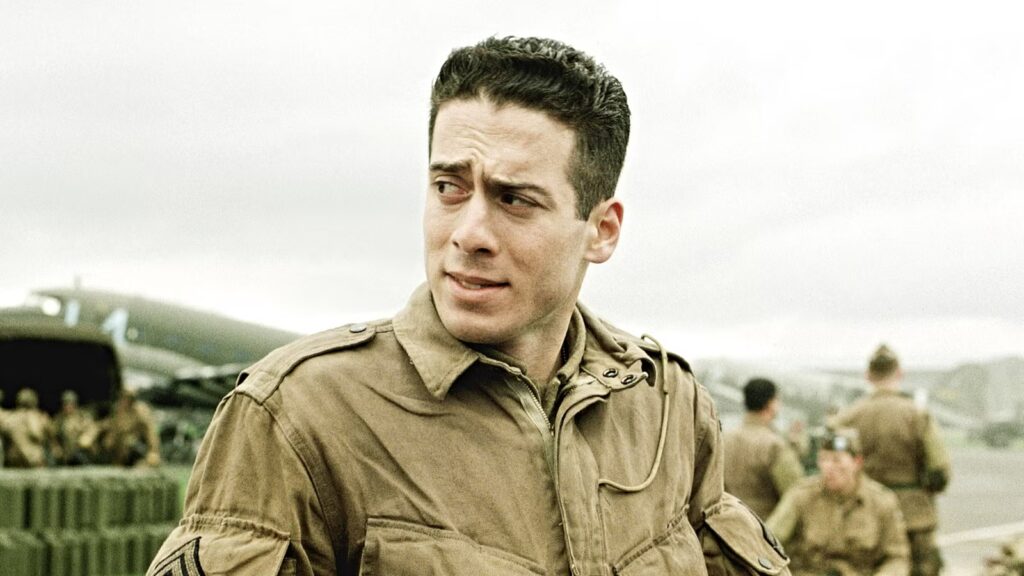

War television has to be compelling without making war itself feel entertaining, and that’s not an easy feat. The audience still needs tension and momentum, but those things can’t come at the expense of reducing real suffering to shallow spectacle. That challenge becomes even harder because, firstly, war is never a single experience. It means different things to different people.
Secondly, history has usually spoiled the ending for every war drama out there. Now, when the audience already knows who won the battle, how does one still make them tune in? The best war miniseries then find their suspense somewhere more personal. These six miniseries understand that responsibility better than most and find completely different but perfect ways.
1
‘Band of Brothers’ (2001)

Band of Brothers is the blueprint for war miniseries, and it’s easy to understand why. The HBO show, based on Stephen E. Ambrose’s book, follows the men of Easy Company, part of the U.S. Army’s 101st Airborne Division, from their brutal training at Camp Toccoa through D-Day, Operation Market Garden, the Battle of the Bulge, and eventually the end of the war in Europe. The story initially seems to revolve around Richard Winters (Damian Lewis), who gradually becomes one of the company’s most respected leaders, but Band of Brothers never limits the narrative to his perspective.
Different episodes shift the focus to others in the unit, which is one of the smartest decisions the miniseries makes. This turns Easy Company into the real central character while giving individual soldiers’ arcs enough room. The audience gets to understand the company from completely different positions, which adds weight to every loss or win. Band of Brothers completely changed the emotional scale of war.
2
‘The Pacific’ (2010)

The Pacific had every chance to recreate Band of Brothers, but it delivers a completely different experience. Instead of following one company across the war, the HBO miniseries splits its story between three Marines whose paths keep crossing. The protagonists include writer Robert Leckie (James Badge Dale), Eugene Sledge (Joseph Mazzello), who initially can’t enlist because of a heart condition, and celebrated hero John Basilone (Jon Seda). Their stories carry the audience through Peleliu, Iwo Jima, Okinawa, and some of the most punishing campaigns of the Pacific Theater. What’s interesting is how the war looks completely different based on the man in focus.
The Pacific never paints its characters as invincible, but as men constantly being reshaped by the situations they face. The Pacific keeps showing how the same war can leave completely different marks on the people fighting it, and that is the show’s gripping hook. The final episode sustains this momentum by following the survivors home and showing how just returning to ordinary life is its own struggle. The Pacific is never building toward a clean victory because it wants to ask what exactly is left of these people once the fighting stops.
3
‘Generation Kill’ (2008)

Generation Kill strips away all the shock value audiences normally expect from a war miniseries. The seven-part HBO series, based on Evan Wright’s reporting and book, centers on the journalist, played by Lee Tergesen, as he follows the U.S. Marines of First Recon during the opening weeks of the 2003 invasion of Iraq. Most of the story unfolds alongside Marines, including Brad Colbert (Alexander Skarsgård) and his endlessly talkative driver, Ray Person (James Ransone), as their convoy pushes toward Baghdad. The show obviously covers all the action along the way, but it’s actually interested in exploring the logistics of war. Generation Kill features long stretches of driving, petty arguments over equipment, confused radio chatter, and frustrating orders coming from the people in command.
The series makes war feel oddly normal. The Marines can be discussing something completely stupid one minute and suddenly find themselves making a life-or-death decision the next. This tonal whiplash is the point. The series captures how boredom, fear, humor, and danger can all exist within the same context. Generation Kill isn’t the show that wants to manufacture stakes or deliver some inspiring military narrative. In fact, its brutal realism is why it remains a fan favorite to this day.
4
‘We Were the Lucky Ones’ (2024)

We Were the Lucky Ones is another show that approaches World War II on an intimate scale. The Hulu miniseries, based on Georgia Hunter’s novel and inspired by the experiences of her own family, begins with the Kurcs, a Polish-Jewish family, celebrating Passover together in Radom shortly before the war tears their lives apart. The five siblings, Halina (Joey King), Addy (Logan Lerman), Genek (Henry Lloyd-Hughes), Mila (Hadas Yaron), and Jakob (Amit Rahav), are eventually scattered across different countries with almost no way of knowing who in their family is still alive.
The series keeps jumping between the siblings as each of them deals with their fair share of struggles. The reason why this hits so hard is that the audience gets to see the Kurcs together before taking all sense of normality away from them. The larger question then becomes whether these people will ever find one another again. That makes the final episode incredibly rewarding when scattered members of the family finally begin finding each other again, forever changed by the lives they have lived.
5
‘The Narrow Road to the Deep North’ (2025)

The Narrow Road to the Deep North is a war story that stays with the audience long after the credits roll. Based on Richard Flanagan’s Booker Prize-winning novel, the five-part miniseries follows Australian doctor Dorrigo Evans, played by Jacob Elordi during World War II and Ciarán Hinds decades later. Before leaving for war, Dorrigo begins an affair with Amy Mulvaney (Odessa Young), his uncle’s young wife. Their relationship is cut short when he is deployed and eventually becomes a prisoner of war, forced alongside other Australian soldiers to work on the Burma Railway.
The show tracks how life in the camp completely changes the central character. He is put in impossible situations, with thoughts of Amy being his only comfort, only for that to be taken away as well. The series jumps between Dorrigo’s affair, his captivity, and his life as an older celebrated surgeon. The audience already knows Dorrigo survives, so the suspense comes from discovering what survival actually does to him.
6
‘War and Remembrance’ (1988)

War and Remembrance is about as ambitious as war television gets. The sprawling miniseries, adapted from Herman Wouk’s novel, picks up immediately after Pearl Harbor and follows the extended Henry and Jastrow families through almost the entirety of America’s involvement in World War II. Naval officer Victor “Pug” Henry (Robert Mitchum) is sent from one major assignment to another, while his sons Warren (Michael Woods) and Byron (Hart Bochner) fight in the Pacific. On the other hand, Byron’s wife Natalie (Jane Seymour) is trapped in Europe with her Jewish uncle Aaron Jastrow (John Gielgud) and her young son, desperately searching for a way out as Nazi control closes around them.
That eventually becomes the most devastating part of the narrative. There’s no denying that the enormous scale of War and Remembrance could have easily felt like a dry history lesson, but the Henrys and Jastrows give every new stage of the war a human connection. Major battles and political decisions are constantly happening alongside marriages collapsing, families being separated, and people simply trying to find out if their loved ones are safe. The miniseries truly earns the word epic thanks to how seamlessly it moves between the different storylines it follows while still preserving the sheer magnitude of the war surrounding them.

War and Remembrance
- Release Date
-
1988 – 1989-00-00
- Writers
-
Earl W. Wallace
-

Barry Bostwick
Uncredited
-
Clifford Rose
Leslie Slote
-
David Dukes
Rudolf Hoess – Commandant K. L. Auschwitz
-
G.W. Bailey
Field Marshal Erwin Rommel