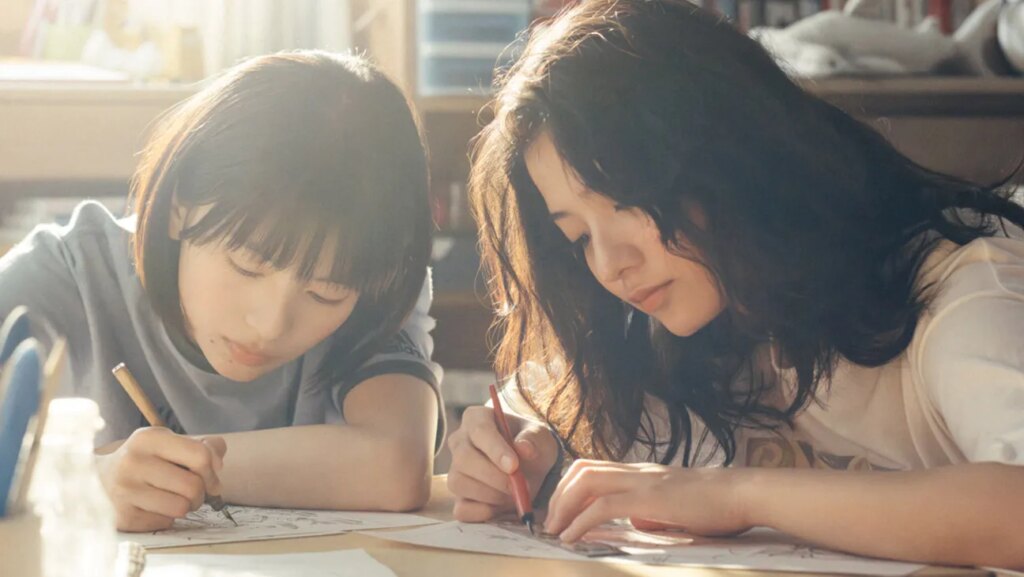

There has always been a magic touch to Japanese humanist Hirokazu Koreeda’s observation of children, and that strength is what first pulls us in to Look Back. This slender, but visually and emotionally captivating story takes its cue from the poetic changing of the seasons that mark its passage of roughly a decade in the lives of two gifted young artists. Based on Tatsuki Fujimoto’s popular one-shot manga of the same name, the minor-key drama can’t help but feel a little padded compared to the faithful 2024 anime adaptation, which did everything it needed to do in under an hour. But the new film’s lingering poignancy is undeniable.
Watching that economical previous screen version, directed by industry veteran Kiyotaka Oshiyama (a former Studio Ghibli animator who worked on Miyazaki’s The Boy and the Heron), it’s inevitable to wonder what will be left in a live-action take on the material once the exquisite beauty of the artwork is gone. But Koreeda and cinematographer Senzo Ueno create an equivalent for the intoxicating pen and paintbrush images, with soft colors, caressing light and elemental texture, at a certain point morphing into stylized anime when the limitations of reality and the escape offered by art demand it.
Look Back
The Bottom Line
Fragile, but alive with beauty and heart.
Venue: Venice Film Festival (Competition)
Cast: Natsuki Deguchi, Aju Makita, Furi Nanase, Rokka Okada, Kayo Noro, Ryo Ikeda, Miyu Sasaki, Maho Yamada. Kankuro Kudo, Masaki Suda
Director-screenwriter: Hirokazu Koreeda, based on the manga by Tatsuki Fujimoto
1 hour 40 minutes
The two protagonists live in the same small rural town and first become aware of each other as tweens. Amusingly puffed up Fujino (Furi Nanase) beams with pride every week when her four-panel mangas are published in the school newspaper, her classmates piling on the praise and encouraging her to turn professional once she finishes school. Fujino is seriously underwhelmed when her teacher (Kakuro Kuda) informs her that he wants to run mangas by Kyomoto (Rokka Okada), a fellow elementary school student whose extreme social anxiety has made her a recluse.
The competition becomes even more distressing for Fujino when she discovers that Kyomoto is, ugh, talented. The cruelest blow comes as she overhears a classmate saying, “Kyomoto’s mangas make Fujino’s look kinda average.” Determined to up her game, Fujino starts studying art manuals and applying herself with feverish dedication to improving her drawing skills. But any satisfaction crumbles when she must concede to herself that Kyomoto is the superior artist, prompting Fujino to put aside her sketchpads and pencils.
While she has moved on to regular-kid pleasures like karate and ice cream parlor hangouts with friends, Fujino is still pickling in resentment when she graduates to middle school two years later and her teacher asks her to swing by her reclusive former rival’s place to deliver her diploma. But that first encounter between the two teens changes everything, orchestrated — as it was on the page and in the anime version — with some enchanting sleight of hand.
As Fujino waits awkwardly in a hallway piled high with full sketchbooks, it appears that Kyomoto will neither speak nor emerge from her room, where she sits at her desk drawing. But when it clicks that the voice outside belongs to Fujino, whose work the shut-in has long admired, she breathlessly dashes out after her, stammering her effusive fandom and showing respect by addressing the stranger as “Fujino-sensei,” calling her a genius.
Suddenly, all thoughts of competitiveness evaporate from Fujino’s head; she skips home in gentle rain with a fresh spring in her step as a life-changing friendship is born. The two teens become inseparable, spending almost all their time working on mangas together in Fujino’s bedroom, where she focuses on the characters and Kyomoto works on the background environments, fueling each other’s wildest imaginations.
With Fujino doing the talking while Kyomoto sits in shy silence, they present their first completed one-shot to a young publishing house manga editor (Masaki Suda). By the time they turn 17, they have a string of mangas under their belts, published under the combined nom de plume Kyo Fujino, which have earned them a sizeable following.
Fujino naturally assumes they will continue their collaboration professionally. But Kyomoto, having been drawn out of her shell, tells her she has been accepted into art school in another town. She needs to try interacting with the world without being dependent on Fujino as her conduit. This revelation does not go over well, generating selfishly harsh words from Fujino and making for a saddening separation.
The casting of the two actors playing each of the teens at different ages is so uncanny that the transition from Nanase and Okada to Natsuki Deguchi as Fujino and Aju Makita (who has worked frequently with Koreeda, including on his Palme d’Or-winning instant classic, Shoplifters) as Kyomoto is almost imperceptible. For a filmmaker whose work has always been graced by the fluid passage of time, this is important. Likewise, his ability always to get the best from young actors.
The evolution of Fujino and Kyomoto’s friendship is rendered with loving care, intertwined with the changing seasons as shown in the rural landscape — the cherry blossoms of spring; a field of long grass shimmering in the breeze in summer; the golden splendor of autumn leaves in fall; and the knee-deep snow blanketing the ground in winter. Often, they seem to be almost literally bursting with joy as they link hands and run through the great outdoors. Lovely gestures become a part of their bond, such as Fujino taking photographs of nature to provide inspiration for Kyomoto’s backgrounds.
The rupture of their connection is a jarring crisis, but not nearly as shocking as the tragedy that reframes the entire story — which echoes a horrific real-life Japanese incident from 2001. Koreeda honors the spirit of the manga by swirling through time and memory, summoning lilting moments from the characters’ shared past or from ways in which one of them wishes things had gone differently. Their visits to the seaside in this section are especially transporting, with Fujino and Kyomoto taking on fantastical forms hatched directly from their art. And the adoring nods here and there to Miyazaki are a nice touch.
But the embellished expansion of the source material to fill a standard feature length is where Koreeda’s vision feels stretched and digressive, bulked up by emphatic use of Yuta Bandoh’s pretty, sentimental score. The scratchiness of pencil and ink on paper or the tapping of touchscreens makes a less prosaic soundtrack. The director does get the story back on its feet in the patiently held closing shot, an affecting image lifted directly from the manga, which conveys both grief and the sustaining process of creation.
Look Back in many ways could be a children’s film. But the sensitivity of the storytelling — even the purity, if you will — should also speak to adult admirers of the director’s work following the disappointment earlier this year of his Cannes premiere, Sheep in the Box.