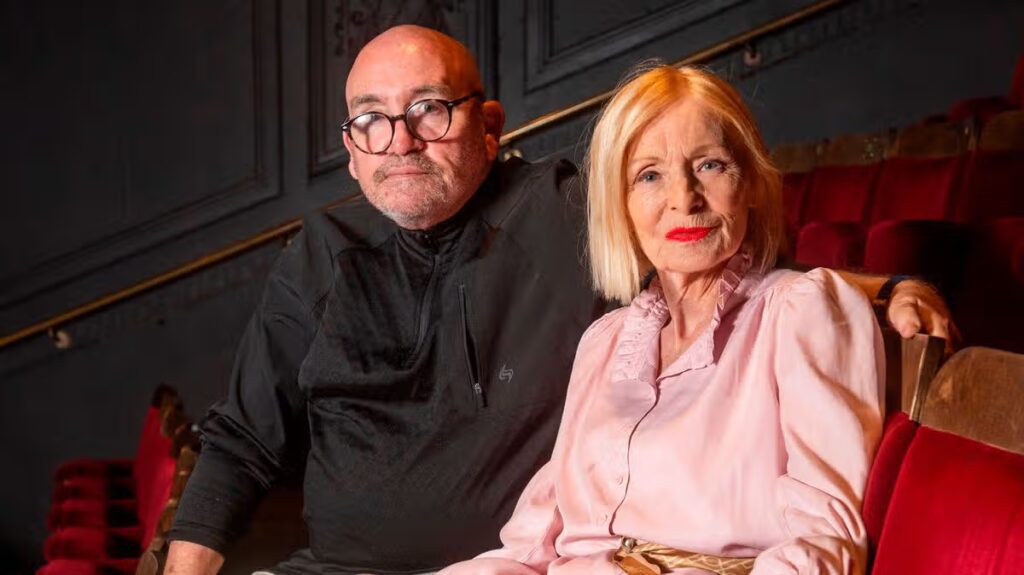

Few films captured Thatcher-era Britain quite like Letter to Brezhnev. Released 40 years ago, it became an instant classic: an against the odds love story set amid economic hardship at home and Cold War tensions abroad. Now new life is being breathed into the story of two working class girls from Liverpool who meet a pair of Russian sailors on a night out and have their lives changed forever.
A new stage version will open later this month in Liverpool with writer Frank Clarke adapting his original screenplay for the world premier. He says the fresh production has come at the right time: “It was a story I had to tell back in 1985 and I think it’s ready to be heard again. There was a lot of phobia about Russia then just like there is now.
“Letter to Brezhnev is about love and friendship but also hope and co-existence; overcoming adversity despite it all. That message is still powerful. It was a labour of love, that love transferred to magic and the magic is on the screen and hopefully now on the stage.
“Meeting these characters again has been like going around to a mate’s flat that you haven’t seen for years, opening the door and they’re all still sitting there waiting for you. I couldn’t resist saying: ‘come on, once more round the dance floor’ to them all.”
The original film starred Alexandra Pigg and Margi Clarke – Frank’s sister – as mates Elaine and Teresa with Peter Firth and Alfred Molina playing sailors Sergei and Peter. Chicken factory worker Terea is looking only for a few hours of fun to escape her humdrum life but Elaine falls in love. After Peter’s ship leaves port she is determined to be reunited with him behind the Iron Curtain and writes to the Soviet leader for help.
It was shot in a matter of weeks on a tiny budget but went on to win international awards. Now 71 and still living in Liverpool, Frank recalls: “It’s really a Romeo and Juliet tale although, over the years I’ve realised it’s just as much about the strength of female friendship.
“The story just poured out of me. I was 25, living in a tiny flat with my boyfriend and dog and I was poverty stricken; nobody had any money. I had always wanted to write a love story but didn’t think I was talented enough. It was a pipe dream, although the idea for the plot had been in my mind for a while. I wanted to show what Thatcher’s Britain was like for so many people but with a romance at its heart.
“I knew Peter Firth and one day we decided to go to the pictures to see a film he was in. I sat looking at him on screen speaking these lines and then sitting next to me and I thought ‘I could do that’. The turning point came when I got up one day to find here was nothing to eat in the flat but a bag of pasta and a tin of tomatoes. I knew I couldn’t carry on like that so I picked up a pen.”
Frank, who also wrote for TV soap Brookside, admits once he started writing he couldn’t stop: “It was like the stars aligned. I lived on cigarettes and cups of tea. It took me about four weeks in all to complete.”
He took inspiration from the lives he saw around him in his home town of Kirkby, a new town about eight miles outside Liverpool, as well as his six sisters. He explains: “Times were hard for a lot of people. Even those in work were just getting by. I remember I’d go to a club and have just enough money for one pint and would then just dance all night.
“I’d see the girls from the local chicken factory go straight out after work, too, still in their bloodied overalls and wellies. They’d cop off because the lads didn’t have any money and knew the girls were in work. I guess that’s what made Brezhnev a political film, because at the time we said, ‘Russia can’t be any worse than living in Kirby – it can’t be grimmer than this.’
“The community was strong though and so were its women. I funnelled all those people into my pen and onto the page. And if I needed to include an argument or a joke or some sarcasm in a scene I’d look to my sisters – it was all there.”
With no tv company interested in bankrolling the movie, funding came in the unlikely guise of Baxi boiler heiress Fiona Caselton (cor) who, after missing her ferry home to the Isle of Mann, slept on Frank’s couch. Frank recalls: “She was so grateful and said if I was ever in the Isle of Mann I should call in. Everyone pooled some money for a ferry ticket and I was over there as quick as I could with the script under my arm.”
Despite Channel 4 later coming on board the budget remained tiny with friends and family drafted in as extras. Margi Clark, 72 recalls Frank turning down the idea of a London based film premier in favour of one in their home town.
She says: “We had an after party at my mum’s council house. There were about 500 people crammed in, all singing and celebrating. We were euphoric. The community all came together – it had been like a big home movie. I could feel in my guts that this film had a message for the world; the story has something universal about it. And it put Liverpool on the cinematic map – now we’re the second most filmed city in the UK after London.
Margi, who played Coronation Street’s Jackie Dobbs, had originally set her sights on the character of Elaine who goes off to the Soviet Union for love. She explains: “Frank said: ‘but you get the final scene; it’s a close up of your face.’ So I thought, ‘fair enough.’”
Now Marg says she is excited to see how her character is realised on stage: “My advice to anyone playing her is make her your own. What would Teresa be angry about today? She’d probably have a gob on about the lack of unity around us.”
The film topped the UK box office and was sold around the world. It was also shown at the Venice Film Festival. Says Frank: “In Venice Mel Gibson was sitting in front of us watching it. I couldn’t believe it. It changed our lives. I went from being on the Dole to having a bit of money – by my standards anyway!”
Now Letter to Brezhnev will once again be in the spotlight thanks to the new stage production at Liverpool’s Royal Court Theatre. Still set in 1985 it features a new cast although its message remains the same.
Frank explains:”“With what’s happening globally now, with both Russia and America, it felt the right time to do it. The tune might be slightly different but it still resonates. But I didn’t have to rewatch the film to adapt the play – it’s seared into my heart. As Teresa says in the film: “‘I don’t want to survive, I want to live’. Those words still ring true.”
*Letter to Brezhnev is at The Royal Court Theatre Liverpool from September 11 to October 10, 2026