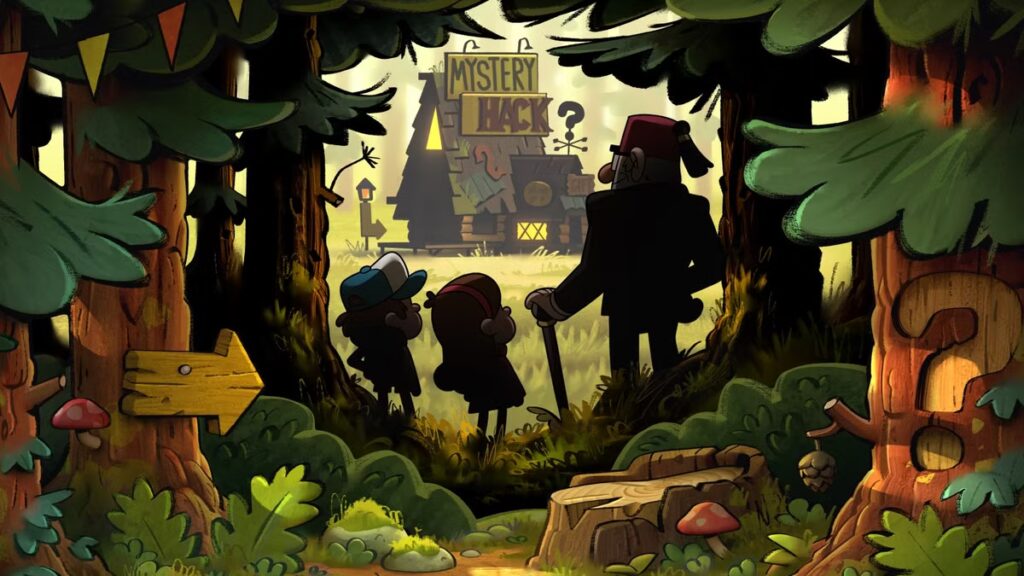

On one hand, Alex Hirsch, creator of Gravity Falls, and Rob Renzetti, a longtime animation veteran who served as the show’s supervising producer and story editor, kinda can’t believe love for their two-season Disney Channel original has persisted for 14 years. The subreddit community of 1.4 million is still posting fan art and theories a few times an hour. Meanwhile, Renzetti has written his own darkly magical YA series and produced Big City Green, while Hirsch dabbles in just about every medium.
But with appropriate modesty, the pair can believe that they created a genuine phenomenon: In their new book The Art of Gravity Falls, the pair reflect on the blood, sweat, and tears spilled to do justice to Hirsch’s ambitious vision for what the tale of twins Dipper (Jason Ritter) and Mabel (Kristen Schaal) could mean to people who hit pause and studied every frame. Spread across one extremely paranormal summer spent with “grunkle” Stan (Hirsch), what started as a monster-of-the-week riff culminated in an extremely unchill multi-dimensional battle against fan-favorite dream demon Bill Cipher. Peppered throughout were codes, clues, and Easter eggs — everything Hirsch hoped to squeeze in what could have been his one-and-only shot running his own series. At 252 pages, The Art of Gravity Falls is a stunning testament to the work that captured a generation’s attention, and still does.
Just a few days away from the book’s Sept. 15 publish date, Renzetti and Hirsch sat down with Polygon to discuss burning Gravity Falls questions, relish in the art, and once again affirm if there will ever be more of the Pines twins’ story. (Note: If Hirsch is bringing Cosmo Kramer energy to this conversation, that’s because he jumped right on our call following a running-over coffee date with Backrooms director Kane Parsons. Theorize all you want.)

The book is absolutely gorgeous. I wouldn’t expect anything less — the show is gorgeous. But a practical question: Why is The Art of Gravity Falls arriving 10 years after the finale?
Alex Hirsch: When we were making Gravity Falls, we had no idea what the reaction to it would be. There are a lot of cartoon shows, and TV shows in general, that are loved for about an hour and then evaporate into cultural amnesia. When the thing was going, I was like, “Yeah, let’s make toys! Let’s make books@” Disney didn’t really merchandise their cartoons in that way at the time, and they just didn’t think it would be worth the investment.
A decade later, it’s getting an unbelievable second wind, culturally. I think there’s a mathematical zeitgeist thing happening where, if you were 12 when the show came out, you’re 22 now, and you want to relive the nostalgia. If you were 22, you’re 32 now, and you want to show it to your kids. There’s a Venn diagram sweet spot. It’s gone from being a “show of the week” to a nostalgia IP. And there’s money to be made in nostalgia, so 10 years later, Disney finally recognizes that people might wanna buy these products and is letting us make them.
Rob Renzetti: I would also say that the success of Alex’s Book of Bill, which was a very successful book, contributed to the appetite for more Gravity Falls books. And this is the ultimate Gravity Falls book because it basically shows you exactly how the show was created: all the inside stuff that you wouldn’t otherwise see, all the inside stories you wouldn’t otherwise hear.
Hirsch: Another secret ingredient is TikTok. When the Book of Bill came out, it was such a phenomenon on TikTok that it sort of propelled Summerween, which was one of our episodes, into becoming kind of a real holiday? And it skyrocketed the amount of views Gravity Falls saw on Disney Plus. People are more ravenous than they’ve ever been. Shockingly. I can’t believe it.
You may have minted an entire generation of conspiracy theorists.
Renzetti: [laughs] I think you mean that in the most positive way possible! But Alex was a little conspiracy theorist when he was a child, so he should speak on this.
Hirsch: I was a weird, paranoid kid. I think it maybe started with The Simpsons. It was my favorite show of all time, and then I realized that if I recorded it off the TV, hit pause, that there were secret jokes hidden in the background on signs. And I thought, Well, gosh, if there’s secret jokes hidden in The Simpsons, what other secrets are there? I started reading the fine print of every object in my house — what are the nutrition facts??? — and I started researching subliminal messages. I would record commercials off the TV and play them backwards to see if there was mind control. I saw the world through a sort of magical lens of mysteries and secrets and treasures and puzzles hidden everywhere — that’s just how my imagination manifested during puberty.
When I finally had a chance to make my own TV show, I thought, “Well, wouldn’t it be fun to reward any kid out there who’s as crazy and paranoid as I am?” I thought maybe there’d be a handful who would sort of enjoy looking for the Easter eggs and clues and secrets and foreshadowing. It never occurred to me that there would be an army of Dippers that would one day be whipping out their magnifying glasses and trying to solve the puzzles that we created. And trying to create ones that we never even imagined.

Renzetti: We also kind of hit a sweet spot in terms of when the show came out, where people were able to participate and communicate with each other about a show, basically in real time. The fact that you could have a collective mind working on these puzzles led to their almost immediate solving and to an enjoyment for the people that were participating in that collective mind. And, you know, nobody was there when Alex was a kid, listening to commercials backward, to tell him, “I don’t think there’s anything here, dude.” [laughs]
Hirsch: The internet has allowed the weirdest people that exist to corral and combine their weirdness and amplify each other, in a way that. So much of this is a story about technology. Like, Tumblr became a big deal right around the year that Gravity Falls premiered. No show and no platform have ever been so perfectly ready for each other. There was a ready-made community of people looking to create fan art and analysis at just the time that we were making something densely layered with stuff to pull apart.
My sense from the book is the two of you have a very yin-yang relationship. Alex refers to himself multiple times bringing chaotic energy, ideas pulsating out of the brain. Rob, I get the impression that you knew how to add to those ideas in ways that brought them to a finish line. How did you achieve balance?
Renzetti: The main purpose that I served for Alex on Gravity Falls… I helped come up with a lot of ideas, which I’m very proud of, but Alex did the overwhelming majority of the creative work on the show — it is his baby. But from a production standpoint, the main function I served was to be calm, to not freak out. [Laughs] Everybody else on the crew was much younger than me, and Alex was a first-time creator with not a lot of history in animation. He’d had, like, a job and a half maybe before he got his own show. That was great because he brought the youthful energy. He hadn’t learned a bunch of bad habits. He didn’t know what he couldn’t do. And after being with him just a short time, I knew that my function was basically to support him and to tell him: When things went wrong or things weren’t working out, that everything was gonna be OK. It will work out. We will figure it out. We’re here to create something and we’ll create it along with all these amazingly talented people that you brought together.
I basically functioned as the cover of The Hitchhiker’s Guide to the Galaxy: “Don’t panic.”
Hirsch: Yes, and I was.
Renzetti: Exploding. Over and over again on a daily basis.
-
-
-

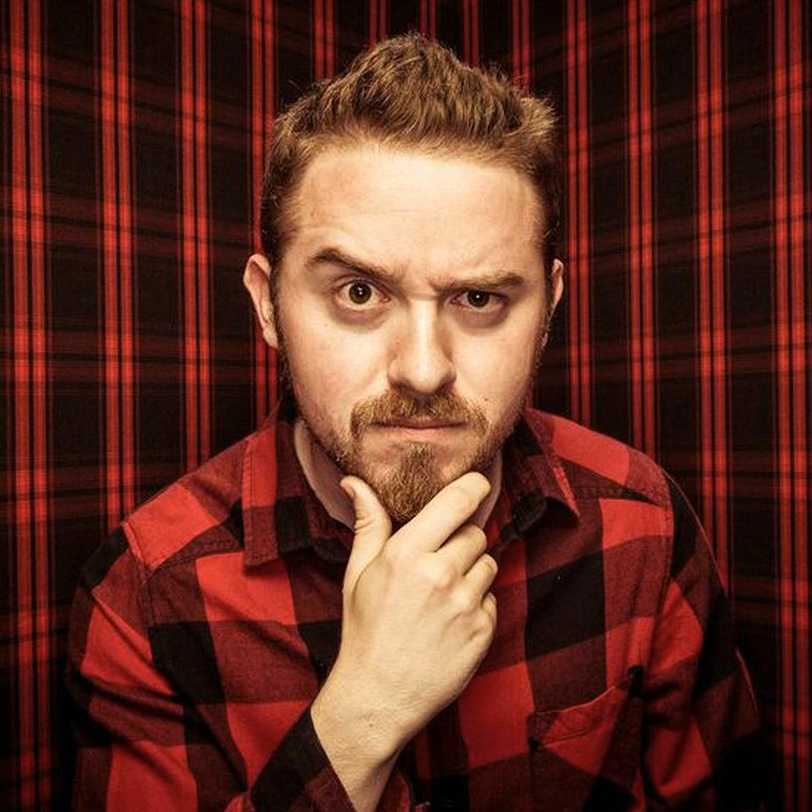
Alex Hirsch and Rob Renzetti
Hirsch: We do joke in the book about me being the chaos and Rob being the order, but I don’t wanna sell Rob short: he’s a brilliant writer and storyteller. A fantastic artist. He has a deep love of horror and the show could not have possibly existed without him, let alone things like Journal 3.
I do remember one of the reasons we got along so well, in my opinion, was I often found that the folks I would speak to would either be condescending to me, because they were like, “This kid doesn’t know anything,” and I would immediately be turned off by collaborators that were like that. (11:11): Or, alternatively, I found that people could be real sycophants. They would hear, “Oh, this kid’s the new guy. Well, we’re just gonna tell him he’s great.” and neither of those fit my creative style. I like somebody who’s gonna be honest with me, and who respects what I’m trying to do. Rob is smart, funny, sassy, and he will bust my balls and keep me honest. I was very lucky to have worked with Rob all these years.
You’ve talked about sources of inspiration for the show, many named in the book, but what about the ambition and scope? What was your beacon for how the lore would expand and come together in the end while remaining character-driven?
Hirsch: My primary ambition was not to embarrass myself because we didn’t know what we were doing. These were a lot of new chefs in a fancy kitchen with a lot of untested ingredients. But I did know what I liked. I loved The Simpsons for how layered it was and how it got better the older you got. There are shows from when you are a kid, and you go back and watch them, and you’re like, “Oh, man, like, I really needed to be five to think that was good.” But The Simpsons stayed good.
I also wanted something that rewarded viewers’ attention. I was a Nintendo kid. I was obsessed with finding secrets in video games, so I wanted to give those “Holy shit, I found a secret treasure chest in a dungeon mystery” prize feelings I would get from video games. And I also wanted it to make me curious and have a sense of ominousness, like The X-Files. The big challenge was, especially at the beginning of season 1, knowing the proportion of all of those? Is it 90% Simpsons, 10% X-Files? Is it, 60% X-Files, 40% Simpsons, 2%, this one random Spielberg movie? Like, it required a lot of, taking all these ingredients, putting them in the pot, tasting the soup and saying, “Oh, fuck — that doesn’t work.” And then tweaking and calibrating.

I remember the first few episodes, I was really stressed out, because it didn’t taste right yet. I was just like, Hmm, this feels a little bit just too like a light kids show. This isn’t sincere enough in its sort of depth of curiosity. and as we started making our way through the season, halfway through, I think we were doing “Double Dipper” or “The Time Traveler’s Pig” and the magic really started to feel like it was supporting the character stuff. It was funny, but also it was emotional. The paranormal aspects were meshing. We started to have setups and payoffs where we had hidden a time traveler in the background, and now we were revealing him, and just suddenly all these things started to gel, and it started to take on its own voice.
And the voice wasn’t something I really knew what it was gonna be before I heard it. Then when I heard it was like, “We have to protect this. We have to keep it feeling this way.” Which is very difficult because, left to its own devices, a script will happily turn into something very cliche and basic.
Renzetti: I think anyone’s ambition going into a show is to do for their audience what they discovered as a kid or as an adult, which is to deliver a show that you can’t believe exists, that you never thought of. And at the same time, you’re like, “Why didn’t I think of this myself?” Something that you can’t live without, characters that you love, things that you don’t want to end, and yet you hope it ends before they spoil it. To add to that wealth of storytelling that the human race has created and to do something that resonates with people, I think that’s your ambition whenever you start a project like this.
Hirsch: Make the best thing ever. No pressure.

You mentioned Tumblr, feeling close to the audience even as you’re making the show, and in the book that relationship seems very high stakes by season 2. How did the fans challenge you? Where did they make their mark on the finished product?
Hirsch: The fan response once the show was airing was, like, the best thing that possibly could have happened to me creatively because it was so hard to get this thing together. It was so hard to make. And when you’re making a TV show, you’re sort of throwing creative decisions into a mystery hole. The only people who’ve seen the show are you and maybe 20 people in the office. You really don’t know if it’s any good or if it’s working. You have your theory, but you’re not sure. I worked my ass off on this thing. I did not have anything else going on in my life. I wasn’t married. I didn’t have a rich social life. I had the show. The show was my life. I was like a captain living on a boat and I cared so much.
When I’d go home for Thanksgiving and I’d say, “I’m working on this cartoon,” everyone would sort of roll their eyes at me, like, “Is it so important to lose sleep over?” And once the show came out and the fans loved it and engaged with it and got tattoos of it and theorized about it was like they were giving me back the permission to care as much as I had been caring up until that point. I thought maybe I’m crazy for caring this much. And then when there was this army of charming and sweet and creative kids all saying, “Yes, keep going,” it gave me the second wind to say, “All right, it’s worth it.” because you don’t always know.
I would go three or four rounds of emails trying to preserve one joke in one episode, and I’d have executives say, “Who cares? Just let it go!” and I think “Maybe they’re right.” And then when the joke would get through, and I’d see a hundred people who have that joke tattooed on their arm, I’m like, “Thank god I cared that much.” I wasn’t sure if I was insane to care until the audience told me that I was allowed to. I’m glad I took the risk.
Renzetti: To have a chance of anybody reacting that way, you have to care that much. You have to put all the love that you have into the show. A lot of people wanna have their own show, but you really have to question that desire. Do you really wanna have your own show? Because it will swallow your life. You have to put all the love and care and energy you have into it because if you don’t, it will show. People will not respond to something that’s half-assed. Your taste may not align with the cultural taste at the time, but that doesn’t mean you don’t owe it to your potential audience to put all the love and care you have, otherwise you’re guaranteed to fail. And you only have the smallest chance of success if you put all that love and care and energy into it.
Hirsch: The other thing that was really useful about having a sort of live audience reaction as we were writing season 2 was that they functioned as a heat map of passion. We didn’t know, for example, that Bill Cipher was gonna be the main villain of the series when we started. He was sort of an inside joke. “Wouldn’t it be funny if there was a little eye of Providence dressed like the Mr. Peanut, who’s kind of a jerk?” But the reaction to Bill Cipher when he first a- appeared in “Dreamscapers” in season 1 was so enormous. We went into season 2 brainstorming a different Big Bad. My creative director, Mike [Rianda, who later directed Mitchells vs. Machines], a genius, he was really skeptical that Bill Cipher could sustain the dramatic attention necessary to be the Big Bad. He was like, “This guy’s like Mr. Mxyzptlk” But I was like, “Listen to the audience, man. He’s the villain now.” It’s never that we took ideas from the fans, but this thing we put out there, people said, “Holy shit, we need more now.” And we’d say, “OK, that’s something to pay attention to.”

You talk in the book about “writing yourself out of the rooms” of various plot breadcrumbs or puzzle-y secrets you peppered into the background that didn’t necessarily have trajectories at first. So what was the hardest room to write — or design — yourself out of?
Hirsch: To my recollection, we knew when we started the show, Grunkle Stan had a twin brother who investigated the paranormal and got somehow spirited away by a mysterious force, and that run Uncle Stan assumed his identity and has been trying to find him for 30 years. We didn’t know what his brother looked like or acted like. We didn’t know where they were from. We didn’t know where his brother had gone. We didn’t know Bill Cipher existed yet. So in season 2, when we did a “A Tale of Two Stans,” and it was time to finally reveal the fallout between Stan and Ford, why Ford came to Gravity Falls, what that had to do with a portal, what did that had to do with Bill Cipher… that was a giant game of Twister.
It was OK if it was a little crazy or silly in terms of the logic of the A to B to C, but the backstory had to plausibly explain Grunkelstan’s attitude toward him, the siblings, toward the shack, toward his brother and it had to plausibly set up where we were going with the finale and the apocalypse. The thing that I remember just banging my head against the most with the most amount of drafts was “A Tale of Two Stans” and making sure that this all sort of felt like it worked and we weren’t just pulling something out of our ass.
It sounds like you dwelled on which details to eventually include and scrap because you knew the fans hit pause on episodes — I was shocked to see that a framed photo of Ford was cut last minute due to potential spoilers.
Renzetti: The fans were fanatical and you couldn’t hide the smallest thing without 20,000 people discovering it. So, I think Alex says in the art book, why would Stan have a picture of himself? Even Stan doesn’t have that much of an ego. Not in this place — Stan leaves his ego behind when he goes down to the portal room. That’s the sign of his life failure. He messed up his relationship with his brother and sent his brother to another dimension down there. He wouldn’t be celebrating himself in any way down there.
Hirsch: Fans would’ve immediately figured out that something was wrong there. We knew they would. So once we sort of knew the lore, we were always looking for clever ways to hide it, and then often removing it at the last second [laughs] trying to figure out how obvious is too obvious.
We’d finished seven episodes before the first episode aired. So we were less than halfway through the season when we first started getting audience feedback. And I remember when, in “Hand that Rocks the Mabel,” the first episode with Gideon premiered, it’s revealed that Gideon has a second journal… I didn’t know if anybody would care. I was watching a sort of live chat when that moment premiered, and it was like a bomb went off. People were losing their minds. They said, “Oh my God, that journal from episode 1, there’s another one. Gideon knows something about the town.” We just had no evidence that anyone would follow this! Other amazing shows on the Disney Channel at the time, like Phineas and Ferb, didn’t have story continuity. So we had no proof that this audience was going to pay attention to that sort of thing. When they did, it was, like, all hands on deck to try to make that attention worthwhile.
Are there continuity or lore “errors” that have left some fans spinning in circles for the last decade.
Renzetti: The one that occurs to me, and it’s not really an error, but talking about the first appearance of Ford is, in “Time Traveler’s Pig,” where he sticks his head out of the shack in winter — we really didn’t know what he looked like. We were just kind of guessing at what he could possibly look like. When we actually had Ford figured out, we had the character designers trying to align, which was a bit of a challenge. We kinda got close to the bullseye.
Hirsch: There are hundreds of errors throughout the show and there’s an expert on finding those errors named Wikipedia [laughs]. I get people DMing me on Instagram, you know, a decade after the show aired, “How dare you? Uncle Stan doesn’t have his glasses in the flashback!” I’m gonna stop feeding those trolls because nothing satisfies them. When you say, “We’re humans. We were trying our best. There are some mistakes.” — that’s not interesting. They want a conspiracy, even with screw-ups. That’s one conspiracy I can’t encourage them to follow.
You’ve truly shaped people with this show! And between the in-world books and this art book, they’re well fed 10 years later. So does Gravity Falls feel over for you? Or is there more to say? I bet you’ve never been asked this.
Renzetti: This is probably the ultimate question for Hirsch because everybody wants to know.
Hirsch: This is a funny question because I’ve been saying, “Sorry, shows over” for a decade. Yet every single convention, every single Reddit AMA, every single Twitter thread has someone saying, “OK, but when are you gonna answer the question?” [laughs]
I will say, the enormous response to The Book of Bill did sort of shock and really hearten me. I was really happy to see that this world stood the test of time. I have no intention to ever create a season three of Gravity Falls because I think one of the reasons we’re still talking about it 10 years later is that there’s a satisfying ending to the story. It was designed to tell a story about one incredible summer, where these two twins sort of went through this threshold of going from little kids to starting to become young teens and their uncle who had this long lost brother who finally found him and this question, “Who wrote the journals?” and this big answer. It’s not designed for us to then say, “OK, what if there’s a long lost triplet and they go to Mars and they’ve got a talking race car?”
Renzetti: Wait a minute… now I’m changing my mind.
Hirsch: OK, Rob. Season 3: What’s the name of the talking race car, Rob?
Renzetti: Rum McGee.
Hirsch: So, I mean, Gravity Falls season 3, The Legend of Rum McGee, might be coming out, but it probably wouldn’t be me making it.
The Art of Gravity Falls arrives wherever you get your books on Sept. 15.