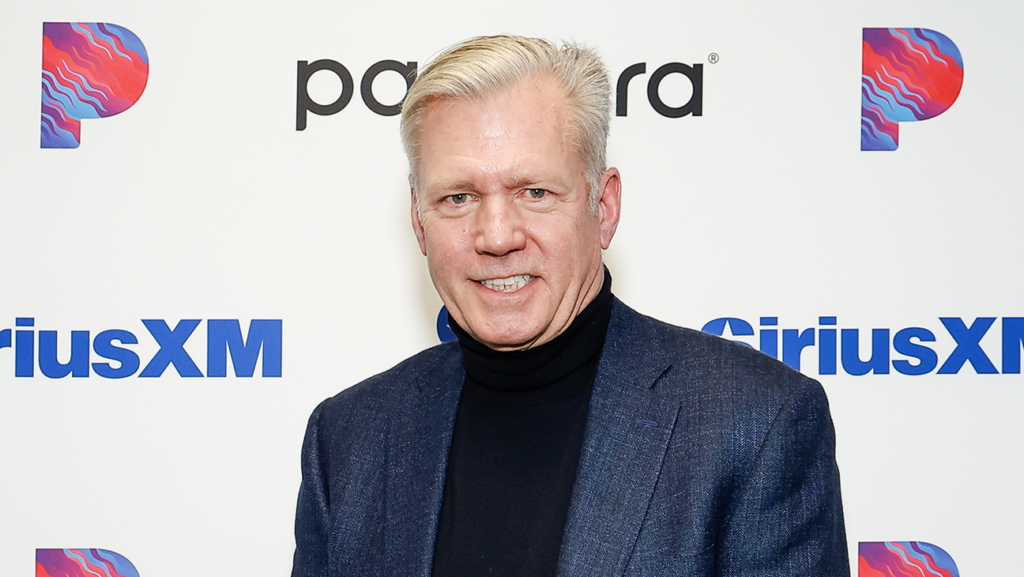

Chris Hansen has not seen Primetime, and has no plans to sign anything in order to do so. But following the news out of the film’s Venice Film Festival premiere, the former NBC correspondent has read enough about Robert Pattinson‘s performance and the film’s fictionalized depiction of his work to know that he objects.
Directed by Lance Oppenheim in his narrative feature debut — who’s also grabbing headlines for co-directing with Nathan Fielder the Elizabeth Holmes doc You Can See Everything — and written by Ajon Singh, Primetime dramatizes the 2006 boom year of Dateline NBC‘s To Catch a Predator, when Hansen’s hidden-camera stings became a ratings phenomenon and, eventually, a legal liability.
Pattinson, who also produces Primetime, plays a version of Hansen consumed by the segment’s success and hungry for a primetime slot; Merritt Wever plays his producer; Skyler Gisondo and Phoebe Bridgers play decoys; and former NBC chief Jeff Zucker appears as himself.
The film premiered in competition at Venice on Sept. 5 to a roughly eight-minute standing ovation. Pattinson emerged with strong notices and early Oscar talk, while reviews of the film itself were more mixed. A24 opens it in select theaters Sept. 25 before expanding in October.

Lance Oppenheim and Robert Pattinson attend the red carpet for the ‘Primetime’ premiere during the 83rd Venice International Film Festival.
Laurent Hou / Hans Lucas / AFP via Getty Images
Hansen’s dispute with the studio began well before Venice. In August, he said A24 would screen the film for him only if he signed a nondisclosure agreement that, by his account, would have been unacceptably restrictive. Studio sources called it a standard screening NDA meant to prevent plot leaks. But legal experts shown the agreement by The Hollywood Reporter say that the prohibitive legal language went far beyond that of a boilerplate NDA.
Hansen decided to skip the screening and, as first reported by THR, bought ad space for his true-crime streaming network, TruBlu, to run before every screening of Primetime for at least the first four weeks of its release.
Talking for the first time since Primetime‘s unveiling in Venice, Hansen, 66, called THR from Chicago, where he was presenting at the annual conference of the National Center for Victims of Crime. He called the film an “insult,” compared Hollywood’s conduct to the predatory behavior it depicts — citing Harvey Weinstein in the process — and responded, with little hesitation, to questions about the controversial death of a sting target that serves as Primetime‘s dark climax.
The film has now premiered in Venice, and Pattinson is receiving Oscar talk for playing you. How would you feel if he were nominated?
There wouldn’t be a movie if I hadn’t created the Predator investigative series, so that would not be possible without my work. Robert Pattinson has said that he hopes the movie adds to my legacy, and I appreciate that.
But you still have something that is a complete work of fiction attached to a real name. Based upon what I’ve seen in the trailer and my understanding of what has been written about the film, they wanted to create something much darker and way more dramatic.
I think it’s an insult to the thousands of men and women who work hard every day to protect children from predators. They turn something that is very positive, very challenging and not without risk into what is essentially a horror film.
I guess it’s not surprising that a Hollywood studio would act in such an exploitive or predatory manner. We’re talking about an industry that was led by perhaps one of the biggest predators to walk the planet, Harvey Weinstein. They’ll all pat each other on the back and say, “What a great job. This is really dark and mysterious and intriguing.”
But at the end of the day, it is a completely made-up work of fiction. Why would they not contact or consult me? Because they don’t care about the real story. And the irony is that the real story is pretty darn dramatic on its own.
Robert Pattinson as Chris Hansen in ‘Primetime’
BFI London Film Festival
A24 did not officially approach you until shortly before releasing the trailer. What bothers you most about how the studio handled this?
Obviously, we knew something was in the works. I’ve been a reporter for 45 years. You hear things. But to come to you at the last minute and say, “We’ve done this, and we didn’t feel that we had to come to you to discuss it,” seems sneaky and somewhat disingenuous, especially because the project is so largely a work of fiction. You look at the trailer, and there’s nothing in it that actually happened in real life.
That raises the question: Why use somebody’s name, image and likeness? They do that because it has commercial value. The name is a brand, and the brand brings people into theaters, just as it does to my podcasts, my network and everything else we do.
I have no issue with Robert Pattinson. I think he’s a great actor and a nice guy, and he has been very gracious in his comments about me. But they put him in a difficult position. He’s going to be asked, “Did you actually meet with Chris Hansen?” And he has to explain why, as an actor portraying me, they never reached out even to have a discussion.
I think it’s because the studio and the director didn’t want to know the truth. They had a notion of the film they wanted to create, and they wanted to benefit from the use of my name.
Has A24 offered you any explanation for not consulting you?
In the correspondence we had back and forth, they essentially said, “This is loosely based on Chris’s work, so we didn’t have any compelling need to reach out to him, consult him or get permission.” But they used the name, and they never want to answer that question.
But the filmmakers did consult Jeff Zucker, and he plays himself in the movie. What do you make of that?
Maybe Jeff is a Hollywood insider. I haven’t talked to Jeff in some time. I learned later that he was going to be in the film, and I saw him in the trailer. But I never had the conversation that Robert Pattinson has with Jeff Zucker [depicted] in the trailer. Again, it’s totally fiction.
Jeff Zucker and Chris Hansen at a party in 2008.
NEIL RASMUS/Patrick McMullan via Getty Images
You still haven’t seen the film?
No. They wanted an NDA and said it was their standard procedure. It may be a very standard NDA for them, but it’s not standard if you’re Chris Hansen, and it would have been restrictive. I said, “I’d love to see it. I’m happy to agree not to give away the plotline or anything like that, but I don’t think I need to sign an NDA.”
We came to an impasse, and that was that. I will see the film at some point, I assume when it comes out, and I’ll be able to judge it based upon that.
The reviews suggest the film depicts the investigations as having crossed a line, becoming exploitation in which the public good was secondary to ratings. How do you respond to that?
It’s just not true. From the beginning, we were transparent about what we did, how we did it and the results. The film’s timeline, scenario and conversations are completely made up. It just didn’t happen. I pitched [the stings] because I thought it was a critical issue, and Dateline approved it. It was never meant to be its own series. It was one of the many stories I did for Dateline and NBC. We hit on something incredibly compelling, so we continued to do it, and we continue today.
The film apparently portrays the Predator investigations as your consuming obsession and suggests you were desperate to turn them into a primetime franchise. Was that true?
I’ve won 10 Emmys for various reporting. None are for the Predator series. My understanding is that the film’s character has invested his whole world in this, doesn’t feel he gets enough respect for it and thinks it should be a primetime show. It was never the only thing I did. It was part of my repertoire as a reporter. It was compelling television because you had a felony being committed in real time, the person confronted with evidence, interviewed by me and then facing criminal justice. There’s never been anything quite like it.
People keep asking me whether you’re furious about this or happy about the attention it could bring to TruBlu and your current work. Is it a mixture of both?
I’ve never been angry about it. Don’t portray me as some angry guy. I understand how the media world works. I’m less schooled in the Hollywood world, but I understand my media world. And of course we will benefit from this in any way we can, because this very important work continues. We produce Takedown on TruBlu and have several documentaries in the works, including I’m Chris Hansen, which was underway before we knew about the film and is nearing completion.
You participated in David Osit’s documentary Predators last year, which questioned the methods and legacy of the franchise. Was there anything objectionable to you about that film?
It was one director’s point of view, and he left a lot of important things out. He was out to raise questions. It was almost like, “Have you hugged your neighborhood predator today?” He had a sociologist analyze whether it was appropriate to expose these guys and whether we’re too rough on them. It got a little silly at some point, and I think people saw that when they watched the documentary.
Chris Hansen appeared in David Osit’s 2025 documentary ‘Predators.’
Everett Collection
[Primetime‘s final act centers on Louis William “Bill” Conradt Jr., a 56-year-old chief felony assistant district attorney in Rockwall County, Texas, and a former Kaufman County DA. During a November 2006 sting in Murphy, Texas, Conradt exchanged sexually explicit messages with a Perverted Justice volunteer posing as a 13-year-old boy but never went to the sting house. On Nov. 5, police obtained warrants and sent a tactical team to his home in nearby Terrell; he fatally shot himself as officers entered while members of the Dateline crew, Hansen among them, waited outside to film his arrest. Hansen and NBC have maintained that law enforcement and Dateline conducted parallel investigations. Collin County’s district attorney subsequently declined to prosecute any of the 23 other men arrested in the Murphy sting. Luke Dittrich’s September 2007 Esquire investigation is the principal account on which Primetime is based.]
Reviews confirm that Primetime depicts Bill Conradt’s death. How do you feel about the case being reexamined this way?
We were completely transparent about what happened from the moments after it happened. This was no secret. It was unfortunate that somebody chose to take his life rather than face criminal consequences. You can draw your own conclusions as to why. They found child pornography on his computer. He had sexually explicit conversations with two different decoys posing as 13-year-old boys.
I can’t speak for the police, but they decided to arrest him, apparently concerned about the possible destruction of evidence. He chose to take his life rather than face the consequences. We reported what we knew the next day on the Today show and continued to be transparent throughout the story.
There are certain things you can’t control. Obviously, you don’t want anybody taking their own life, but that was a decision made by that individual. They’ll ramp it up in the film, I’m sure, and make it more dramatic than it really was. It was based upon an Esquire article that came out years ago that was a bit of a hit piece then, and apparently it’s part of the narrative in the film.
According to the Esquire account, this was the first time you went to someone’s home after he did not come to the sting house. Do you regret that decision?
We were covering what the police were doing. We didn’t have a role in the decision. The police decided to do it, and we covered it like any other arrest we would cover in the course of reporting the story.
So you’ve never had sleepless nights, second thoughts or a change of heart after that incident?
No. We continued to conduct investigations after that.
[Conradt’s sister, Patricia, sued NBC for $105 million. In February 2008, U.S. District Judge Denny Chin allowed the principal claims to proceed, writing that a jury could find NBC had “crossed the line from responsible journalism to irresponsible and reckless intrusion into law enforcement.” The ruling did not establish NBC’s liability, and the network settled with the family that June for an undisclosed sum.]
From left: Chris Hansen, Josh Macikoiewicz, Hoda Kotb, Keith Morrison and Dennis Murphy attend the ‘Dateline’ 20th Anniversary Mystery Party on Oct. 4, 2011.
Eugene Gologursky/Getty Images
Your theatrical ad buy was a clever response. What are you hoping comes from it?
I want people to know that we do this important work every day and that they can see it on my streaming network, TruBlu, where we have the freedom, the independence and the control of our content to continue doing it. I think its importance is reflected in how many people continue to follow it.
[Hansen’s comments to Fox News and Dan Abrams’ SiriusXM show in late August produced a wave of headlines saying he was “weighing legal action” against A24. As a matter of law, his path is narrow. Public figures face a high bar in defamation cases, and courts have afforded dramatizations of real people broad First Amendment protection. In the 2018 case De Havilland v. FX Networks, a California appeals court threw out Olivia de Havilland’s suit over Feud.
Daryl Hannah raised a similar objection in March, when she published a New York Times op-ed denouncing her portrayal in FX’s Love Story as “not even a remotely accurate representation of my life” and questioned whether real people have any recourse when a series takes liberties with their names.]
Are lawyers still examining whether you could take action against A24?
I have lawyers looking at it, the best guys there are in this part of the world. But what do you get out of that besides making a statement? Is there something to be done? Is there some justice to be served? I don’t know.
It’s an interesting legal question. Daryl Hannah raised a version of it in her New York Times op-ed about Love Story. I don’t know if you saw that.
I sure did see that. Obviously, I’m a public figure, and the threshold for defamation is high. A number of things have to be shown. Are there other, more creative legal theories that could hold them accountable? Maybe. Is it identity theft? What separates this from identity theft? If somebody takes your name and image and makes money from it in a commercial enterprise, is that stealing somebody’s identity? I don’t know. It’s a question for our legal system, I suppose.
Is legal action something you’re actively exploring?
Somebody asked me that, and I said, “Well, I can’t rule it out until I see the film.” Obviously, nobody would. And then suddenly there’s a headline: “Hansen Weighing Legal Action.” It got the Page Six treatment. So no, you can’t rule anything out until you see the film. I’ve got some very well-schooled lawyers and advisers who keep an eye on it for me.
But I don’t get up every morning and obsess over this. We just finished [a sting] in Louisiana, worked until 3:45 a.m., got on a plane at 6 a.m. and flew to Chicago for my niece’s wedding. Then I came back to New York and watched the U.S. Open. Now I’m at this conference helping survivors of these crimes get justice. I’ve got work to do. It’s a full-time job being the real Chris Hansen, much less worrying about a fictional movie. We’re not going to be taken advantage of or rolled over. But I don’t spend sleepless hours on it.
One thing that’s become a lot more known because of Primetime: You’re still producing new Predator investigations. And they’re still resulting in arrests.
It’s very active. TruBlu has around 270 episodes from the last four years, and we drop a new episode every Thursday. People get caught up in their feelings one way or the other about the franchise, and I understand that. But the positive effect of it way, way outweighs any negatives.
I’ve often said jokingly that I wish we’d have a year when nobody showed up. I’d love to do a Southern cooking show in Florida, visit all the barbecues and work my way through the state. That would be a great way to spend some time as a journalist — but I don’t see it in my near future.