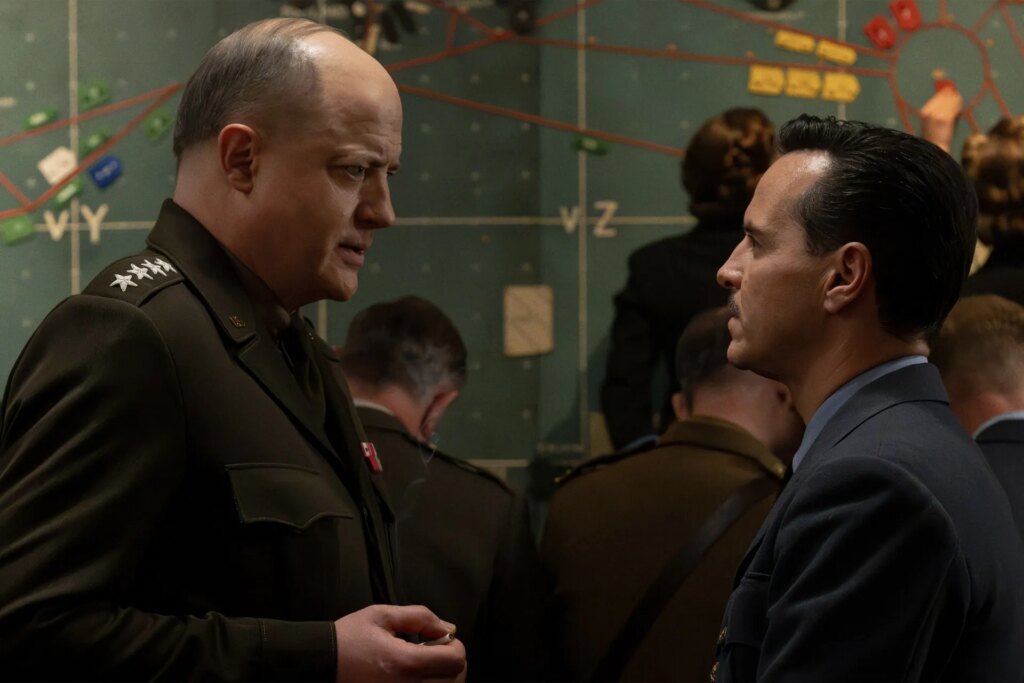

“How can the weather be boring? It feeds us. The weather can destroy us. It controls our daily life.” Andrew Scott delivers these lines impeccably as meteorological expert James Stagg in Pressure. After hearing them, you may well never look at a rainy or sunny day in quite the same way again. Director, co-writer and editor Anthony Maras’s latest movie will make you think differently about the weather. It also offers a D-Day story you’ve probably never seen before.
Unless, of course, you’ve seen David Haig’s 2014 same-named play on which the movie is based. Just like its theatrical counterpart, this feature is a top-notch portrayal of the crucial 72 hours before D-Day. General Dwight D. Eisenhower (Brendan Fraser) tasks Stagg with assessing whether the weather will be favourable for the British troops. He must determine whether conditions are too dangerous to proceed or not. During his assessment, Stagg faces immense pressure from the unpredictable weather and the military leadership. That includes Field Marshal Montgomery (Damian Lewis), as well as his fellow meteorologists, who have their own opinions about the forecast. They reject Stagg’s expertise while allowing their judgement to be clouded by bias and outdated forecasting methods. This soon leads to internal clashes at Allied military headquarters. But the nearer D-Day gets, the fiercer the disagreements become.
Don’t expect Pressure to be just another war movie. Nor is it another retelling of how the Allies experienced one of the most important days of World War II. Instead, Maras makes full use of Haig’s unique angle on the events and his top-notch cast. The result is a captivating, tightly wound drama. Soon after we begin following Stagg, it becomes crystal clear that Andrew Scott is once again at the top of his game. That comes after his tip-top turns in Blue Moon and All of Us Strangers. While the headstrong meteorologist has something emotionally impactful to deal with on the home front, Scott never allows Stagg to become overly emotional. Instead, he captures his character’s uptight yet subdued personality with magnetic restraint.
What makes Scott’s portrayal even more compelling is the beautifully rich and warm cinematography from Jamie Ramsay (Living). Instead of relying on the usual grey and desaturated colour palette, he opts for something more tactile. The soft visuals blend seamlessly with Scott’s understated approach, the wider ensemble and the wonderfully restored historical archival footage. Just like the movie itself, Stagg’s inner pressure cooker eventually explodes during one unforgettable moment. Ramsay captures the immense psychological strain he is under while keeping the camera close to him. The result is an intimate yet never overly dramatic scene. It also firmly propels Scott into the upcoming award season’s Best Actor conversations.
In some respects, Scott’s more subtle portrayal makes Fraser’s larger-than-life approach feel even bigger. His Eisenhower might not be as tyrannical as his real-life counterpart, but that doesn’t make Fraser’s interpretation any less blustery or entertaining. He not only brings an impressive physicality to the role, but also beautifully navigates the more emotionally heated scenes. His personal secretary, portrayed beautifully by Kerry Condon, is the main witness to the emotional glimpses of vulnerability beneath the confidence.
This is particularly evident on the eve of D-Day. Just like in The Banshees of Inisherin and F1, Condon is surrounded by plenty of machismo and inflated egos. That’s even more apparent when Lewis makes his explosive appearances as Montgomery. But she certainly knows how to bring strength and emotional depth to an otherwise male-dominated story. Her warm presence provides a welcome counterweight to the military bravado surrounding her.
Much like the men on screen, Maras clearly keeps one eye on the clock with this feature. The runtime comes in at just around 100 minutes, which is quite rare for a war drama. Nevertheless, this movie about the seemingly mundane subject of meteorological planning strikes an impressive balance. There are slightly conventional elements, but also urgency, compelling drama, and sharp performances.
Pressure is out in UK cinemas now.