
As another Nintendo Direct passes by without a mention of Mario, there is room in this hyper-AAA fall season for a platforming hero to emerge. Good news: That hero is the Prince Frog from Croak, who’s expected to step out before the year’s end.

After playing the demo for Woodrunner Games’ debut title, I raced to talk to anyone explain how all the elements — hand-drawn 2D animation, elastic mechanics, and studious level design — merged into one light-on-its-feet game. Thankfully Max Petroff, CEO and co-founder of Woodrunner, and Tina Nawrocki, one of the lead animator’s on Cuphead, heeded my literal call.

Polygon: I’m playing an amazingly fun platformer right now called Croak. Congrats: you made it. Where do you even start with this thing — the art or the mechanics? The tongue is so fundamental to everything.
Max Petroff: I wish the Frog Prince would’ve come first! So how it all started: we were playing a lot of platformers. When Super Mario Maker came in, we were able to do our own level design, but we were also playing a lot of the hardcore Super Mario World stuff, like in the Kaizo community, which is super-hardcore levels of Super Mario World. And of course, we played all of the indie stuff like Celeste, Cuphead, Super Meat Boy, and all those platformers. We thought, why not do our own version of that? So we did a lot of playtests, a lot of iteration about what kind of gameplay we wanted.
We knew that we were more focused on precision platformers. We didn’t want to have any power-ups and stuff. We wanted to have one core mechanic and push it to the maximum. That was kind of our idea. And we wanted to make sure it was accessible. Since the Kaizo community is really, really hard, we wanted something more accessible where you have small puzzles that you go through and you never lose your progression. So one particular puzzle can be really hard, but you already have that satisfaction of beating it right away. And if you die after, you don’t lose your progression.
We had a big vision. We wanted to do a cool story, and we already knew that we wanted something visually really nice from the start, but we didn’t actually know where to start. At first, it was actually pixel art because we didn’t know how to do hand-drawn stuff. We even tried 3D stuff at first, just because that was our skill set, up until we met a couple of animators. Then we were like, “Oh my God, hand-drawn animation is amazing.” But we wanted to push the quality a little bit more, so we reached out to Tina.
Tina Nawrocki: And it wasn’t a frog to begin with — it was a duck. We had a little fat duck. He was still very round and very pudgy. And the game wasn’t called Croak; it was called Quack. I think the tongue-grapple mechanic was the clincher to change the design from duck to frog.
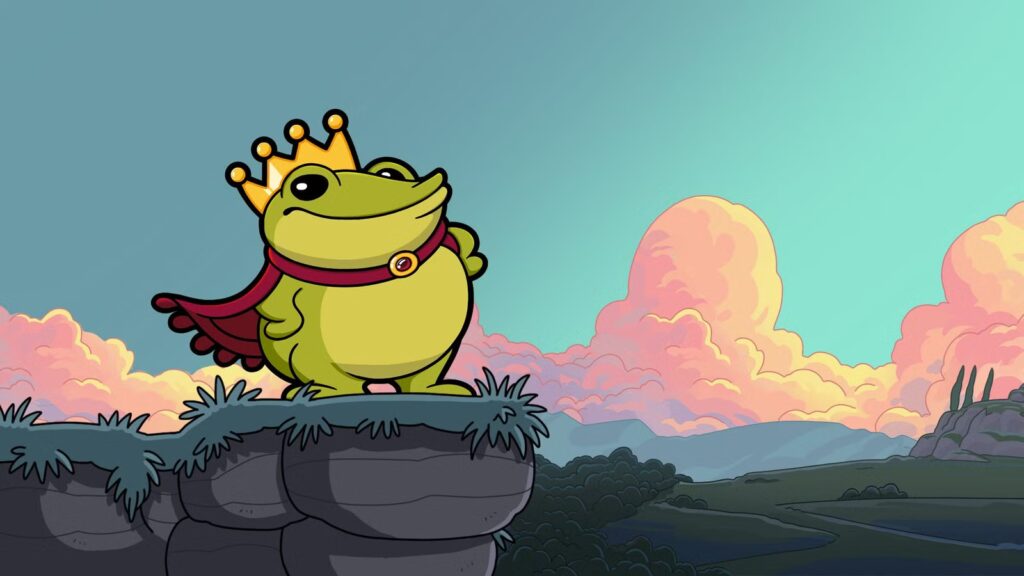
Once we had a frog, at first he was kind of like a little bit of a Western frog. He was like The Good, the Bad and the Ugly frog. He had a little cape and a little hat. Then at some point, we were like, if we’re going to lean into this kind of fairy-tale aspect of it, let’s just make him a frog prince. Let’s go to the original trope, the OG: he’s a frog prince.

I was hired as a consultant to begin with, so I was just there to look over some of the animations and give some feedback. They knew I worked on Cuphead and really admired my work. Then one thing led to another, and I really loved the game. I thought it was so much fun. So in the end, 99% of the animations are mine. We had another Cuphead animator briefly join us, my good friend Joseph Coleman, who had some downtime. He did one of the boss fights, a mouse with a shoe, and so the rest of it is all me, which is really exciting. I got to single-handedly do all the animations for Croak.
How do you make Croak without knowing there’s going to be a frog with a sticky tongue? That’s the whole game.
Petroff: When we had the duckling, the gameplay was not that far from what we have right now because he had a dash of exactly the same distance as the tongue right now. He would dash and hit stuff and recoil, very similar to what we have right now. Why we changed is because we wanted to have that grapple hook that can also gobble and spit stuff. The only difference is you can only grapple on something that’s near you.
After that, once we had that frog design, which was a little bit more round and more chubby, it looked a little bit more like a squishy ball. That actually helped us figure out the pinball animations. That’s how we kind of completed the core mechanic, because we felt like it was a little too simple.


Nawrocki: Most of the characters in this game are round and chubby. Somehow, it was an actual accident. It was just really fun to draw them that way —I love squashing and stretching. I love Looney Tunes. Obviously I’m inspired slightly by the 1930s. So for some reason, I kept drawing these super-round characters. At some point, it was kind of a design effect on the storyline, because the storyline has a lot of food involved in it now, and that’s mostly because all the characters look really pudgy. So design kind of inspired story, and story inspired design.
Judging from the art and your anecdotes, Croak required dramatic evolution as you perfected every element — but how did you know when to stop? When you got it right?
Nawrocki: At first, because of this gobble mechanic that Max mentioned, the first concept was to have a little skinny frog, and whenever he eats something, he turns really poofy. Then whenever he spits it out, he turns back to normal. So there was this visual tell: when you’re carrying something, you become really chunky. So I did a whole bunch of different run cycles; I’m a huge fan of walks and runs and I find that tells the personality of a character.
The consensus was that we loved the chunky one. There were also concepts of even more chunky, because well, if he’s already chunky, when he swallows something he becomes morbidly obese. But then we scrapped that idea and just kept him round and fluffy throughout the whole thing. That was kind of one of those things where it was a knee-jerk reaction to this new design that was inspired by the mechanic.
Can the evolution of the art then impact the mechanics?
Max Petroff: It does sometimes, and that’s how I like to work also. It’s fun to just see how it goes and not stick to the OG plan and just figure it out along the way. Sometimes we have something in mind, and when Tina draws it, we’re like, “Oh, you kind of remind us of this.” Everything we think is fun and cool and beautiful, we just put in the game.
Tina Nawrocki: I think that’s what’s lovely about indie studios. I find creativity flows more freely in the indie space than in large studios, which have a rigid hierarchy. In those kind of legacy studios, there’s a script and everything’s very planned out. There’s a concept phase that’s very rigid. Whereas when you’re a ragtag team, a small studio of just a few people, your vision really influences the final product. You can bounce ideas off each other. If you have somebody as awesome as Max to work with who’s really open to changing things up and trying something new, if we find a cooler solution to some problems, it goes really quickly.
So you crack the character art and moves — how do you create ideal platformer levels to take full advantage of what you’ve created?
Petroff: Mario is a huge, huge, huge influence on us, obviously, as well as Celeste. You can see the inspiration of a bunch of the Super Mario World community, where people just try new stuff, new gameplay mechanics. For us, since the mechanic is so simple at its core, it’s easy for us to put some ideas in and ask: What can we do with that? We think of cool ideas, then we just test it out. We’re just roughing with black and white, gray-box, no animation at first, just random stuff. Try new mechanics, just real quick, buggy as hell, but is it fun?

Then we also use our Discord community. Once we think it’s fun and the concept is there, we make people playtest and see if they think it’s fun. Sometimes they have really good ideas. For example, this week, in the fourth biome, we have flowers that gobble you and then spit you. People were wondering, “Why can’t you tongue those flowers?” “When they throw you, maybe they could throw you in a pinball way instead of just dashing straight up?” And we’re like, “Oh, shit, that’s our core mechanic!! Maybe we should try that.”
Sometimes it’s really simple. We’re so focused on trying stuff that we forget sometimes the basic stuff. That’s pretty much how we do it. Then once we’re happy with it, that’s when we go with Tina. We send her a video and some sketches, some random drawings that I do: “This is what I imagine it could be.” Then she tries — again, 10 concepts just in five minutes. I’m like, “How is this already made?” We take one, and then we put it in the game.
Is there a moment in the game that surprised you because of the latitude of your core mechanic? Like, “Oh wow we can do this!”
Max Petroff: The first moment it happened was when we introduced the pinball mechanic, which started with what we call the super bonk. Hopefully we’ll find a better word for it later on… Basically, we wanted something that propels you, but we had a hard time making the players understand that you cannot go there by jumping. You need to use the tongue and recoil.
We’re using units, like squares, for measuring. The frog is jumping three units high and can basically go six units in length. When it was super-bonking for eight units, it was too close of a distance. So at some point, we’re like, “Let’s just try 12.” But a level is 25 units long, so that was too much. But once we found that, right away we were like, “Oh, let’s recoil it again.” That’s when the pinball mechanic arrived, and we’re like, “That’s SO cool.”

We’ve put a lot of work into making sure it’s satisfying, with a bunch of VFX and a bunch of squishy animation and a couple of freeze frames. Sometimes we go to our private YouTube channel and see the evolution of some stuff, and we saw the same mechanic, the same thing, so not satisfying at all without any screen shake, any squishy stuff. So we’re like, ‘What did you change?’ And at the end, it was basically just juice. That was fun to see.
TIna, how do you squeeze that juice on the animation side?
Nawrocki: I think it’s a lot of instincts. What’s really lovely about working with Max and the team is that we’re not being micromanaged. We’re trusted to do our job and do it well.
Patches: It sounds like when creatives are professionals who are really smart about certain things and the bosses allow them ot be professionals and smart about the things they’re good at, a project can go really well.
Tina Nawrocki: There’s a lot of trust involved, right? Just trust people to do their damn job.
Do you think you’ve all created a character in Frog Prince who can stand up to Mario? That has to be the quiet goal of a platformer right?
Max Petroff: That would be not so humble of me!! He’s so beautiful. I love him so much. At the same time, this is the first time I’ll say that publicly, and I never said that to Tina, but I kind of understood late, like right now, that I feel like he’s missing something. We might tweak something before the release, but I feel like right now it’s missing some iconic part, something more distinctive, like, “THIS is Croak.”
But I would say the design is really unique. Once you see the art style and the design, you can understand that it’s the Croak frog.
Nawrocki: Max gets to be humble, so I’m going to talk a big game. I work on many indie games, and what’s really wonderful is the elevator pitch of Croak is literally: it’s a fat frog. And that’s all I have to say. Everybody’s like, “I’m buying it.” And I’m like, “You should buy it.” I think we’ve come onto something that’s a winner.
Croak is set for release in 2026. You can play the demo and wishlist the game on Steam.