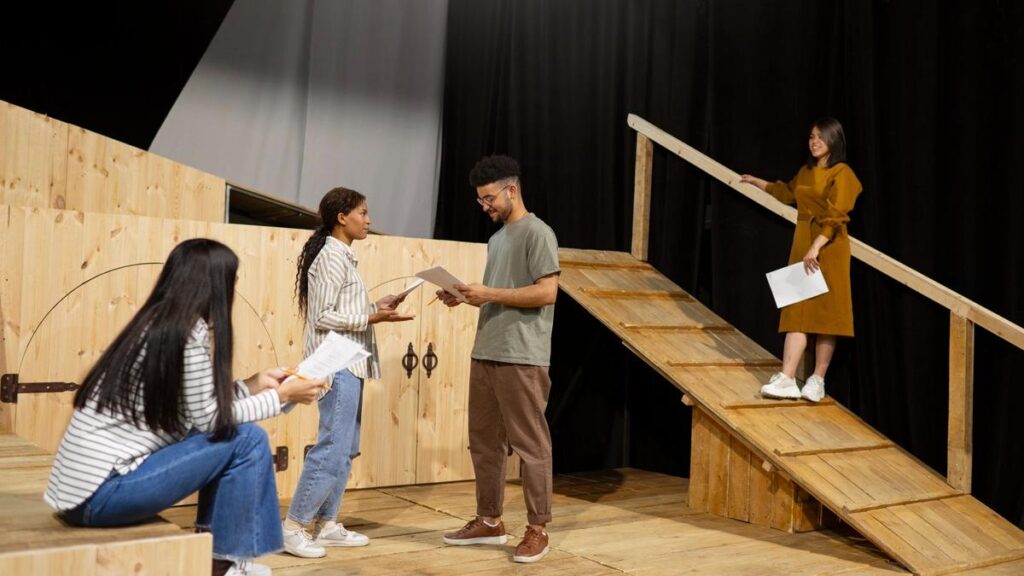

What should education prepare a young person for in a world where machines can already write, design, analyse and increasingly solve problems? Paradoxically, the rise of Artificial Intelligence (AI) may make some of our oldest human capabilities — judgement, empathy, presence, interpretation, collaboration and the ability to respond when there is no prescribed answer — more valuable. This is why theatre deserves a central place in education. As one of the most powerful labs for developing future generations, it is not simply training for performance, but a rehearsal for life.
Beyond textbooks
Education must prepare students to enter unfamiliar situations, make sense of people and circumstances, express themselves with clarity, work with others, handle disagreement, recover from failure, exercise judgement, and act with confidence when there is no prescribed answer. Schools and universities increasingly describe these as communication skills, life skills, creativity, collaboration, critical thinking, empathy, or emotional intelligence. Theatre brings all this together in a remarkably natural way; not because every student needs to become an actor, but because theatre asks something unusual of its participants: to think, feel, speak, listen, interpret, and respond at the same time.
Indian educators understood this much before terms such as “experiential learning” and “multidisciplinary education” entered contemporary academic vocabulary. Rabindranath Tagore placed music, dance, and drama at the heart of his educational experiment at Santiniketan. For him, artistic experience was not a diversion from intellectual development but a part of becoming a complete human being.
Other influential educators developed similar ideas in different contexts. British drama educator Dorothy Heathcote pioneered “drama for learning”, particularly through her Mantle of the Expert approach. Students might enter an imagined situation as archaeologists, scientists or community planners and learn by assuming responsibility within it. Brazilian theatre practitioner Augusto Boal went further with his Theatre of the Oppressed, transforming spectators into participants who could explore social situations and rehearse possible responses. Their approaches differed but they shared a powerful proposition that some forms of understanding cannot simply be explained. They must be experienced.
Research increasingly supports this intuition. Psychologists Thalia Goldstein and Ellen Winner found evidence that sustained acting training can strengthen empathy and, particularly among adolescents. Studies of drama pedagogy have also reported improvements in collaborative behaviour. The reason may be quite simple. Theatre creates consequences for communication. A student cannot merely know what good communication is. He/she must make another person understand, believe, or respond. He/she discovers the value of tone, silence, gesture, timing, eye contact and listening. Confidence also acquires a different meaning. It teaches collaboration with unusual honesty.
Design meets drama
This is also where theatre and design education find a meaningful intersection. Bringing a production to life requires students to think about spaces, costumes, lighting, visual identity, props, and the overall audience experience. It introduces them to the principles of visual storytelling and human-centred problem-solving. Design students, in turn, can learn from theatre how people experience space, emotion, movement, and narrative in real time.
Theatre is equally powerful as a multidisciplinary space. A single production can become a live lab where students of fashion design explore costume as character and storytelling; interior and spatial designers understand how environments influence human behaviour; graphic and communication designers create visual worlds and identities, and technology students experiment with lighting, sound, and immersive experiences. It allows students to move beyond creating an object or visual and understand how their work is perceived, experienced and emotionally interpreted by people. Thus history, psychology, music, architecture, fashion, visual communication, technology and management all come together under one setting.
The scholar Kapila Vatsyayan repeatedly emphasised the interconnectedness of Indian artistic traditions rather than treating individual arts as isolated domains. Theatre makes that interconnectedness visible. The larger educational potential lies in opportunities where theatre interacts with design, visual arts, technology, business and other disciplines to make it more holistic and multidisciplinary.
India’s National Education Policy calls for experiential, multidisciplinary learning and for breaking rigid divisions between curricular and extracurricular knowledge. Theatre offers one of the most practical ways of achieving precisely that. Its importance may become even greater in the AI age. Machines will increasingly generate competent text, images, presentations and solutions. Education must, therefore, become more deliberate about nurturing qualities that arise through human encounter: presence, interpretation, empathy, judgement, collaboration, and the ability to respond when reality refuses to follow the script.
The writer is Vice Chancellor, World University of Design.
Published – September 08, 2026 05:57 pm IST