

Just outside the Czech city of Brno, known for its motor racing circuit, there are rolling fields and orchards dotted with hamlets and canals.
Pulling up to the white stone frontage of an old mill in the village of Velké Němčice, you might think we were about to enter some artisanal throwback to a hand-crafted past. But a quick look around inside tells another story.
Five-axis robots cut precision neck joints, while humidity is micro-controlled in different areas of Furch’s factory to optimise the various processes taking place – from glueing bracing to soundboards, to fitting hi-tech climate-compensating truss rods to the guitars being built.
Latest Videos FromGuitar World
There is a certain boyish delight on CEO Petr Furch’s face as he explains how Furch engineers guitars as much as it crafts them. He’s a big believer in human hands doing the jobs that require lots of careful micro-decisions and judicious tweaks – like glueing binding to a guitar body.
But when it comes to the things that are at their best when they are simply deadly accurate, every time, like cutting a neck joint, he says without a shred of doubt that he prefers hi-tech robotics to do the job.
Like a football manager picking the best squad, he simply assigns people and machines to different stages in the construction of a guitar according to which choice will yield the best finished instrument, as he sees it.
It’s refreshing to hear after all the (admittedly compelling) emphasis on craft and legacy that established acoustic makers such as Gibson and Martin often employ. To be fair to them, they know that not only can they lean quite hard into history to sell their guitars but that people actually expect it of them – which can be its own form of gilded cage sometimes, if you want to branch out and try something new.

As a relatively young company that’s still building its profile around the world, Furch doesn’t have that problem. Instead, it has plenty of things to talk about concerning the future of acoustic guitar design, which is being defined in its workshops every day, according to the company.
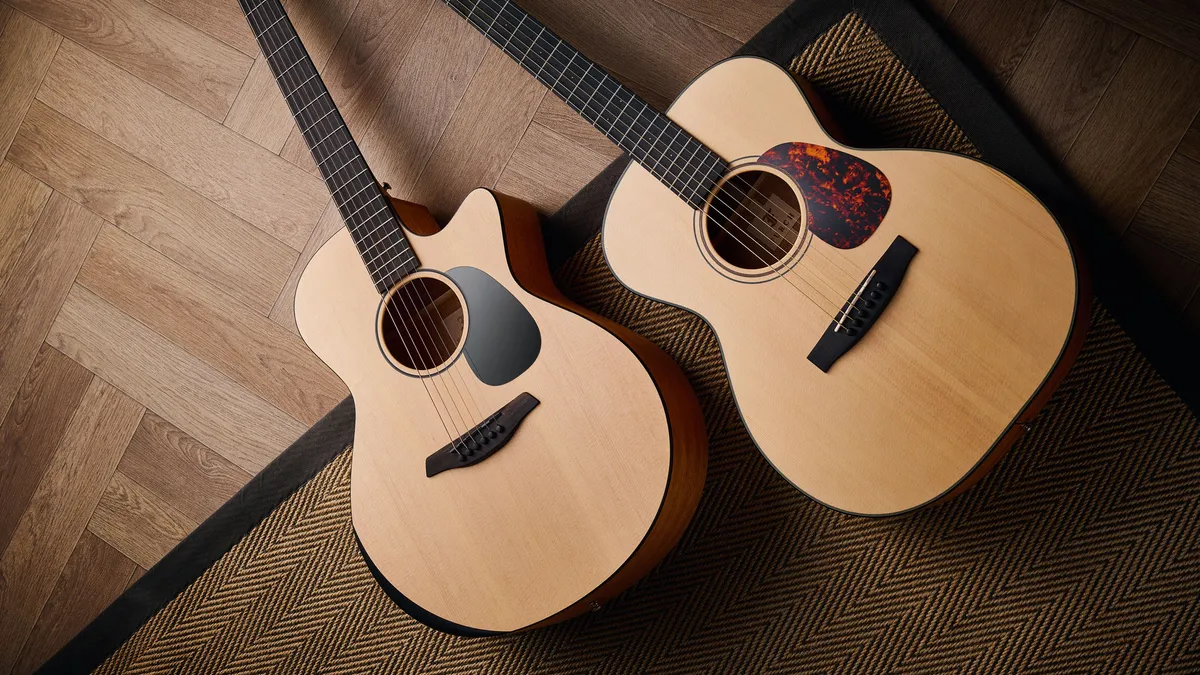
Its guitars are now offered in one of two formats: Performance or Deluxe variants. The former comes with a high-quality LR Baggs pickup system, whereas the Deluxes are designed for an immersive unplugged experience and feature the elegant Booster Soundport system – a series of slots in the upper side of the guitar that spills some of the sound of the instrument back towards the player for a more immersive playing experience.
The company’s colour-coded system for indicating where each model sits in the overall range, from entry level to the highest spec the company offers, is perhaps the only unintuitive thing about their instruments (the cheapest guitars belong to the Violet range and the quality and features increase incrementally through the Blue, Green and Yellow ranges all the way up to the flagship, high-end Red range).

But what is common to all Furch guitars is perhaps more surprising than what differentiates them.
All have soundboards that have been individually analysed and tuned for the best resonance and performance, a high-end feature normally reserved for Custom instruments, and most of them feature some variation of the Bevel Duo system of a comfort armrest on the top edge of the guitar and a bellycut behind, again a feature normally only seen on high-end or custom acoustics but, at Furch, a pretty standard perk on its guitars.
With all this percolating in our minds, we managed to grab CEO Petr Furch – son of company founder, Frantisek Furch – for a chat amid various 45th Anniversary celebrations taking place at the factory during our visit, to talk about what it takes to be different and to genuinely move the state of the art forward in that most traditional area of lutherie: acoustic guitar design.

Furch has been around for 45 years now – what core values that were a feature of the company when it started are still true of it today?
I think even from the beginning, even in my father’s times, it was not really about making a copy of somebody else’s guitar. It was about improving the guitar in general. In the ’90s, we didn’t have so many possibilities. We didn’t have the budgets and the revenue we have right now, so we didn’t have so much possibility to invest in such great things [as we can do] today.
But still, I think the core [of our ethos] was: let’s improve the guitar somehow [with] things that customers need – or maybe they don’t know they need it, but it would be helpful for them – in terms of the ergonomics, durability or longevity of the guitar. Or, of course, the main thing: the sound.
I think these are our core values, which have been there basically since the first guitar. And these days, bigger-budget technology is available, and let’s say our internal knowledge – how to utilise that technology – these are new things and they’re opening new doors for us.
You have to consider that the guitar world and the world in general is a very dynamic place. Therefore, new ideas are coming, new technologies and new ways of how you can produce something. So if you mix it all together, you can always find some new way to improve [things], though that doesn’t mean that the older stuff was bad. It’s just that you have new possibilities, new knowledge, and so new opportunities. So that’s how I see guitar as well.

What’s interesting about Furch is that it isn’t just interested in the usual showpiece upgrades to a guitar’s tone such as a nice soundboard. You’ve spent just as much time coming up with a so-called Resonance-Enhancing Finish. What does that contribute to the sound of your guitars and why make it such a priority to get right?
The acoustic guitar generates its sound by vibrating the body of the guitar. Therefore, the physical properties of that ‘box’ are important and, of course, it has to somehow resonate the weight of the soundboard – and the flexibility of the soundboard is important.
So if you want to go deeper into the detail of the guitar construction, at some point you have to say to yourself, “Okay, how do I cover and protect this ‘box’?” And, at the same time, ‘How can I avoid compromising the sound?’

You’re trying to figure out, “What kind of protective cover should I put on it? What should be the material? Should it be soft or hard or thick or thin?” Years ago, that [question had] already prompted me to think about exactly what finish I’m going to use.
So we consulted with many companies that specialised in producing lacquers and finishes, and we came up with a formula for a material that is specific for us and specifically designed for a guitar body and guitar shapes. We had to really play with properties of the finish so it’s applicable, especially on round edges and sharp edges of the guitar.

Basically, we needed a lacquer that was as thin as possible and as hard as possible. But at the same time it must also be flexible somehow, though not soft, because the guitar body is always moving with humidity: the top is either lifting or dropping down, even the sides.
It took me more than a year in our spraying department, mixing different additives supplied by the manufacturer of the lacquer. And I was mixing and testing, spraying, curing, sanding and so on. After a year, we got to the [right] formula – I think it was in 2017 – where we started to apply this finish to all our guitars.
And actually these days we call it a Resonance-Enhancing Finish and we apply at least a little bit of that lacquer to all our guitars. Even if you have a [more basic] open-pore finish, we put a little bit of that lacquer on it because we found out that it really improves the sound.”

What tonal qualities does that Resonance-Enhancing Finish enhance, in your view?
Extra volume is the main thing that you can notice – but it’s improved balance as well, and enhanced high frequency a little bit, too. But the volume [boost] is really noticeable.
One of the most eye-catching innovations Furch has recently introduced is the CNR System Active neck joint and truss rod mechanism. It’s designed to automatically counteract changes to your setup that might happen when you take the guitar into different climate conditions, either drier or more humid. How does that work?
CNR Active System is a special neck-to-body joint. We made sure that it’s not visible from the outside, but inside there is this piece of wood that we call the Expansion Element. So the direction of the grain of this block of wood is set so it can absorb the humidity and expand and shrink with ambient humidity.
Basically, the expansion or shrinkage of that piece of wood [which is mechanically connected to the neck joint] is making the neck tilt backwards or forwards a little bit relative to the body…

If your top is exposed to high humidity and is lifting, the Expansion Element basically compensates for a change. And the other way around, if you have a guitar exposed to low humidity and the top is dropping [CNR Active will adjust the neck angle slightly to compensate], so the string action stays pretty much the same.
Also the added value to that concept is that you can use a special Allen key to perform what for years was termed a ‘neck reset’ in seconds. You very quickly adjust your neck angle and therefore your string action and playability in a couple of seconds, and this is very powerful.

It’s pleasing that amid all the hi-tech solutions Furch uses, a block of wood – albeit mounted in a precision-engineered mechanism – turned out to be the best material for automatically adjusting for changes in climate…
It makes sense. I mean, your top is also made of wood, and wood is reacting with certain dynamics and a certain speed to the humidity.
We were initially thinking about some artificial material [for the Expansion Element], for example, that probably could be more predictable than wood. But after all this, [wood] was the best solution. Because once you do a couple of tests, find the right length of that expansion element – basically, how big the expansion is going to be – then it really does the best job here.

Do you think of making acoustic guitars as a craft or a science?
I think it’s a little bit of both. I’m an analytical person, so I tend to work with data and I tend to [take steps to] obtain the data if I don’t have them.
But, of course, there are many things that I still don’t know about guitars and don’t understand about the guitar, so those are the blind spots for me, which still need to be explored. Those, for now, I just have to sort of intuitively decide – so in that way I would say it’s more like a craft.

What are the most interesting challenges that still lie ahead of you, in terms of crafting ever-better guitars?
Materials, for sure. Every year some materials become less and less available. That doesn’t mean that we will go away – or anybody should go away – from making wooden guitars because wood is still the best acoustically performing material out there and not every species is endangered.
When we are getting deeper and deeper in understanding the guitar and basically improving for guitar sound specifically, it’s getting tougher and tougher to make another step forward
But working with materials, that would be one topic not only for us [to expand our horizons on] but for all guitar manufacturers. Because when we are getting deeper and deeper in understanding the guitar and basically improving for guitar sound specifically, it’s getting tougher and tougher to make another step forward.
We have a couple of main [areas for evolving the art of making guitars] that we are still researching… there are always ideas. And there are also dead ends that we encounter, where we have to say, “Okay, we shouldn’t go this way because if the guitar would maybe end up being too expensive, the resulting sound improvement will be too small.”
So the [process of raising the game] gets more difficult with every new generation of our guitars. But I’m not complaining – this is the game and we’re gonna play it well. I like challenges and they give us the potential to improve ourselves.