
With filmmaker Beth de Araújo was just a child in her native San Francisco, she witnessed a devastating crime that reverberated through her family and her life. And while it had long been the filmmaker’s desire to turn her experience, in which she saw an assault in Golden Gate Park, into the kind of thoughtful film the subject demands, putting such a feature together was no easy ask.
But after more than a decade of starts and stops, Araújo finally made her “Josephine,” which premiered at this year’s Sundance Film Festival, where it earned massive acclaim and helped reclaim a story that had long haunted her. Told largely through the eyes of eight-year-old Josephine, the film is as much about bearing witness as it is about what happens after we do.


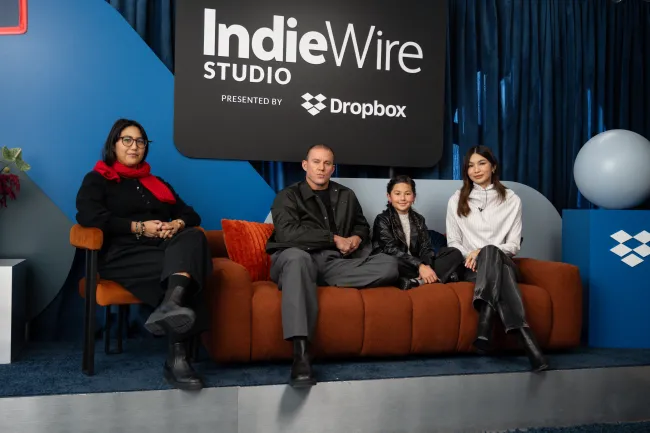
Because of the nature of its story and telling, “Josephine” could not possibly exist without a young star. But how do you tell a story about childhood trauma without inflicting any new negativity on a young performer? For Araújo, that question was at the center of everything. As the film readies for a Toronto International Film Festival premiere and a fall release, IndieWire sat down with Araújo and star Gemma Chan to talk about that very question.
Araújo wrote her first draft in 2014, which then got into the 2018 Sundance Lab (a “huge push” for the filmmaker). The script made its way to Chan’s long-time agent Esther Chang — “When you haven’t made a film, people are like, ‘Oh yeah, send me your script! I’ll read it,’” the filmmaker said. “And you’re like, ‘OK, sure. You’re not.’ But they did.” — who connected the pair.
“I had been waiting for a role like this in a film like this for pretty much my entire career,” Chan said. “I knew from the moment that I read the script. I was like, ‘I have to do this film.’ I couldn’t get it out of my head. When I met with Beth, she explained what she wanted to do and her vision for it. I just was like, ‘Yeah, I’m all in.’”
In 2019, Chan signed on for the role of Claire, a ballet dancer who reacts to the assault by advocating for therapy for her daughter and her daughter’s testimony in court. But Araújo couldn’t get the financing to work. “Then there was COVID and then there was the strikes,” she said. “I think it was the universe telling me to do the smaller thing first, to just show people that I could do a feature. You’re always the risk when you are a first time feature. I wrote [‘Soft & Quiet’], got financing, shot it, sold it all in 11 months. And this took 11 years till the premiere.”

“Soft & Quiet” helped Araújo cast the film’s other key adult role: Josephine’s dad Damien, who was originally written as British until Tatum arrived. Tatum was an immediate fan of Araújo‘s first film, and reached out to see what else the filmmaker had cooking. “I was like, What role do I have for him?’ I almost had to close the door on ‘Josephine’ for a second, because it hurt so much to keep not getting it up off the ground,” she said. “I was meeting people for a different script, and then when Channing wanted to work with me, and I knew I had this role, I was like, ‘I have to do this now.’”
When the director finally told Chan about Tatum, she was “so thrilled.” “He’s got such charisma and natural ease and charm,” she said. “And I knew he had dramatic chops as well, but I was even more blown away working with him, the level of vulnerability and emotional accessibility that he had.”
But they still needed Josephine. I mentioned to Araújo that, in all of her talk about waiting, starts and stops, things not coming together as she had expected, “timing,” I couldn’t help but think: You were waiting for Reeves. “Was she even born? She wasn’t born when this movie was first being written,” Chan added with a smile.
Araújo had cast another actress back in 2019, when it seemed like the film was coming together. “I had been working with her for a year, this little girl,” she said. “I was picking her up from school and we were doing a lot of getting to know each other and rehearsing. When we couldn’t get things together, she aged out, and that really was the moment that I think I knew I needed to pivot. I also didn’t want to put another kid in the position where they were doing work on something and then not getting to follow through. So we actually didn’t cast Mason until six weeks out, which also was a little scary.”

Added Chan, “I was like, ‘This isn’t real until we have the kid. We don’t have her yet!’ And, obviously, this was Mason’s first job. She didn’t set out to be an actor. It was kismet or something. … It was such a winding road. We got so close several times, and then it didn’t happen. But I had this belief that somehow it would get made. I’m just so, so happy that it did.”
But Araújo, who is characteristically pragmatic most of the time, remembered feeling that things were finally about to come together. When she set out of a scouting trip at a local farmer’s market in San Francisco, she couldn’t shake the feeling that she was about to meet her star.
“It was so strange. At the time, I should have been freaking out, but there was something that I was like, ‘I know she’ll be at this farmer’s market,’” she said. “It was right in the neighborhood that I grew up in, and one neighborhood is quite white, and one neighborhood is quite East Asian, and the farmer’s market is right in the center, right at the edge of it. I was like, ‘She’s just going to be there. I just have a feeling.’ I don’t know why.”
Reeves ran by Araújo, which caught her eye. “Josephine is quite physical. She’s a bit of a tomboy, and so there was something there already,” she said. “She also really looked the part. And then when her first audition tape came in, I was like, ‘This is a girl who lives in San Francisco who’s never acted before. This can’t be.’” Still, she admitted: “I still talk to her mom about this: ‘What if you guys didn’t go to the farmer’s market that day? What would’ve happened?’”
I asked Araújo how she explained the project to parents. It seems like a tough sell. “After the first audition, I reached out to my top five favorites’ parents, and I Zoomed with all of them,” she said. “I said, ‘This is what the film is about. Let me explain to you how I’m going to do these scenes, so you know that I’m really making sure she’s not seeing anything, and also how we’re going to do other scenes so she feels taken care of and it wouldn’t affect her negatively in any way. Read the script and then let’s have another conversation, and I’m sure you’ll have more questions, and we’ll go through it.’”
When Reeves’ parents came back to Araújo after reading the script, they shared something unexpected. In the film, Josephine discovering the word “rape” and what it means is a major moment, completely destabilizing and terribly revelatory. “And they said, ‘She actually does know the word rape,” she said. “It had come up with her older brother in a conversation, and they had explained ‘it’s how you hurt someone with sex.’”

The very sort of conversation Araújo had written had already happened in Reeves’ life. So not only did she not have to worry about introducing these topics to her young star for the very first time, but they also both had a working language from her own family to help navigate that scene.
“Everything else we did was sense memory from her own life,” Araújo said. “I would have her write out a time she was really frustrated, a time she really had a lot of pride, a time she was really sad and cried, and we would just assign that to scenes. Because even if it’s a scene where she’s frustrated and it’s because her sister drew over her drawing, that to her feels really real and really sad and like a betrayal.”
Reeves never read the full script, and even when the film is being discussed around her now, adults are asked not to explicitly talk about the assault that happens in the film. She knows it’s something bad, of course, but she’s also been protected from the darkest parts of the story. That desire to protect extended throughout every element of production.
“I think everyone felt a real responsibility to make sure Mason had a good experience,” Araújo said. “And I think that bonded us all as cast and crew. It’s like, there’s something more innocent than us here.”
Reeves lives just 10 blocks away from where Araújo grew up. The young actress didn’t just get to feel at home — she got to be at home during shooting too. She’d go home to her own bed every night. She had time for playdates with pals on her days off. Her older brother came and got a small part in the film. The Reeves family dog came too, and even he got his own role (he appears as a therapy dog). Her mom was on set every day, along with any other family members who could swing by.
“Just having her whole family there, it was reassuring for me, that she’s OK, she’s got her people,” Chan said. “She’s still able to go and be a kid and see her friends and have a life outside of work. That was so important.”
Chan was utterly taken by her tiny scene partner (Tatum was too). “She is so wise beyond her years, so smart, so watchful in the way that Josephine is in the movie. She’s constantly taking in everyone. She doesn’t miss a trick,” Chan said. “But she’s also just a really normal kid who wants to have fun, is high energy. She is that perfect combination of innocence and experience that the role required, and it also meant that she was an amazing scene partner to work with. I felt really that she was just completely present with me and with me in all of those really emotional scenes.”
To bond the onscreen family, Araújo planned outings for the trio, but also made special time for Tatum and Reeves alone (remember, Chan said, “Josephine is a daddy’s girl”). “I knew immediately when Mason met Gemma and spent any quality time, she would start to totally see Gemma as this second mom,” Araújo said. “Gemma’s so warm to her, it was going to happen so fast. So I wanted to make sure that her and Channing felt really bonded when we first started shooting.”
As the film begins, Josephine and Damien are the closer pair. But as Josephine navigates her experiences, she grows closer to her mom and her ideas for how to get through this trauma. “So, as we went on, Mason and Gemma spent a lot of time together,” the filmmaker said. “They went on a hike together. In the film, she starts to see her mom and appreciate her mom more clearly, and I wanted Mason to then start gravitating toward Gemma in that way with their friendship. And, yeah, they were adorable.”
Keeping things both light and open helped on even the toughest days. “Even on days where we were filming very intense scenes, we tried to keep it light in between takes,” Chan said. “And Mason never flagged. Channing and I might be flagging by the end of the day, and she was completely full of beans. We were always checking, ‘Are you OK, Mason? Are you tired?’ She’d be like, ‘Stop asking me if I’m OK. I’m fine!’”

Both Araújo and Chan laughed over Reeves’ (very understandable) love of craft services. “Her sushi bill was extensive,” Araújo said with a smile. “But hey, you’re the star. On the second day, the key grip came up to me, and he was like, ‘She’s starting to understand she can get whatever she wants.’ She would be like, ‘I want pizza for lunch. I actually want ramen for lunch. I want sushi,’ and because we were shooting in her hometown, she has her favorite spots. So we’d be like, ‘Alright, Mason, you totally deserve that. Yes, you will get whatever lunch you want.’”
As they neared the end of filming, Araújo wanted to make sure Reeves got the full “hey, you just made a movie!” experience. She wanted Reeves to relish it, bask in it, and spend time with the people who made it so special.
“We were doing one last scene with Mason the next day, but Gemma and Channing weren’t going to be there, and so we decided to do the ‘That’s a Wrap on Mason Reeves!’ while at least Gemma was still there, so she could really feel the full energy of it,” Araújo said. “Mason, she’s always like, ‘Oh, you guys all cry so much.’ So, everyone was just clapping for her, in a circle around her. She let herself take it, she stood around and she looked at everyone. She turned and did this 360. I think she was proud of herself, and she was so cute, and she started crying, and then I started crying, and then we all started crying.”
“She really bonded with the crew as well,” Chan said. “I mean, we all had bonded. I feel like this film was such a labor of love for everyone involved. Everyone made certain sacrifices to be able to make this film. And they put so much blood, sweat, and tears, and love. Too many to mention.”
When the film premiered at Sundance in January, Araújo was just happy to have everyone there to see what they had made together, after so many years when it simply didn’t seem possible.
“Basically the whole crew came out for Sundance,” Araújo said. “It was really special. You don’t make this project to get rich. You don’t make this project to do anything other than to try to get this story into the world. And in that way, I think maybe it needed that amount of time to find those right people that really just felt that way and who could take care of Mason in this way.”
The film was a smash hit from the jump, winning over not just critics and its audience, but also the jury. At the last Sundance awards ceremony in Park City, the film walked away with both the Grand Jury Prize and the Audience Award. (Weeks later, Sumerian Pictures would purchase the film for distribution and a planned awards run this fall.)
“Watching it with an audience for the first time was such an amazing experience,” Chan said. “I didn’t expect so many people to be audibly reacting like that, laughing, gasping, being on the edge of their seats. I knew what was coming up, but I was still completely riveted. I don’t know the words to describe it.”
When the film debuted at the Eccles, Park City’s biggest theater, in a prime Friday afternoon slot, the reaction was profound. But for Araújo? As always, she just wanted to make sure Reeves was having a good time.
“My biggest fear going to Sundance was, ‘Oh, my God, what if when I call Mason up, people are walking out of the theater? And she will see that and hopefully wouldn’t internalize it and think it might be her fault or something,’” Araújo said. “That was what I was most nervous about, and then when I saw no one left when we were calling people, that’s what I was surprised by. I was like, ‘Oh, no one’s left. They’re still here.’ For this to be Mason’s introduction? I’m just so happy that this is her first experience.”
Sumerian Pictures will release “Josephine” in theaters on Friday, November 20.