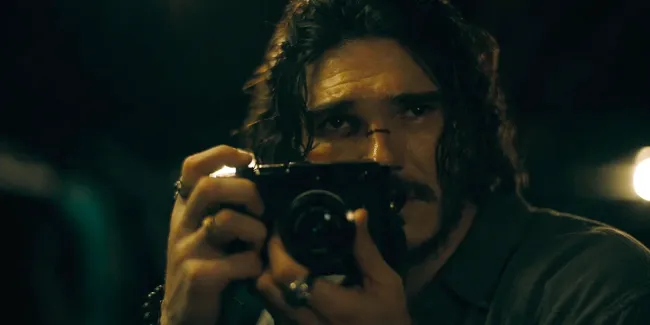

The three crucial things to know about Zack Snyder’s “The Last Photograph,” a surprise late addition to the Toronto International Film Festival, are as follows: 1. It’s the bombastic filmmaker’s stab at an intimate two-hander about haunted men trying to outrun their respective demons. 2. Snyder explicitly riffs on John Ford’s “The Searchers” by following a former soldier’s quest to avenge the murder of his family at the hands of Indigenous men. 3. It is very bad.
It’s somewhat notable that a famously maximalist director made a relatively small-scale project that, by his own admission, took two decades to make. (It was first announced in 2011 and was set to star Sean Penn and Christian Bale. At one point it was titled “Horse Latitudes.”) The mere fact that “The Last Photograph” takes place in contemporary times and features human beings rather than zombies, fantastical Grecian kings, superheroes, or space warriors means it technically doesn’t operate on the mythic plane where most of Snyder’s previous films reside.


That’s a moot point, however, because Snyder can’t modulate his ponderous, soap-operatic tone to fit more “grounded” material, but that also becomes irrelevant when the material itself eventually betrays its ostensibly modest trappings. “The Last Photograph” is ultimately a superficial departure for the director that mines a familiar, shallow thematic pool about the psychological burden of witnessing and perpetrating brutality.
Hardcore Snyder fans who believe the director is infallible will probably jive with “The Last Photograph,” if only as an auteurist object. But even some of them might balk at its callow psychology and interminably dull plotting that no amount of gratuitous, unengaging violence or nudity can overcome. Within its first 10 minutes, hitmen conduct a massacre at a nine-year-old’s birthday party, which Snyder, who acts as his own cinematographer, depicts as a series of carbon-copy graphic headshots, largely inflicted against small children. He intercuts this sequence with heroin-addicted conflict photographer Joe Wallace (Fra Fee) having dispassionate sex with an anonymous woman in a dingy basement below the slaughter. (The film’s second shot is of Joe’s paramour’s breasts, captured in torture-porn lighting, sans any erotic charge.) After hearing the gunshots, Joe runs upstairs, not to escape or get help, but to impassively document the atrocities, including a shot of the birthday boy’s mother, Catherine (Costanza Andrade), in her final harrowing moments.
When former all-around paramilitary badass Ethan Black (Stuart Martin) sees Joe’s photograph of Catherine on the front page of a newspaper, he abandons his quiet life tending to and religiously butchering lambs in rural Iceland to avenge her murder. (Why this international incident was front-page news in the local Icelandic press is never made clear.) He travels to an unnamed South American country that’s clearly Colombia first to identify the bodies and then to hire Joe to travel with him upriver (or down; once again, it’s never made clear) so he can help identify the perpetrators. Why does he do this? Well, you see, Catherine is his sister-in-law and was killed alongside his brother as their two children were taken by nondescriptly “evil” marauders.
It’s fine that Snyder swiped the premise of “The Searchers” for his macho revenge thriller; directors have been extracting elements from that Western for decades, leaving aside its sweeping grandeur and understated moral complexity. What fascinates are the specific parts he chooses to take, like the unspoken undercurrent running through Ford’s film that John Wayne’s character, also named Ethan, had an affair with his brother’s wife, Martha, and that one of her children is almost certainly his own. Whereas “The Searchers” communicates these ideas through mise-en-scene and Wayne and actress Dorothy Jordan’s body language, Snyder, being generally allergic to subtext or subtlety, makes the affair between Ethan and Martha explicit, and conveys their passion (and its predictable aftermath) entirely in the clichéd formal language of Nicholas Sparks adaptations and Hallmark movies.
Over the course of “The Last Photograph,” Snyder teases out the details of Ethan and Catherine’s brief, supposedly intense relationship, which Martin and Andrade choose to play without an ounce of joy and as if they both received news of their respective terminal diagnoses at the same time. They consummate their love in a roadside motel room shot and dressed like somewhere people go to die, after which, I think, Ethan chooses to become some sort of soldier where he’s tasked to help some South American (read: Colombian) rebel group combat their oppressors. If that description sounds vague, that’s because things like “details” or “coherence” matter so little in “The Last Photograph.” (A minor example: the festival description claims that Ethan is a “retired DEA agent.” If that was expressed in Snyder’s film, it was done so in a whisper.)
Similarly, the South American figures in “The Last Photograph” are so sapped of any cultural specificity that they’re inherently otherized compared to Ethan and Joe. “The Searchers” is primarily about racism, and the ways that it can insidiously poison the mind and rob people of their capacity to love and forgive. Meanwhile, “The Last Photograph” has zero perspective on the nature of prejudice, other than, perhaps, spending time in the developing world will make you a hateful person. Snyder visually embodies noxious, xenophobic attitudes towards the Global South. The vast majority of the non-white characters are either sex workers, sex traffickers, guerrilla fighters, or savage tribal leaders, all of whom are either impediments or adversaries along Ethan and Joe’s journey. The women are frequently naked, and the men are either murderous or barbaric. The depiction of racial minorities in “The Last Photograph” feels so lazy and antiquated that it almost entirely circumvents offense and parks at bewilderment.
Snyder has professed his liberal bona fides and claims his films don’t have a right-wing agenda, which, if I take at his word, means his work unconsciously reflects an up-to-date reactionary outlook about everything from race and gender relations, masculinity and protein-maxxing, drug culture and child exploitation. It would be slightly interesting that Snyder aimed for “The Searchers” (or, to some extent, “Apocalypse Now”) and landed somewhere adjacent to “Sound of Freedom” if he didn’t also pathologically render his attempt so devoid of entertainment value.
It’s not that “The Last Photograph” doesn’t look good — it’s that its action scenes, an area where Snyder alleges proficiency, remain stubbornly repetitive in the vein of a first-person shooter, complete with blood splatters that are nearly identical in shape and size. The dialogue is unbearably pretentious: whenever somebody speaks, it often takes the shape of long-winded monologues, sometimes about drowning horses that feature phrases like “severe quiescence of the wind.” Snyder litters his film with blunt butterfly symbolism to the point where someone could make a drinking game out of their recurring appearances that would end in alcohol poisoning.
“The Last Photograph” infrequently sustains interest whenever it trips into unintentionally funny territory, like the fact that Ethan becomes a living God to the unnamed South American country that’s actually Colombia because he got struck by lightning and survived. (A slow-motion shot of smoldering boots illustrates the pain he endured.) Two mildly protracted, adeptly directed scenes show Ethan making meals, suggesting Snyder has a future in the food content space. A late sequence involves a truck driver briefly blasting Morrissey’s 2004 single “First of the Gang to Die.” (He refers to the former Smiths singer as “the King.”) Inevitably, gunfire interrupts the song.
Snyder ends up implicating himself in depicting Joe as a sociopathically detached cameraman. “The Last Photograph” glibly traffics in Susan Sontag-ian ideas about photography and voyeurism mainly through Joe’s characterization. His camera records human atrocities and, in theory, gives a voice to the voiceless. But it also impedes empathy and turns violence into an aesthetic matter rather than a moral dilemma. You know what else is like a camera? A gun! Two tools that can liberate or destroy. If ideas seem too abstruse, Ethan and Joe discuss them at length in rhetoric indistinguishable from pompous teenagers working through philosophical basics.
Snyder’s self-critique of his style would be compelling if he actually interrogated his penchant for aestheticized bloodshed as a means of processing emotion. Instead, like everything in “The Last Photograph,” he goes through the motions of contemplating it before getting back down to the business of showcasing grotesque violence, like a woman getting her teeth knocked out with a hammer or a dead mother with half her skull blown off, appended by shallow-focus shots of men disturbed by it. As much as Snyder tries to veer into a richer, more sensitive domain, a place where he can cultivate his ideas in a different fashion, he ends up right back where he started. Maybe it’s comforting that he personifies an old truism about identity and acceptance: wherever you go, there you are.
Grade: D+
“The Last Photograph” premiered at the 2026 Toronto International Film Festival. It is currently seeking U.S. distribution.