
WHAT ARE MY THOUGHTS ON BLUE FILM?
WARNING: This review for Blue Film contains explicit references to sex, sexual abuse and assault, homophobic slurs, and paedophilia. Anyone who may be offended, triggered or traumatised by any of these topics should take serious precaution before proceeding.
The first step to tackling any serious problem in our world is to simply talk about it. From there, discussions and debates aplenty will surface that give weight to both sides of the argument while allowing enough room for people to make up their own minds on the matter, no matter how severe the topic. Paedophilia, for example, is something which really shouldn’t be argued about: it is a reprehensible, immoral and just downright wrong way of life that pretty much every sane person on this planet can agree is something that needs to be eradicated from society. But again, just talking about it will make people understand exactly why it is such a disgusting thing that can leave severe psychological and emotional harm on its victims, and to an extent why people do it in the first place.
Writer-director Elliot Tuttle, with his latest feature Blue Film, ignites that most uncomfortable of conversations while also doing something particularly daring by making us empathise with, but never excusing, the offender themselves. For that reason, this is not a film that will inspire the masses, nor will it entice more mainstream viewers to keep watching once it plays its empathetic hand. But if you’re courageous enough to proceed, you’ll find Blue Film to be an effective two-hander that tackles increasingly taboo sexual topics through the power of frank discussion, without making light of some extremely nauseating subjects.
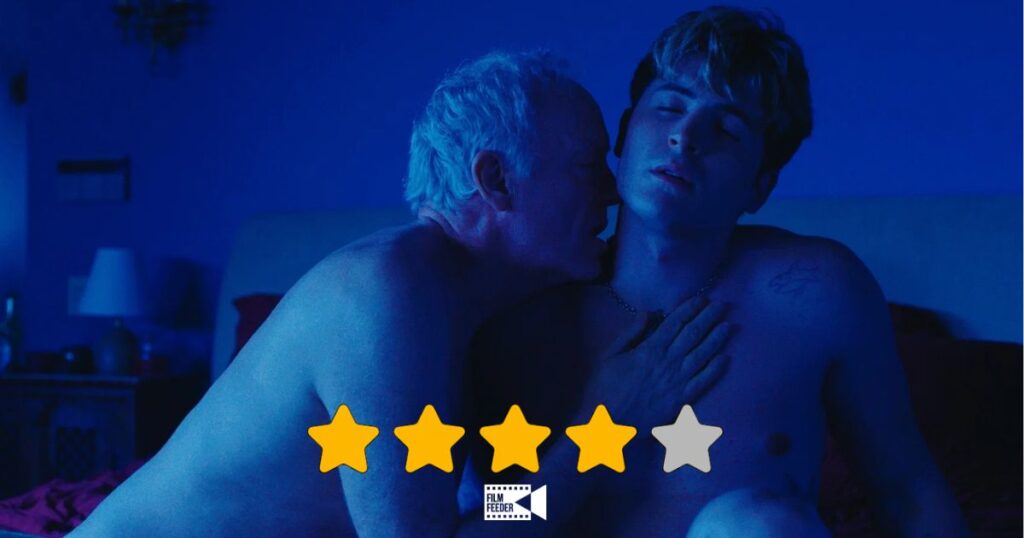
The film takes place over the course of a single night, where gay Los Angeles camboy Aaron Eagle (Kieron Moore) is drawn to a house rented by a masked older gentleman (Reed Birney). Aaron, who specialises in “findom” – that’s financial domination for all you non porn-brained folks out there – is enticed by the man’s offer of $50k to spend the whole night with him, but is quickly put off by his unusual approach of filming him on his camcorder while asking a series of personal and deeply invasive questions, including where he went to school and when his first sexual experience was. The eventual unmasking reveals Aaron’s mysterious client to be Hank Grant, the young man’s former middle school teacher who was fired and arrested for attempting to rape one of his students, and has now travelled all the way from Maine to reconnect with Aaron – whose real name is revealed early on to be Alex – and, possibly, fulfil his fantasy of getting with the young man.
If you’re feeling at all icky just from reading that premise, then congratulations: you are a human being with a moral conscience. Tuttle is, of course, banking on his audience feeling discomfort whilst watching his film, as it raises plenty of questions and ideas that are extremely difficult to digest for any reasonable viewer, including the attempt to understand the paedophilic mindset as well as the ramifications of being outed and even self-identifying as a pederast, which in many of the film’s duologue scenes is said to have come from the days of Ancient Rome. Beyond such things, the characters also share in heavy detail instances where they’ve engaged in a rape fantasy roleplay, and the power that they felt during it as the dominant abuser, while also confiding in being groomed and assaulted as children by family members, which in one character’s case was encouraged by their own complicit mother because, in their words, it’s better to offer up one rather than all three siblings at once. “Jesus Christ!” doesn’t even cover it.
But Tuttle, through strong dialogue and a carefully intimate directorial style, keeps the focus entirely on these two characters and their present situation. Even as we hear them describe their darkest desires and experiences, the camera remains steady on their expressive faces as they reckon with their current reality as a result of events that happened years prior, with the dimly lit atmosphere constantly emitting an uneasy blue hue that signifies a boyish innocence within them that has long since departed this world, as well as an erotically charged spark that ignites a genuine connection between them – out of curiosity, if anything.
The exceptional performances by Moore and Birney certainly hold it all together, as you can always sense their initial disgust, shame, fascination and vulnerability whenever they’re pressed on sensitive opinions, including why Aaron repeatedly refers to his fellow gay webcam viewers by the f-slur or why Hank shows little remorse for what kind of person he is, among many other things. Yet, Tuttle also exposes their inner perversions through an interesting use of camera format; for one sequence involving age-related roleplay, the aesthetic switches to a handheld digital camcorder look, kind of like a 2000s era Steven Soderbergh movie, before abruptly switching back to the more polished visual look once the erotic illusion is shattered. Either way, you’re very much on board with these characters as they undertake this rather twisted journey of the soul together, since the filmmaker and his actors are able to convincingly convey the trauma that has led to either a place of self-hatred or self-acceptance which they then must reckon with, long after the events of this movie are over.
While I am giving Blue Film a positive review, please do not mistake it for an endorsement of any kind for paedophilia. People like Hank are vile creatures in our world who need to be dealt with accordingly, while extra support is needed for victims of paedophilia like Aaron and his less lucky classmates so that they can grapple with life beyond their initial objectification. But once more, the mere discussion that’s required to get these views as refined as they need to be is what Blue Film is here to provide, and it does that with striking aplomb and a refreshing honesty.