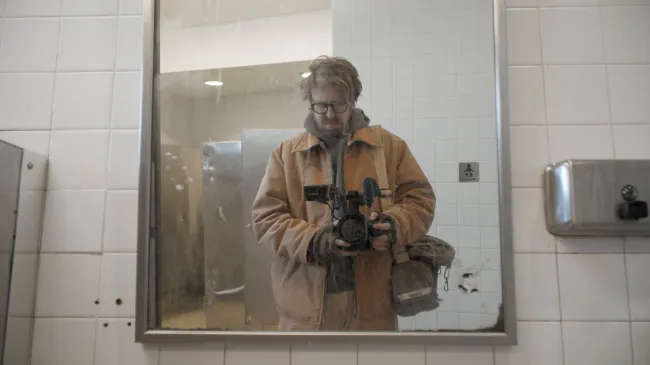

Documentary films go to all kinds of far-flung and exotic places. But for one of the most interesting sections of “The History of Concrete,” John Wilson‘s new documentary, it was imperative to go to Starbucks.
This is part of how Wilson’s documentary filmmaking works, of course, as fans of his HBO series “How To with John Wilson” know well. It starts out structured around what one might assume are the expected beats of a nonfiction story — albeit one Wilson is exploring because he found the idea of titling a film “The History of Concrete” really funny. But Wilson is so interested in people and the stories he finds along the way that it ends up on the tiniest road in Ohio, or an unholy wax museum in Rome, or at a rock bar at the ass end of Long Island.


Or at Starbucks made entirely of 3D-printed concrete out in Texas.
Wilson’s producers hired a freelancer to go capture some footage of the 3D concrete Starbucks in a “John Wilson” style — handheld, on the ground, eye-level on all those venti lattes. They got back a bunch of slick-looking drone footage that should probably have been unusable. Except Wilson used it to connect concrete, trends in modern documentary filmmaking clichés, and the role of Hollywood storytelling in the age of AI.
Wilson’s voiceover, which can go from self-effacing to deadpan to genuinely searching at the drop of a hat, uses the drone footage to examine ineffective but abundant materials, increasingly incentivized by the capitalist structure we all live inside of. Whether it’s aggregates bound with fluid cement or streaming content on Netflix, it’s so, so easy for anything human to be squeezed out of it.
“That’s my bad boy attitude coming to the surface there,” Wilson joked on an episode of the Filmmaker Toolkit Podcast. But the space of a feature gave him the room, on the very last edit of “The History of Concrete,” to lay out his stylistic critique of drone footage and muse on the role and impact of documentaries themselves.
“I love basically every documentary — even if it’s bad, it’s usually a good document of something, even if it’s kind of half-baked,” Wilson said. “But there is a sameness to the way a lot of drone-heavy stuff looks, and you can tell that it’s filler. A lot of documentaries tell a story about something that’s already happened and to visually populate that, you sometimes need a dramatic shot of the city it takes place in or the meat-packing facility or whatever. And I just find that’s kind of not a great relationship to have with imagery.”
Perhaps a healthier relationship with imagery, which Wilson relentlessly explores throughout the film, is one where completely disparate events, paired together, can fuse and give the viewer a new understanding of both. The very first sequence Wilson edited together was documentary footage of the announcement of former New York City mayor Eric Adams’ housing initiative, “The City of Yes,” paired with footage of a Buddhist ceremony to destroy a Mandala, including deep, meditative chanting about the impermanence of all things.

“It’s a very ceremonial moment where you are celebrating the renewal of the city in certain ways, with all this new construction augmenting the visual landscape, and I think they both ultimately are positioned as these positive ceremonies. But there is something, some kind of unease, and I think a darkness somewhere within there,” Wilson said. “I have complicated feelings about everything in the film, but that felt like a very obvious pairing to me, and I really loved the way that it flowed.”
Some of the joy of the film is that Wilson is so honest and open with his audience about the complicated relationship he has with his material and how he’s actively grappling with it. “The kind of stuff that I’m most interested in is a living document of the moment that is at a human scale, and like almost at our eyesight,” Wilson said.
Thinking about films at human scale may be what makes the most sense for Wilson’s personal brand of filmmaking. It may be the only thing that makes sense for films going forward.
“I try not to be too heavy-handed about it in the film, but there is a lot of fear around what we in the entertainment industry are useful for in this landscape. If we are creating robotic imagery via stuff like drones, then we aren’t that different from the machines in certain ways. I think we should take a bit more care to have things feel like they were made by a human — it gets back to nothing being permanent, and part of the value of a documentary is that, whatever the quality of it is, it visually captures what was there.”
“The History of Concrete” is now playing in theaters.