
For those of you who (like me) have never watched her reality series, Julia Haart is a fashion executive and reality television personality who became famous as the star of the Netflix series “My Unorthodox Life.” The show debuted in 2021 and followed Haart and her four children as they navigated the enormous cultural shift between the ultra-Orthodox Jewish world in which they had been raised and Julia’s radically different new life in Manhattan.
And when I say radically different, I mean radically different.
Julia was born in Moscow and came to the United States with her family as a young child. As her parents became increasingly religious, the family moved to Monsey, New York, a town with a large Orthodox Jewish population, when Julia was in elementary school. She attended religious girls’ schools, spent a year at a seminary in Israel and, after returning home, entered the traditional matchmaker-arranged dating process. At 19, she married her first husband, Yosef Hendler, a yeshiva student, and they went on to have four children.
For much of the next two decades, Julia’s life revolved around her family and the Yeshivish Orthodox community. She has described a highly structured world with strict expectations surrounding modesty, clothing, education and the roles of men and women. Julia has also been careful to distinguish her criticisms of the fundamentalist environment she experienced from Judaism itself, repeatedly saying that she remains proud of being Jewish.
In her early 40s, Julia left both her marriage and the religious community in which she had spent most of her adult life. She adopted the surname Haart, launched a luxury shoe company and began building an almost implausibly different second act.
By the time Netflix cameras started following her, Julia had engineered a remarkable transformation. She went from Orthodox wife and mother in Monsey to fashion entrepreneur, creative director of luxury lingerie brand La Perla, and eventually CEO of Elite World Group, a major international modeling and talent-management company. “My Unorthodox Life” was essentially built around the contrast between those two lives.
Then Julia’s new life blew up almost as spectacularly as it had come together.
Outside of reality TV, Julia has been waging a bitter financial and legal war against her second husband, Italian businessman Silvio Scaglia. The fight involved control of a major modeling company, a spectacular Tribeca penthouse, accusations of financial misconduct, forensic accountants, multiple lawsuits, appeals, contempt proceedings and tens of millions of dollars.
After a four-year legal battle, the divorce war is finally over. And Julia came out on top. Spectacularly.

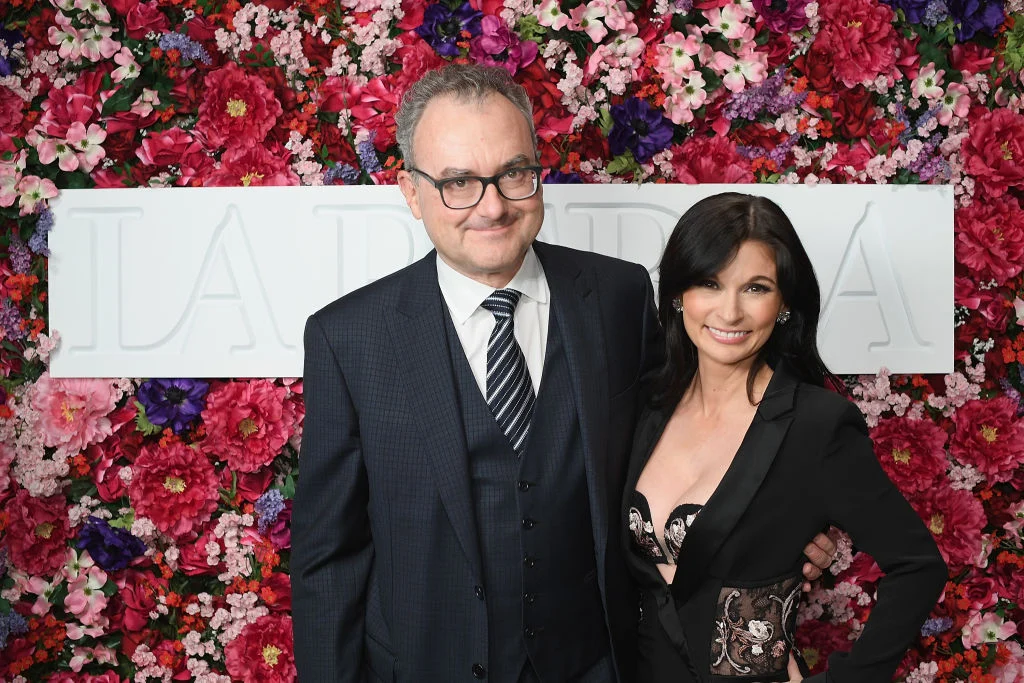
Silvio Scaglia and Julia Haart (Photo by Dimitrios Kambouris/Getty Images)
How Julia Haart And Silvio Scaglia Got Here
Julia Haart actually met Silvio Scaglia through one of his other fashion investments. Scaglia, an Italian technology entrepreneur who later moved heavily into fashion, owned the luxury lingerie company La Perla. In 2015, Julia’s fledgling shoe company collaborated with La Perla, putting her in Scaglia’s orbit. She subsequently became La Perla’s creative director, overseeing an ambitious expansion of the famous lingerie brand into ready-to-wear fashion. Julia and Silvio eventually became romantically involved and married in 2019.
By then, Scaglia also controlled one of the most famous names in the history of modeling: Elite.
Elite Model Management traces its roots to Paris in 1972, when John Casablancas and Alain Kittler founded the agency. Casablancas eventually became the face of the business and helped transform the economics and celebrity culture of modeling. Elite expanded into New York in 1977 and went head-to-head with established agencies like Ford and Wilhelmina during the so-called “model wars.” Over the following decades, Elite became closely associated with the rise of the supermodel and helped discover, launch or represent an extraordinary list of stars, including Cindy Crawford, Naomi Campbell, Linda Evangelista, Claudia Schiffer, Gisele Bündchen, Heidi Klum, Tyra Banks, Adriana Lima and Stephanie Seymour.
Casablancas sold his stake in Elite in 2000, and the company went through a complicated series of ownership changes and restructurings in the years that followed. In 2011, Scaglia’s investment vehicle, Pacific Global Management, acquired a controlling stake in Elite World SA, the international business behind much of the Elite network. Under Scaglia, the organization expanded further, including the launch of The Society Management in New York and the acquisition of Women Management.
That sprawling collection of modeling and talent businesses would eventually be consolidated under the Elite World Group umbrella.
And in 2019, Scaglia put his new wife in charge.
Julia became CEO and chief creative officer of Elite World Group, giving her control over a global talent-management operation with decades of history behind it. At the time, she and Silvio publicly presented themselves not merely as husband and wife, but as partners running the empire together.
Their lifestyle reflected it. They lived in an enormous Tribeca penthouse, drove matching Bentleys and moved through the highest levels of the international fashion world. When “My Unorthodox Life” premiered on Netflix in 2021, that extraordinary transformation was a central part of the fantasy: Julia had gone from an ultra-Orthodox community to running one of the most storied names in modeling.
But behind the scenes, one crucial detail would eventually become the center of their divorce war: Julia believed she and Silvio had structured their ownership of the business so that they were equal partners.
That distinction suddenly became enormously important when their marriage collapsed in early 2022 and Silvio removed Julia as CEO of Elite World Group. Julia challenged the move, arguing that as an equal owner, Silvio could not simply push her out on his own.
The entire fight would ultimately come down to a fraction of a percentage point.
The 0.0008% Disaster
Julia argued that she and Silvio were equal 50/50 owners of their holding company. If that were true, Silvio could not simply remove her unilaterally.
But the corporate records told a different story.
A Delaware court concluded that Scaglia had retained a microscopic voting advantage. After a complicated series of stock issuances and transfers, Scaglia controlled approximately 50.0004% of the voting shares, while Julia controlled roughly 49.9996%.
That tiny fraction made an enormous difference, and Julia lost.
The court concluded that Silvio had the controlling interest required to remove her, and the ruling was later upheld on appeal.
At that point, Julia’s situation looked bleak. Her marriage was over. She had been fired from the company she had been running. And her central argument that she was an equal owner had just been rejected in court. But that was only the beginning of the war.
The Divorce Case Turns Around
While Julia lost the initial corporate battle in Delaware, the divorce litigation continued in New York.
And this is where things began moving dramatically in the opposite direction.
In early 2025, a New York judge took the extraordinary step of striking Scaglia’s pleadings and granting Julia a default judgment in the divorce. The court cited repeated failures to comply with court orders involving discovery, legal fees, forensic-expert fees and court appearances.
The financial consequences were enormous.
Julia was initially awarded a 50% interest in Freedom Holding and its subsidiaries, including Elite World Group. She was also awarded half the proceeds from the sale of a valuable painting, millions in disputed management fees, half of certain withdrawals Silvio allegedly made from company entities after the divorce began, and 90% of her legal fees, with some amounts still subject to further calculation.
Silvio appealed.
An appellate court largely upheld the devastating procedural ruling against him, including the decision to strike his pleadings and grant Julia the divorce by default. However, the court sent portions of the financial award back for additional factual findings and calculations.
Meanwhile, there was another enormous asset sitting in the middle of the fight.
The $57 Million Penthouse
During their marriage, Julia and Silvio lived in an extraordinary duplex penthouse at 70 Vestry Street in Tribeca, one of the most luxurious residential buildings in downtown Manhattan.
Scaglia acquired the apartment through an LLC for $56 million in 2018, while the building was still under construction. Designed by Robert A.M. Stern Architects, the 14-story limestone building sits directly along the Hudson River waterfront.
The apartment itself is enormous. Spread across roughly 7,800 square feet, the 13-room duplex has six bedrooms, five full bathrooms and three powder rooms. Walls of glass look out over the Hudson River, lower Manhattan and the Statue of Liberty. The home also has two kitchens, a media room, library, solarium, enormous dressing room and multiple outdoor spaces, including terraces and a roughly 2,000-square-foot rooftop deck.
Even the building’s monthly common charges were more than $21,000. Amenities include a 24-hour doorman and concierge, private storage, two parking spaces, four swimming pools, a fitness center, sauna, steam room and squash court.
The penthouse became instantly recognizable to viewers of “My Unorthodox Life,” where it served as the backdrop for much of Julia’s spectacular post-Orthodox lifestyle. Here is a video tour. It is truly next-level:
The apartment eventually became one of the biggest prizes in Julia and Silvio’s divorce battle.
Julia ultimately gained full control of the property. Before selling, she briefly offered it for rent at an astonishing $125,000 per month. In November 2025, she put it on the market for $65 million.
Three months later, in February 2026, it sold for exactly $57 million.
Interestingly, that was only $1 million more than Scaglia had paid for the apartment seven years earlier. And that’s before accounting for years of enormous carrying costs, broker commissions, transfer taxes and other transaction expenses.
Of course, a $57 million sale does not mean Julia simply deposited $57 million into her bank account. Mortgages and other obligations against the property would have reduced the ultimate proceeds. But gaining control of an apartment worth nearly $60 million gives you some sense of the financial stakes involved in this divorce.
And the penthouse wasn’t even the most contentious financial issue.
Enter The Forensic Accountant
As part of the divorce fight, Julia hired a forensic accountant to dig through the couple’s businesses. According to newly revealed court papers, the court ultimately received evidence alleging that Silvio had transferred tens of millions of dollars to himself and various third parties while the litigation was unfolding. The forensic accountant also testified that company money had allegedly been used to purchase a striking collection of personal luxuries, including two Bentleys, a Porsche and Van Cleef & Arpels jewelry.
Scaglia’s attorneys have denied allegations of financial wrongdoing. But the dollar amount became extremely important. According to testimony from Scaglia’s former assistant, the disputed withdrawals totaled more than $25 million, and the court ultimately concluded that Julia was entitled to half of those funds. That potentially represents another $12.5 million-plus flowing to Julia, depending on the final accounting and what can actually be recovered.
From 49.9996% To 100%
And here’s where the entire story comes full circle. Remember that Julia’s first major legal defeat came because she didn’t own quite enough of the company. She believed she was an equal partner, but a court found that Silvio had retained a voting advantage so tiny that the percentages had to be carried four decimal places to see it.
As the divorce litigation progressed, however, the alleged dissipation of marital assets attributed to Scaglia became enormously significant. According to the final divorce papers, the value attributed to those withdrawals ultimately equaled the value of Silvio’s remaining company interest — and then some.
The result was dramatic: Julia was awarded Silvio’s remaining ownership interest, leaving her with 100% of Elite World Group.
Julia summed up the reversal perfectly:
“In 2022, Silvio claimed I owned zero percent; today, he owns zero percent and I own 100 percent of EWG.”
It would be difficult to script a cleaner ending for a reality show.