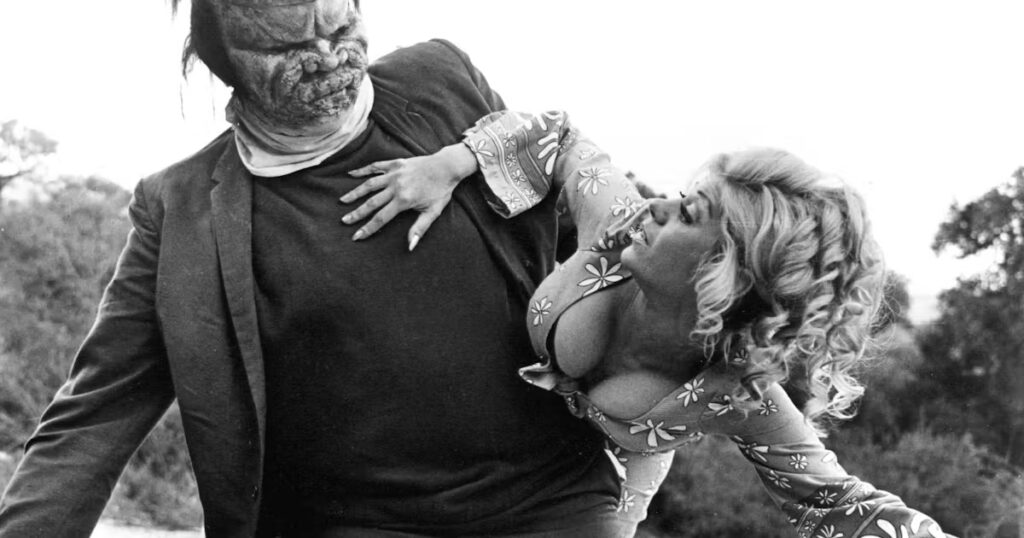

No one will ever mistake 1971’s Dracula vs. Frankenstein for a horror classic. Directed by down-and-dirty low-budget filmmaker Al Adamson, the movie was a fly-by-night production featuring what may be the worst (or at least the most bizarre) versions of its title characters ever seen onscreen. Its threadbare production values are evident, while its direction and much of its cast decidedly lack polish. Yet the flick also featured the final onscreen appearance of Lon Chaney Jr., whose own career took off during the latter part of the original Universal Monsters era, making him one of the last classic horror stars of the ’30s and ’40s to keep working into the 1970s.
Dracula vs. Frankenstein originally began life under the titles Blood Freaks and The Blood Seekers. J. Carrol Naish — an Oscar-nominated veteran actor who appeared in the 1944 monster mash-up House of Frankenstein — stars as Dr. Durea, who sends his mute, hulking, simple-minded assistant Groton (Chaney) out to murder young women near the California amusement pier where they run a haunted house. The wheelchair-bound Durea hopes to perfect a serum from the women’s blood that will repair his crippled legs and Groton’s addled mind. There are also bikers around and a Las Vegas showgirl (Regina Carrol) looking for her missing sister.
Adamson and producer Sam Sherman were unhappy with the rough cut of the film, so they decided to revamp it as Dracula vs. Frankenstein — a title which, strangely enough, had never been used before. They turned Durea into the last surviving descendant of the original Dr. Frankenstein and filmed new scenes featuring Raphael “Roger” Engel, aka Zandor Vorkov, as Count Dracula (complete with goatee, curly hair, and inexplicably echoing voice). The Count helps Durea revive the Frankenstein monster (John Bloom, with a face like a lunar crater) to secure more victims’ blood for his serum, which Dracula hopes will make him near-invincible.
There is a lot of lore attached to Dracula vs. Frankenstein, but horror buffs find it notable because it contains the last onscreen performances from both Naish and Chaney before their deaths in 1973. The latter actor, whose real first name was Creighton, was of course the son of the great silent film star Lon Chaney, whose indelible title performances in The Hunchback of Notre Dame (1923) and The Phantom of the Opera (1925) made him a horror movie legend.
The younger Chaney — who the studios insisted use the name Lon to reinforce the connection to his old man — toiled largely in supporting and bit roles before achieving fame as the star of Universal’s The Wolf Man (1941). His werewolf makeup, created by Jack Pierce, remains the definitive pop culture image of the monster, backed by Chaney’s tormented, haunting performance. Chaney stayed busy with the Universal Monsters franchise throughout much of the ‘40s, appearing in films like The Ghost of Frankenstein, Son of Dracula, The Mummy’s Tomb, and Frankenstein Meets the Wolf Man while becoming the only actor to play all four major monsters: Dracula, the Wolf Man, the Mummy, and Frankenstein’s creature.

Lon Chaney Jr.’s monster-movie career ended with this strange exploitation film.
Independent International/Kobal/Shutterstock
Although he worked steadily in later decades, his star power faded and he retreated back into supporting roles in TV shows and B-movies, occasionally showing up in top-shelf fare like the classic Western High Noon (1952) and the prison escape drama The Defiant Ones (1958). He also continued to appear in horror movies, like Roger Corman’s The Haunted Palace (1963), the little-seen yet underrated Witchcraft (1964) and the cult classic Spider Baby (1968). But years of heavy drinking and smoking took their toll, with Chaney looking increasingly bloated and unhealthy onscreen while developing throat cancer (like his father) and heart problems.
In Don G. Smith’s biography of Chaney, Lon Chaney Jr.: Horror Film Star, several members of the cast of Dracula vs. Frankenstein recall the sickly actor as needing to lie down between takes and often drunk during production. His voice a whisper (which is why his character was mute), Chaney allegedly told fellow actor (and Al Adamson’s father) Denver Dixon, “There’s nothing left for me. I just want to die,” while co-star Russ Tamblyn (of West Side Story and, later, Twin Peaks fame) claimed that the crew “had to hold [Chaney] up” while filming some of his scenes.
It was, in its way, as sad an ending for a horror icon as that of Bela Lugosi, who died in poverty, addicted to morphine, and working in bottom-of-the-barrel movies directed by Ed Wood. Yet in a strange way, Al Adamson (who was murdered in 1995 at his house by a live-in contractor) was respectful toward Chaney’s legacy, hiring him sight unseen — and thus not knowing how ill he was — simply because he wanted the chance to work with such a legendary genre figure.
Chaney’s poor health and failing faculties somehow makes his work as the child-like Groton — who likes to play with his pet puppy when not driven to kill – surprisingly sad and sympathetic. Even if Dracula vs. Frankenstein was far from his finest hour, it now represents a fond, melancholy farewell to the last of the Universal Monsters, who rightly sits alongside his father, Lugosi, Boris Karloff, and others in the pop culture firmament.