
In a time of tech-bro billionaires, a meaning crisis among an anxious youth and questions surrounding national identity, where better to go than back to the old stories to have one’s heart reenchanted? That’s something poet, scholar and priest Malcolm Guite has become renowned for on his popular self-titled YouTube channel, which has 220,000 subscribers and counting.
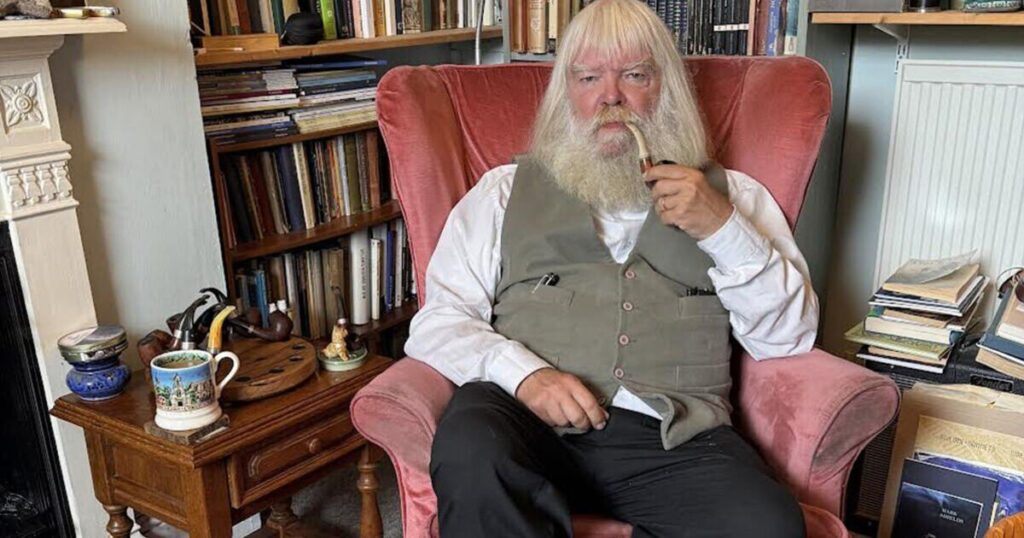
The real-life waistcoat-wearing hobbit, with wizard-like long silver hair and beard, has charmed millions around the world with his videos from the perspective of a visitor to his cosy, book-lined study. For each typical upload, Guite will settle into his wing armchair, light one of his many pipes, and usually read aloud from a chapter of JRR Tolkien or CS Lewis.
The author of several books, including five collections of poetry, the 68-year-old with a twinkle in his eye realised that it’s been about a century since there was a proper re-telling of Britain’s great myth, the Arthurian legend. In what could well be his magnum opus, Guite has set about writing Merlin’s Isle: An Arthuriad, a four-volume epic ballad of King Arthur and the Knights of the Round Table.
Beautifully illustrated by Stephen Crotts, the first volume, Galahad and the Grail, is set in the 5th century, after the Romans have departed, leaving Britain in a chaotic mess of savage warlords before the Anglo-Saxon invasion. King Arthur seeks to unite the realm by establishing a kingdom of peace and stability, one led by his chivalric knights who are fierce in battle against the “might is right” pagans, while being gentle and kind to the weak and vulnerable they are sworn to protect.
Ahead of the publication of the second book, The Coming of Arthur, I had the privilege of interviewing Guite in his famous study, at home in Norfolk. As he lit his pipe, I asked him what is distinctly British about the King Arthur stories and what they have to say about our national heritage for a modern audience.

Malcolm Guite with his first two Merlin’s Isle books (Image: EXPRESS)
“First of all, they’re completely set in these islands, and that setting is really important. The place is Tintagel, which you have at one end, and you have King Lot of Orkney at the other end of the island. Almost everywhere you go in Great Britain, there are place names associated with the Arthur story, from Arthur’s Seat and Merlin’s Cave to the Glastonbury Tor and Cadbury Castle. The medieval poets had a phrase for this entire collection of Arthurian stories: the matter of Britain. So, it’s distinctly British in that it is absolutely wedded to the land and the landscape. It’s not a transferable story. It is about Britain. It’s real places where the place names and the land keep it.
“Secondly, I think it’s distinctly British because it deals with what it is to be an island nation, and to be an island nation is to be dealing with people who come from elsewhere, for good or ill, and trying to become a kingdom within that context. There’s a bit at the end of my second volume, The Coming of Arthur, before he’s crowned, where Arthur has a dream in which he sees two dragons fighting, and then a golden dragon comes, and the two dragons go to the golden dragon. And the white dragon becomes white gold, and the red dragon becomes red gold, and there’s peace. Arthur doesn’t know the meaning of this dream. Merlin says that the red dragon represents the British people (including the Welsh, the Britons, and the Celts), and the white dragon represents the invading Anglo-Saxons. And as long as these two are fighting, there will be no peace in the kingdom. And right at the end, before Merlin leaves, he tells him that he, Arthur, is and will be the golden dragon:

The Coming of Arthur is published on November 9 (Image: CANTERBURY PRESS)
“Then Merlin said, ‘I leave these words with you. In Elvendom, you dreamed a dream wherein you saw two dragons come, one red, one white, and both a flame whose fire laid low both house and home. And then a Golden Dragon came and changed those other two. I also saw those dragons once when I was yet a child. This vision and its mystery means many things, as you will see. One meaning was revealed to me: the Saxon folk from out the sea are the white drake. In mystery, the Britons are the red. For now they fight, and by their ire men’s dwellings are devoured. But I foresee a day will come when both will call this island home, and it will form the island. That is, it will form their blood and bone, and the great story of your throne will by both folk be shared, you are the Golden Dragon, you, the king who binds them both. Though now you call the Saxons foe, that people bears God’s image too, and the true faith they’ll learn from you, for God in Christ makes one of two, and future ages then will know two peoples of one faith. You hate to hear the Saxon tongue, but this I say to you: an English bard will one day sing the deeds of Britain’s Celtic king, and the Round Table’s tales will ring around the wide world too.'”

Malcolm Guite in his famous study (Image: EXPRESS)
“So this is why we need this story, because we are one island with many different peoples. We’ve done this in the past. We’ve taken something partisan, and it’s become a story that binds us together, a common heritage, an ideal we can live up to from within our different races and cultures. Obviously, I’m saying they ended up sharing the Christian faith.
“Bede’s History of the English Church and People is a hugely important text to me. And what that story tells you is that although Gregory sent the mission with Augustine of Canterbury writing in 597, Christianity was already here among the Celts, the Irish, and the Scottish, and those in the north of England. And those people were converting to Christianity, the Saxons who were pushing them off their land. They’re actually sharing their faith. And then, when the Saxons became Christian, and the pagan Vikings came, they did the same. If you go to the Jorvik museum in York, you’ll see that eventually they had Christian Viking kings and camps. So there’s an astonishing power of Christianity grassroots up, to make new converts and that seems to me to be very much part of the story of these islands. Arthur, in that sense, is the golden dragon, and I want to offer Arthur again as the whole story, as a national epic, as a formative myth that includes the different peoples.
“I see our culture as a hybrid in an incredibly good way. The fact that our forbears (the Celts, the Saxons, the Vikings, the Normans) were at war with each other over this island, actually finally intermarried, settled, and eventually developed the great English language, which depends on Celtic, Norman, Norse and everything else. So I see the Arthurian legend as a parable of what it is to be British: we can find a common heroic figure in Arthur, who was once part of a strife between races and peoples that we have overcome.
“I do think we need national legends, and we definitely need patriotism. I deeply love this country and I do hope I’m writing a national epic. But I want to make a very, very sharp distinction between patriotism, which to me is love of the patrie, the land itself; England in all its myriad depths and beauties and peculiarities. I’m partly writing the Arthurian legend again because I don’t want this great story, which is formative for us, to be entirely hijacked by a sort of xenophobic Englishness. Love of land and love of nation are not the same thing as fetishising race. Our patron saint, George, is a Middle Eastern character, and the British Empire had an international reach.
“The question is, when you’ve got here, how do you put down roots here? How do you feel that your story is part of another story and is set in a great story? And obviously, as a Christian priest, I’d say the great story in which we’re set is the story of creation, fall, and redemption, and the story of Christ, which is necessarily ‘I saw a great multitude and no man could number of every tribe and nation’ (Revelation 7:9). But I love the story of Christianity meeting the primal pre-Christian stories of this land and finding a kind of beautiful, kind of almost a fulfilment of them. It is the great formative story. These great myths are older and wiser than we are, and they have fresh truth to teach every generation. I’m recovering a Christian heart to the story, and I’m very clear and unapologetic about that. But it’s a Christian heart that makes sense of all the beautiful pre-Christian things.”
Galahad and the Grail by Malcolm Guite is out now and The Coming of Arthur is published on November 9. Book 3: Days of the Round Table and Book 4: The Passing of Arthur will follow in 2027 and 2028 respectively.