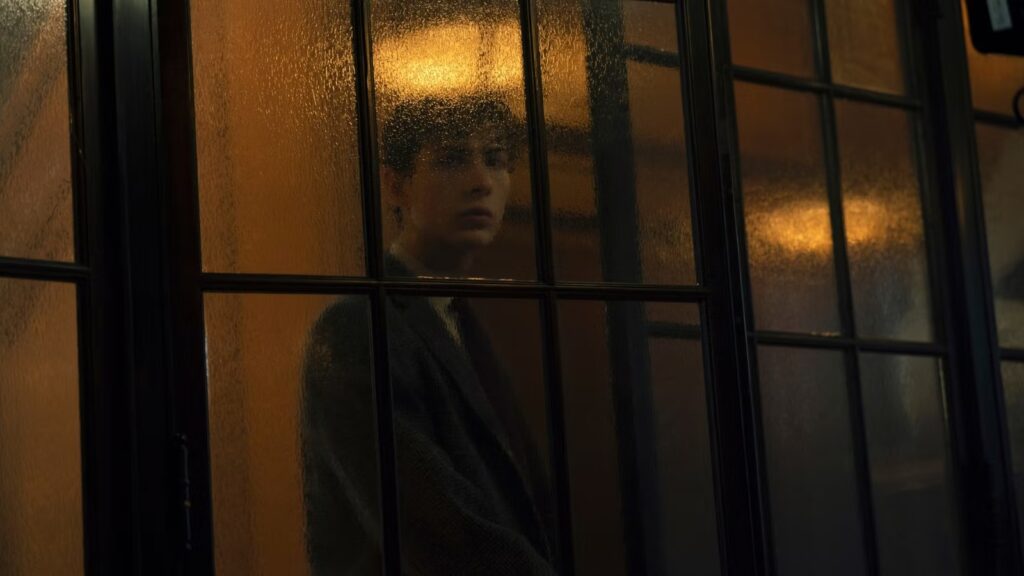

Netflix’s Unabomber dramatizes Ted Kaczynski’s past, weaving it into the investigation that ended the serial bomber’s 17-year campaign of terror. Kaczynski is a peculiar figure, and elements of his writing have been adopted by various counter, fringe, and outsider cultures, particularly his views on technology and government encroachment on rights. This has made Kaczynski’s story appeal to creatives worldwide, from Tony Stone’s Ted K (2021) to Toshiaki Toyoda’s Monsters Club (2011).
Janus Metz’s Unabomber on Netflix is a fairly accurate telling of Ted Kaczynski’s story, both in how it frames his larger life and in its attention to small details. Still, the movie takes liberties and shifts its focus elsewhere at times, which doesn’t fully capture the Unabomber’s story. This isn’t uncommon in movie adaptations, and even the cast and crew acknowledge some of these inconsistencies and ambiguities. To compile this list, I reviewed the historical accuracy of each claim. Additionally, MovieWeb spoke to the cast and director about the decision-making process when crafting Unabomber.
Christiana Morgan’s Role Was Expanded

Annabelle Wallis plays Christiana Morgan, a collaborator whose work contributed to the early projective testing Murray published (often credited to Murray). Morgan and Murray published related material in the 1930s, though historical credit for the Thematic Apperception Test is generally attributed primarily to Murray. Biographical accounts describe a long and intimate relationship between Morgan and the married Murray, also depicted in the film. However, the record doesn’t show her having a role in the 1959 to 1962 study that Kaczynski took part in. No source places her in the experiments or in a room with Kaczynski. Murray’s graduate assistants handled the day-to-day work.
“I think the asset of a woman to be perhaps underestimated in a very male-dominated world and how that can be used in [Christiana’s] favor because they never suspect her as the insidious part of the equation… There’s just the femininity alone, like makes [Ted] perhaps more susceptible to her grooming, her intellectual grooming.” — Annabelle Wallis
This is a primary example of creating characters to cut closer to the core of the film’s themes and issues. While this version of Morgan is entirely invented, she serves as an emotional crux for exploring Kaczynski’s internal conflict with the study. Where Professor Murray offers a persona for Kaczynski to admire in Unabomber, Annabelle Wallis’s Morgan gives viewers a more introspective look at his emotional side.
Ted Kaczynski Was a Loner at Harvard
‘Unabomber’ Gives Him More of a Social Life
Kaczynski arrived at Harvard in 1958 at just 16, after skipping two grades, a timeline that matches the movie. He spent his first year at 8 Prescott Street, a small house for younger first-year students, before moving to Eliot House. His classmates remembered almost nothing about him socially. Suitemate Patrick McIntosh told The Harvard Crimson that Kaczynski was “polite but as brief as he could manage it,” while Eliot House classmate Frederick Boersma said, “I don’t think I ever saw him smile.“
In Unabomber, the young Ted Kaczynski is certainly an outsider, but he is still on friendly terms with other students, even goes out for a drink, and has a double date with another student. In real life, Kaczynski did not associate with others unless necessary, and he was also a very messy individual (another contrast to the cleaner version in the film). Giving Kaczynski a clear voice and more of a social life seemed necessary to tell the story; otherwise, the movie would have had to rely on internal monologue alone.
Shailene Woodley’s Joanne Wasn’t a Real Person

No agent named Joanne Miller served on the UNABOM Task Force, and no single agent led it. The real investigation was a team effort by a task force formed in 1993, run by Terry Turchie under San Francisco special agent-in-charge Jim Freeman. The woman closest to Joanne’s position was Kathleen Puckett, an agent with a psychology background who worked on profiling the bomber. The linguistics angle borrows from Jim Fitzgerald, the FBI profiler whom Discovery’s Manhunt: Unabomber (2017) already turned into a lone genius.
“Because we didn’t really see any background to Joanne, we didn’t know anything about her life and her personal history and what her life outside of this case looked like. A lot of what I devoted myself to was just infusing as much nuance and kind of quiet, quiet differences in the scenes that I had the opportunity to be in as possible.” — Shailene Woodley
Woodley said she was drawn to Joanne’s background in linguistics and her frustration as a woman in a male-dominated FBI, “knowing that she had information that nobody was paying attention to.” That frustration was real for agents like Puckett, even if Joanne wasn’t one of them. This narrative device is far from uncommon, as a single protagonist makes the story easier to follow and more cohesive. The highly praised HBO series Chernobyl is a gleaming example, lauded for its accuracy despite condensing dozens of real Soviet scientists into one fictional physicist, Ulana Khomyuk.
Harvard Was Just the Start of Ted Kaczynski’s Academic Career

While Unabomber never dives into it, Kaczynski pursued further education after Harvard, and this overlooked detail matters to the overall narrative. Kaczynski graduated from Harvard in 1962 at 20, then earned his master’s and doctorate at the University of Michigan. His dissertation, “Boundary Functions,” won the Sumner B. Myers Prize for the best mathematics dissertation of the year, according to The Michigan Daily. In 1967, UC Berkeley hired him as an assistant professor of mathematics at just 25. He resigned without explanation in 1969 and moved to a cabin outside Lincoln, Montana, in 1971, where he was eventually found.
Unabomber uses real news footage, and one report of his capture calls him a former professor, which can confuse viewers unfamiliar with who he is. The film frames the end of Kaczynski’s time at Harvard as his departure from academia, juxtaposing his final gift to Murray with his arrest and framing it as the point at which he abandons the system. His time at Harvard is arguably the best period to paint a portrait of who Ted Kaczynski was, and adding several more years in academia would not have worked. Still, it is somewhat misleading.
There Was No Bond Between Ted and Henry Murray

This should seem obvious by now, but Ted and Henry Murray were unlikely to have had any social interactions. Kaczynski was one of 22 Harvard undergraduates in Murray’s study. Murray was in his late 60s and oversaw the work from a distance. The infamous confrontations, which Murray himself called “vehement, sweeping, and personally abusive,” were carried out by a law student, which does echo the scenes in the movie.
Crowe (Murray) and Tremblay (Kaczynski) share some of the film’s strongest scenes, and the production leans hard on their mentor-and-subject tension. This is vital, and it speaks to the production’s need to create external figures to tell Kaczynski’s story, rather than the shy loner staff and peers thought he was at Harvard. Murray becomes a figurehead for Kaczynski’s growing mistrust, and while he was very much a real person, these interactions remain entirely fictional.
‘Unabomber’ Overstates Henry Murray’s Influence on Ted Kaczynski

This is a contestable point, as whether Murray’s study helped create the Unabomber is still hotly debated. Author Alston Chase, whose 2003 book Harvard and the Unabomber examined the experiments, argues they contributed to his radicalization. Others disagree, including retired FBI behavioral analyst Kathleen Puckett, who told CBS News, “The Harvard Study has frankly been very exaggerated in my view.” Kaczynski himself downplayed the study’s effect on him, while also calling it “the worst experience” of his life” (via History.com). Director Janus Metz shared his own thoughts with MovieWeb:
“I think you can only ascribe so much truth to what Ted Kaczynski had to say about himself and his own mental constitution and what made him into what he was. Of course, we can’t answer those questions fully… And interestingly, you know, the world that he would seek revenge on was the world of academia.”
Metz makes a fair point. The FBI’s case name, UNABOM, came from his early university and airline targets. But Kaczynski himself cited other experiences he felt were more influential on his ideology, most notably his sexuality and his 1966 brush with a gender transition, which he described as a turning point (via CBS News). Interestingly, Unabomber mentions Kaczynski’s struggle with gender and sexuality without really going into detail on how integral it was to his later views. Isolation, family pressure, and his growing fixation on technology go far beyond what he experienced in the Harvard lab, which the film frames as the major turning point.
Ted Kaczynski Rejected the Schizophrenia Diagnosis

There is a point in the film when Murray tries to upset Kaczynski by diagnosing him with schizophrenia based on his actions. While this is brushed off, the schizophrenia claim would become key to Kaczynski’s trial. Kaczynski was never diagnosed with a mental illness before his arrest. His defense experts later diagnosed paranoid schizophrenia. In January 1998, Bureau of Prisons psychiatrist Sally Johnson reached a provisional diagnosis of paranoid schizophrenia after a week of interviews but found him competent to stand trial, The Spokesman-Review reported. Kaczynski “adamantly resists” that label, the paper noted, and he pleaded guilty that month partly to keep his lawyers from building a mental illness defense.
“He was also driven by possible schizophrenia, by revenge motifs. A lot of the bombings gave him satisfaction and pleasure.” — Janus Metz
Metz’s careful use of “possible” is essential here. The diagnosis was real, but so was Kaczynski’s denial of it, and he took a life sentence over admitting it. Furthermore, not every expert landed on schizophrenia. Prosecution-retained psychiatrist Park Dietz pointed instead to schizotypal and paranoid personality disorders, according to Psychiatric News. The film’s reading is defensible, but viewers should know this was a point of contention for Kaczynski and various professionals.
Ted Never Uncovered the Study’s Secrets at Harvard

Participants were led to believe they would debate their personal philosophy with another student. Instead, they were wired to electrodes, placed under bright lights, and had their own essays torn apart. This is one part of the true story Unabomber gets spot on. Kaczynski took part for about three years, from 1959 to 1962. However, no evidence shows he learned the study’s real purpose before he graduated.
Even after his arrest, the answers stayed out of reach. The Murray Research Center refused to share his evaluations with his defense team, and per The Harvard Crimson, it sealed his file entirely in 2000. Kaczynski’s awareness of what was being done to him in the film further establishes his distrust of academia, but that distrust likely came from participation rather than self-awareness. He certainly never got the final word against Murray before walking away from Harvard.
Moby-Dick Wasn’t Kaczynski’s Obsession

Moby-Dick‘s placement in the movie as a philosophical and moral talking point plays out brilliantly, particularly in the film’s climax. The book serves as common ground and a shared obsession for both Kaczynski and Murray, and as a narrative element, it is well-thought-out. However, the book investigators focused on was Joseph Conrad’s The Secret Agent, whose character “the Professor” abandons society to build bombs.
In a 1984 letter, Kaczynski wrote that he was “reading Conrad’s novels for about the dozenth time,” (via The Seattle Times). Federal agents believed he checked into a Sacramento hotel as “Conrad” or “Konrad” at least three times. Herman Melville’s whale is an accessible literary reference for a modern audience, but no record ties Kaczynski to Moby-Dick the way his letters and aliases tie him to Conrad. He may have never even read the book.
Locals Saw a Polite Hermit, Not a Menace

Kaczynski lived in a 10-by-12-foot cabin with no electricity or running water, biking into Lincoln for groceries, mail, and library books. After his arrest, neighbors reportedly expressed confusion at the revelation. One resident told The Baltimore Sun he was “an inoffensive person who came into town, got his groceries and mail and peddled back up to his place,” while a store clerk remembered him as “always polite.”
His hostility was real, but it mostly played out in private. His journals describe antisocial acts such as sabotaging snowmobiles, vacation cabins, and logging equipment near his land, and he admitted to stringing traps meant to injure dirt bikers on backcountry trails. Unabomber presents Kaczynski as a dark, brooding figure who meticulously made bombs, deeply distrusted people, and was known for his antisocial behavior. In reality, he was on friendly terms with many of the citizens, including the local librarian. The truth lies somewhere between how Lincoln remembers him and the on-screen depiction, but the film downplays the humanity people saw in him leading up to his capture.

- Release Date
-
September 25, 2026
- Runtime
-
97 Minutes
- Director
-
Janus Metz
- Writers
-
Nelson Greaves, Sam Chalsen
- Producers
-
Sophie Cassidy